
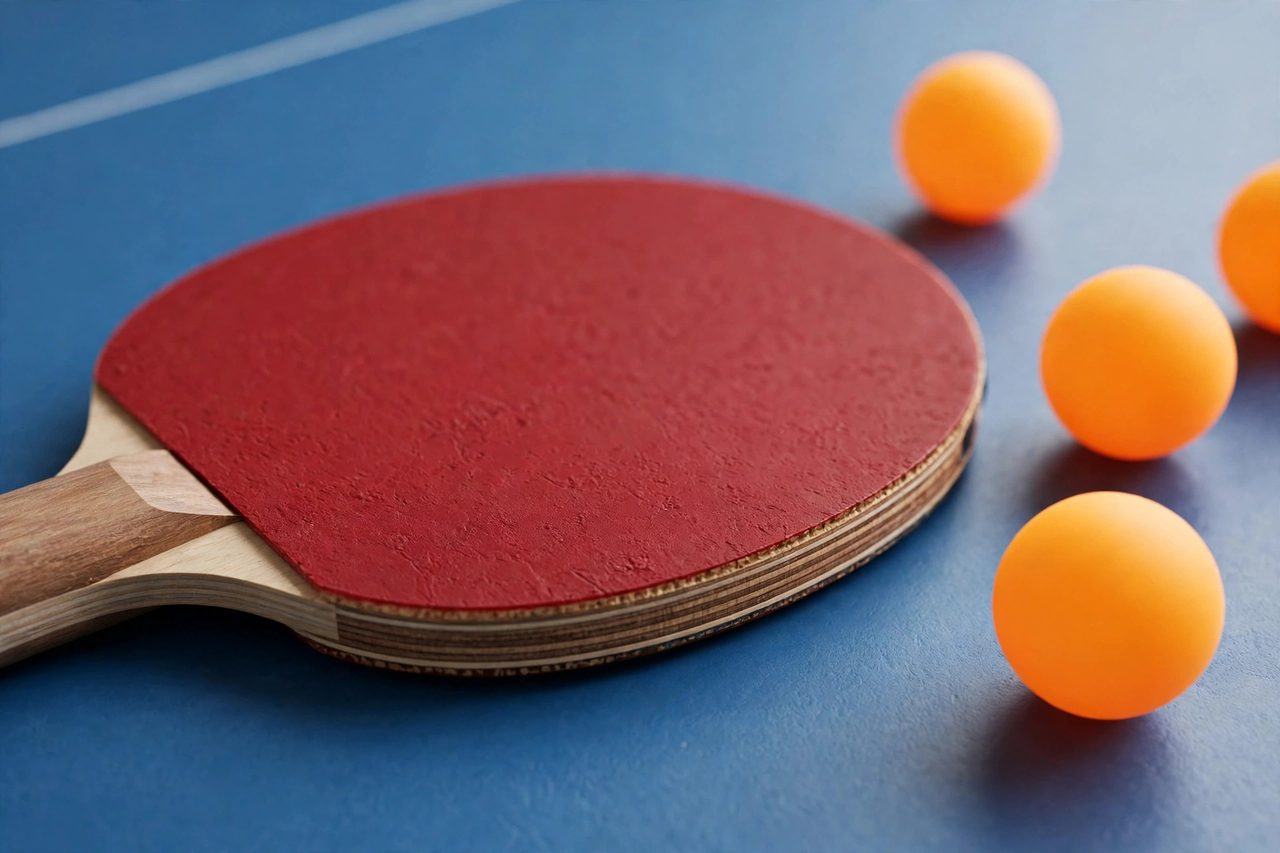
If you have ever wondered why the world’s best forehands all look a little bit Chinese — heavy spin, a second bounce that kicks, rallies won from mid-distance — part of the answer is a rubber called DHS Hurricane 3. It is the most influential forehand rubber in table tennis history, the default choice behind generations of Chinese National Team forehands, and it behaves like almost nothing else on the market.
This is not a review of one sheet. Hurricane 3 is a family of rubbers with different grades, sponges and factory treatments, and buying the wrong one is the most common mistake players make. Here is how the whole thing works.
The core idea: tacky, hard, linear
European and Japanese rubbers of the last two decades are mostly “tensor” rubbers: factory-tensioned sponges with a built-in catapult effect that throws the ball out with pace even on passive contact. Hurricane 3 is the opposite of that. It is a non-tensor rubber: no factory catapult, a highly tacky Chinese topsheet, and a medium-hard sponge. Speed and spin depend on your technique, not on the rubber doing the work for you.
The classic commercial sheet rates around 94/100 for speed, 99 for spin and 95 for control, with a 39-degree sponge on the DHS scale (roughly 48–50 degrees on the European ESN scale) in 2.0, 2.15 or 2.2 mm thickness. The tacky topsheet grips the ball enormously — which gives you massive spin on serves, short play and full loops, but also makes the rubber sensitive to incoming spin. Your blocks and receives have to be technically sound, or the ball will slide off somewhere you did not intend.
The payoff is the famous “heavy ball.” Because the response is linear — the harder you accelerate, the more spin and pace you get — a committed forehand loop with Hurricane 3 produces a trajectory that kicks hard off the table and feels genuinely heavy to the opponent. The short game stays calm because passive rebound is modest, but full strokes activate the sponge completely. It is a rubber that rewards body rotation and forearm acceleration.
The grades: Commercial, Provincial, National
This is where most buyers get lost. DHS sells Hurricane 3 in three selection grades, and the difference is real:
Commercial is the affordable, widely available sheet. Good value, but consistency varies from sheet to sheet.
Provincial is a selected upgrade: more consistent topsheets and sponges, a stronger high-impact response. The Provincial Blue Sponge version is the traditional stepping stone for serious competition players.
National is the top selection tier — the closest retail version to what the pros actually receive. The National Blue Sponge is the flagship, with the firm #22 blue sponge that gives heavy, penetrating forehand loops. Expect to pay several times the Commercial price.
Each grade comes in NEO and non-NEO versions. The NEO treatment is DHS’s factory process that makes the sponge livelier and easier to activate — a response to players who found the traditional sheets demanding. The NEO sheets give more immediate pace while keeping the tacky, spin-first character and the controlled short game. Provincial and National versions are commonly offered in 39, 40 and 41-degree sponge hardnesses.
Who it is for — and who it isn’t
Hurricane 3 suits advanced attackers who generate their own power: players with full strokes, strong body mechanics and a forehand-dominant game. If you like to open with heavy spin against backspin, counter-loop from mid-distance and play the third-ball attack, it is arguably the best forehand rubber ever made.
It is not for beginners or passive players. The rubber is demanding: compared with a Butterfly Tenergy 05 or similar tensor, it asks much more of your technique, rewards committed acceleration rather than passive blocking, and punishes lazy footwork. Players moving from European tensors should expect an adjustment period and should pair it with a medium-stiff offensive blade — overly flexible blades can make it feel dead.
Maintenance and buying tips
The tacky topsheet needs care: wipe it with a rubber cleaner after every session and keep it in a protective sheet, because dust kills tackiness fast. Avoid buying from dubious vendors — check for holographic security labels and batch numbers, since counterfeit Hurricane 3 is widespread. And know that the blue-sponge versions of retail sheets are excellent rubbers but not exact copies of a national-team player’s personal sheet; they are the best step on the ladder, not the ladder’s top rung.
Love it or hate it, understanding Hurricane 3 is understanding modern table tennis. The sport’s dominant forehand culture was built on tacky Chinese rubber — and this sheet, in one grade or another, is where that culture lives.
Related articles
Butterfly Tenergy 05 Review: The Spin Classic That Still Sets the Standard
Launched in 2008 and still the most trusted rubber in table tennis: the Butterfly Tenergy 05 pairs a grippy topsheet with Spring Sponge for huge spin and a high, safe arc. What it does well, who it suits, and who should skip it.
Tecnifibre Slash 125 Review: Light, Fast and Built to Attack
The Tecnifibre Slash 125 is the power frame of the Slash range: 125 grams, a big 485 cm² head, a bumperless X-TOP design and the open-core build made with Mostafa Asal. We put it to the test.
Butterfly Dignics 09C Review: The Spin Monster That Rewards Big Swings
Tacky topsheet, hard 44-degree sponge, huge spin: the Butterfly Dignics 09C is a premium forehand rubber for players who loop hard. What it does well, who it suits, and who should skip it.