
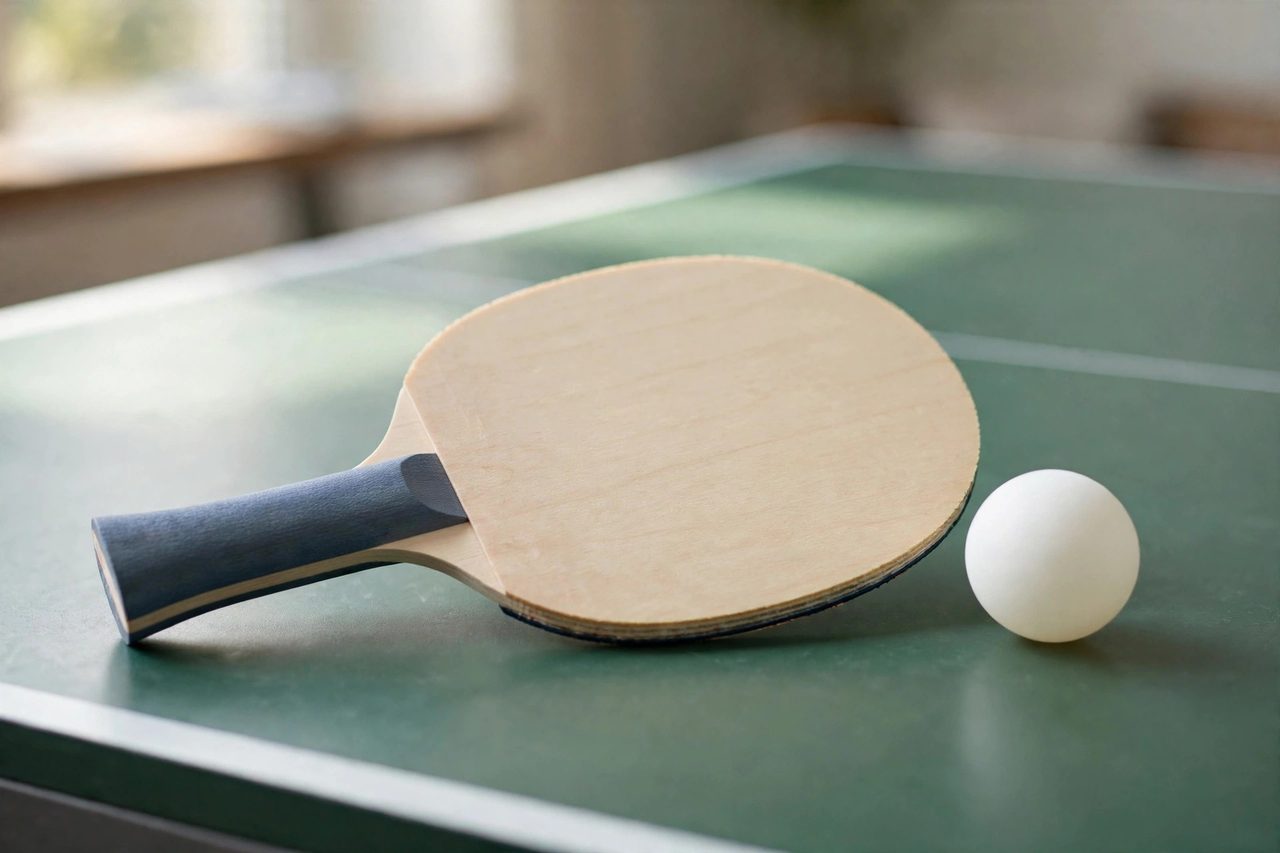
Some blades are famous because pros use them. The DHS Hurricane Long 5 is famous because of one pro: Ma Long, the Chinese star many call the greatest table tennis player of all time.
But let’s be clear. This is the commercial version of the blade family built around Ma Long’s game. His own match blade is a separate, hand-picked premium edition, the W968 National. What you can buy in a shop is the Long 5 — the same basic design, made for the rest of us. Does it live up to the name? Mostly yes, if your game fits it.
What it is
A blade is the wooden part of a table tennis racquet — the bit you glue the rubbers onto. The Long 5 has seven layers, called plies: five wood, two arylate-carbon, a stiff fibre mix that adds speed without much weight.
The key detail is where the carbon sits: close to the core, with two wood layers between it and the ball. That is called inner carbon. Soft shots still feel like wood — calm, with good touch — while hard shots wake the carbon up and fly.
Here are the numbers, from DHS and its US partner:
- Build: 5 wood + 2 arylate-carbon (ALC), 7 plies, inner carbon
- Weight: about 89 g, give or take 3 g — wood varies from blade to blade
- Thickness: 5.9 mm, give or take 0.1 mm
- Class: OFF+, which means very fast and built for attack
- DHS ratings: speed 96, control 62 (on DHS’s own scale)
- Handles: flared (FL), straight (ST), and Chinese penhold (CS)
A flared handle gets wider toward the end, so it sits snugly in your palm. Most shakehand players — players who hold the racquet like a handshake — pick flared.
Who it is built for
This is an attacker’s blade, full stop. It is aimed at serious club players and above, not beginners. It rewards a full, confident swing and a game built around the forehand.
It pairs best with tacky Chinese-style rubbers on the forehand, such as DHS’s own Hurricane 3. Tacky means the rubber surface is slightly sticky, so it grips the ball and creates heavy spin. That combination is the classic Chinese attacking setup, and it is exactly what this blade was designed for.
On the table: loops, drives and the short game
A loop is the big topspin attack: you brush up the back of the ball so it dips hard and kicks forward. This is where the Long 5 shines. On a full forehand loop, the ball stays on the rubber a fraction longer than on an outer-carbon blade, then leaves with serious pace and spin. Players who reviewed it on Table Tennis Reference gave it 9.46 out of 10 for speed and 9.24 for spin, across 46 reviews.
Drives — flatter, faster hits with less brush — are strong too. The blade feels solid when you meet the ball early, and it holds up well in fast rallies away from the table. When you swing hard, the carbon gives you free power.
The surprise is the short game: the soft touches close to the net — pushes, drops and flicks. A flick is a quick wristy attack over the table against a short ball. Because the carbon sits deep inside the blade, gentle shots stay soft and controlled. You can keep a short push low, and place a flick without the ball flying long. In practice the blade feels calmer than its OFF+ label suggests, as long as your hands are soft.
Blocking is good, with one condition. A block is when you hold your racquet still and let your opponent’s speed do the work. The Long 5 is stable enough to block hard loops, but a passive block can sail long. You need an active block with the face tilted slightly forward.
Serves feel natural. The wood outer layers give you enough grip to load up spin, and the blade is not so fast that a short serve pops up high. That matters: a serve that sits up is an invitation to get attacked.
The honest trade-offs
This blade will punish lazy technique. If your swing is short or your timing is late, the speed works against you, and balls go long or into the net. Reviewers say the same thing again and again: it is a blade for advanced players, and hard work for everyone else.
It is also not a great match for soft, bouncy European-style tension rubbers. Tension rubbers are the springy modern kind that add speed on their own. Put them on a blade this fast and the whole setup can feel wild. If you play with tension rubbers, a slower all-wood blade will probably suit you better.
And then there is the price. At about $225 at US retailers, this is a serious purchase, not a casual upgrade. It is cheaper than the W968 National, which sells for several times more, but it is still premium money. Buy it because your game needs it, not because of the name on the handle.
Who should buy it
Buy it if you are an intermediate or advanced attacker who loops with the forehand, plays close to mid-distance, and already uses — or wants to switch to — tacky Chinese rubbers. You will get huge spin, real power, and a short game far better than a blade this fast should have.
Skip it if you are still learning the basic strokes, if you play a blocking and counter-hitting game, or if you want a forgiving blade that covers up mistimed shots. Slower, cheaper blades will help your game more right now.
Verdict
The Hurricane Long 5 earns its reputation. It is fast, spinny, and far more controlled in the short game than most blades in its speed class. The catch: it asks a lot of you — clean technique, a full swing, and the right rubbers. Give it those, and it is one of the best attacking blades you can buy. Give it anything less, and it will expose your game rather than improve it.
Related articles
Butterfly Tenergy 05 Review: The Spin Classic That Still Sets the Standard
Launched in 2008 and still the most trusted rubber in table tennis: the Butterfly Tenergy 05 pairs a grippy topsheet with Spring Sponge for huge spin and a high, safe arc. What it does well, who it suits, and who should skip it.
Tecnifibre Slash 125 Review: Light, Fast and Built to Attack
The Tecnifibre Slash 125 is the power frame of the Slash range: 125 grams, a big 485 cm² head, a bumperless X-TOP design and the open-core build made with Mostafa Asal. We put it to the test.
Butterfly Dignics 09C Review: The Spin Monster That Rewards Big Swings
Tacky topsheet, hard 44-degree sponge, huge spin: the Butterfly Dignics 09C is a premium forehand rubber for players who loop hard. What it does well, who it suits, and who should skip it.