
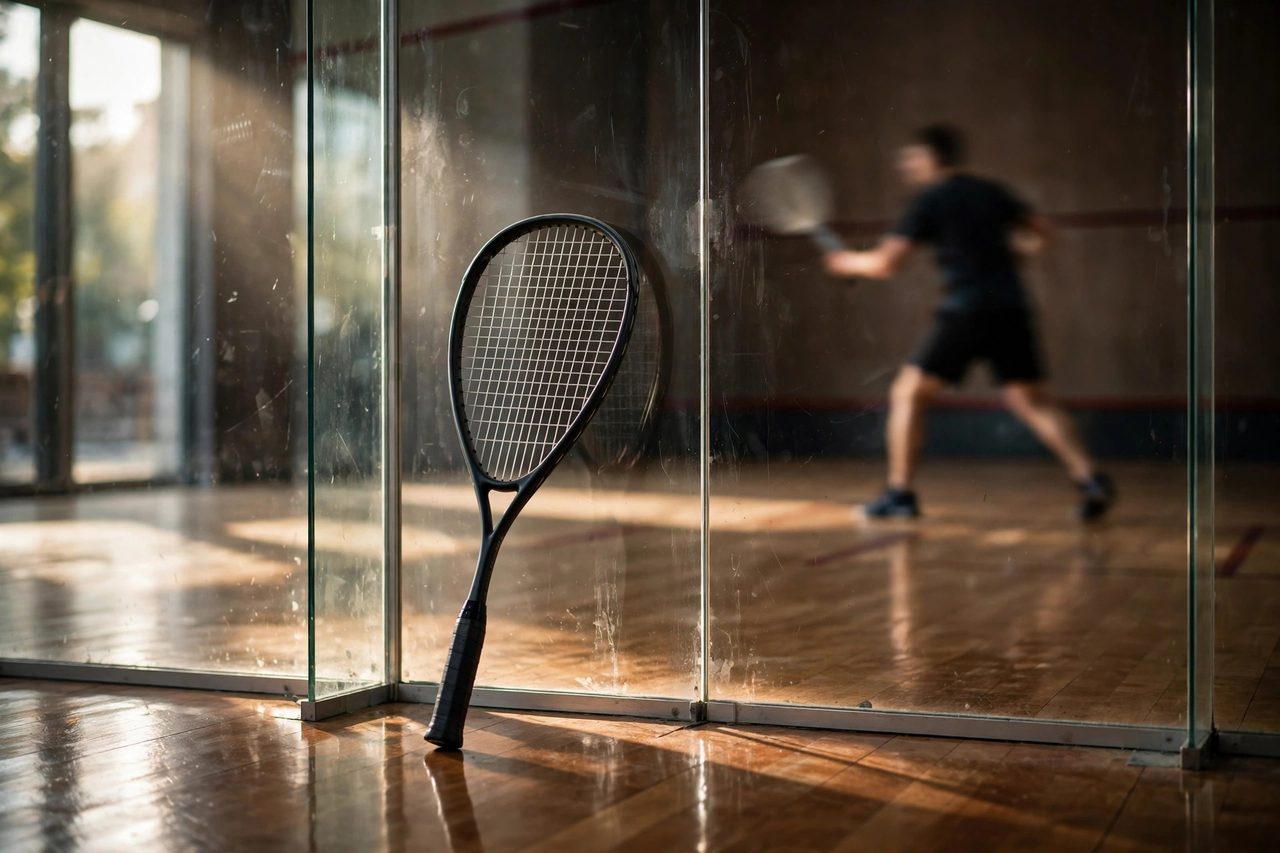
Pick up the Harrow Vapor and the first thing you notice is how little there is of it. At 135 grams with strings, it is one of the lighter racquets on the market. It does not feel like a toy, though. It feels quick. And for a certain kind of squash player, quick is everything.
Harrow is an American brand that has been making racquet-sport gear since 2000. The Vapor is one of its main squash models, and it sits in the middle of the company’s range: not the lightest frame Harrow makes, and not the heaviest, but the one built around balance. The headline numbers tell the story. The Vapor weighs 135 grams, its balance point is 380 millimetres, and Harrow lists it as even-balanced. Balance is where the weight of the racquet sits. A head-heavy racquet puts more weight near the top, which adds power but makes it slower to move. A head-light racquet puts the weight near the handle, which makes it fast but less powerful. Even balance splits the difference: the weight sits in the middle, so the racquet feels steady in your hand without feeling slow.
It comes strung from the factory with Harrow’s Barrage Pro string. A factory string is the string the racquet arrives with, so you can play with it straight away instead of paying for a restring first.
On court: speed first
The Vapor’s best quality is how fast it moves. In squash, you rarely have time to take a big swing. The ball comes back quickly, often from a tight spot near the wall, and you need to get the racquet to it in a hurry. A light, even-balanced frame helps here. You can pick the ball up late, flick it short, and still recover for the next shot.
That makes it a natural fit for attacking players who like to volley. A volley is when you hit the ball before it bounces, usually near the front of the court. Volleys are about quick hands, not big swings, and the Vapor is built for exactly that. It is also good for players who like to play a lot of drop shots. A drop shot is a soft shot that dies near the front wall, and it needs touch and control rather than power.
Control is the Vapor’s other strength. Because the frame is not head-heavy, it does not pull your swing around. You can place the ball where you want it, which matters when you are trying to hit a tight line down the wall or a delicate crosscourt. Crosscourt means hitting the ball diagonally, from one side of the court to the other.
The trade-off: power
No racquet does everything, and the Vapor’s trade-off is power. If you are the kind of player who likes to hit hard from the back of the court and drive the ball deep, a heavier, head-heavy racquet will give you more help. The Vapor can still hit a good length — a length shot is a deep drive to the back of the court — but you have to generate the pace yourself, with your swing and your movement. Players with slower swings, or players coming back from injury who want the racquet to do more of the work, may find it a bit underpowered.
There is another thing to know. Light racquets can feel less stable when you meet a hard-hit ball slightly off-centre. The sweet spot is the area on the strings where the ball comes off best. On the Vapor it is generous for a light frame, but if you catch the ball right on the edge of the strings, you will feel it. That is normal for racquets in this weight class, and it is the price you pay for speed.
Who should buy it
The Vapor suits intermediate and advanced club players who move well, like to attack, and want a fast, controlled racquet. If your game is built on volleys, drops and quick reactions, this is your kind of frame. It also suits younger players moving into adult racquets, because the light weight is easy on the arm over a long match.
It is less suited to beginners who need help generating power, or to players who mostly hit from the back of the court and want a heavier frame to do the heavy lifting. If that sounds like you, look at Harrow’s heavier models, like the 145-gram Stratus, or a head-heavy frame from another brand.
The verdict
The Harrow Vapor knows what it is. It is not trying to be the most powerful racquet in the shop. It is trying to be the quickest, most controllable one in its weight class, and it mostly succeeds. At 135 grams with an even balance, it rewards fast hands and good movement, and it punishes lazy footwork less than a heavier frame would. For the attacking club player, that is a very good deal.
Buy it if you volley a lot, love the front of the court, and want a racquet that moves as fast as you do. Skip it if you want the racquet to supply the power. In squash, the best racquet is rarely the most expensive or the most powerful one. It is the one that fits the way you actually play. For a lot of quick, attacking players, that racquet is the Vapor.
Related articles
Butterfly Tenergy 05 Review: The Spin Classic That Still Sets the Standard
Launched in 2008 and still the most trusted rubber in table tennis: the Butterfly Tenergy 05 pairs a grippy topsheet with Spring Sponge for huge spin and a high, safe arc. What it does well, who it suits, and who should skip it.
Tecnifibre Slash 125 Review: Light, Fast and Built to Attack
The Tecnifibre Slash 125 is the power frame of the Slash range: 125 grams, a big 485 cm² head, a bumperless X-TOP design and the open-core build made with Mostafa Asal. We put it to the test.
Butterfly Dignics 09C Review: The Spin Monster That Rewards Big Swings
Tacky topsheet, hard 44-degree sponge, huge spin: the Butterfly Dignics 09C is a premium forehand rubber for players who loop hard. What it does well, who it suits, and who should skip it.