
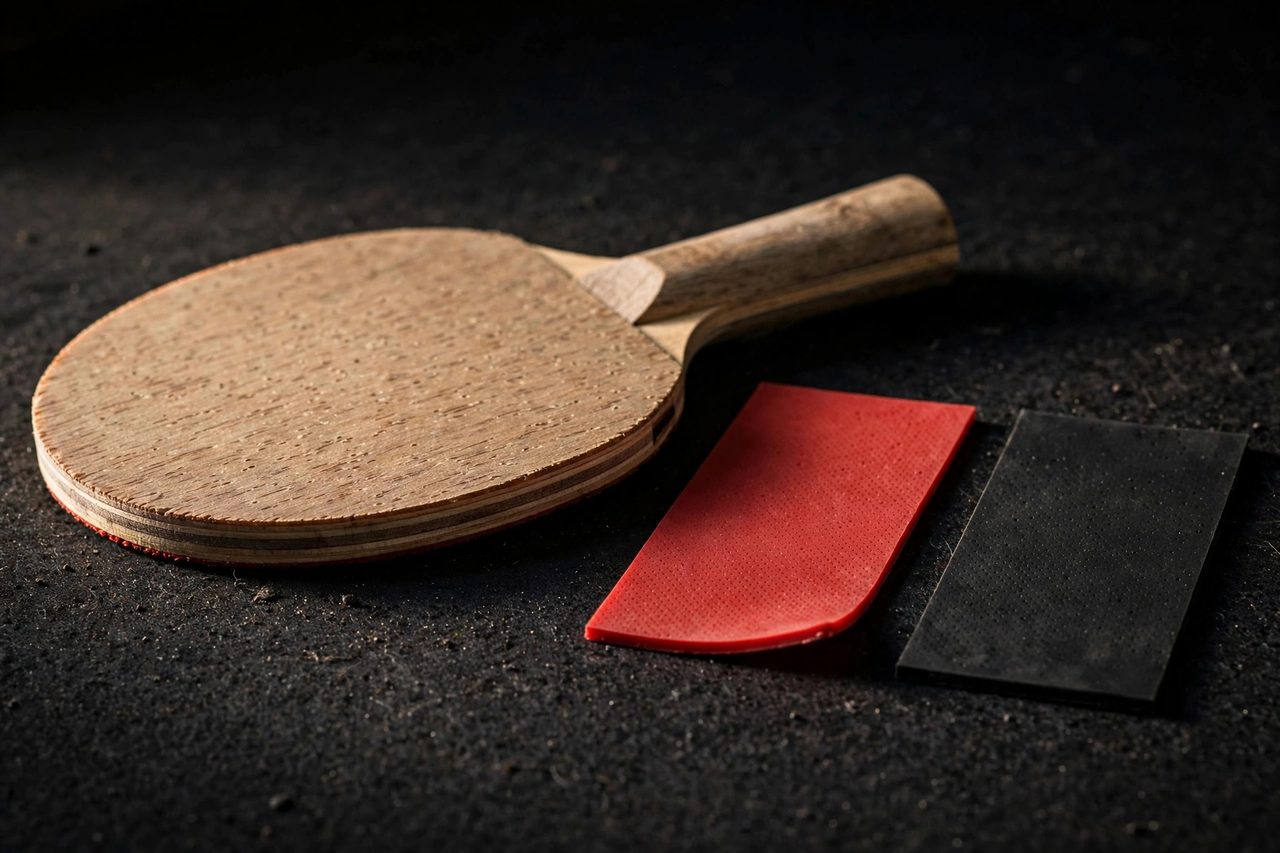
No sport is more equipment-sensitive than table tennis. A table tennis racquet — the blade plus two rubbers — is a precision instrument, and small changes in wood, sponge or topsheet transform how the ball behaves. The good news: the system is logical. Understand blades and rubbers separately, and the combinations make sense.
The blade: the engine room
The blade is the wooden (sometimes composite) core. Blades are built from plies — typically five or seven layers of wood — and the construction defines the feel.
- 5-ply all-wood: the classic. Softer feel, more dwell time, excellent control. The choice of developing players and touch-oriented attackers.
- 7-ply all-wood: stiffer and faster, less vibration. Suits aggressive hitters who want direct feedback.
- Carbon composite: carbon or arylate layers woven among the wood plies. Larger sweet spot, more speed, slightly muted feel. The modern professional standard for power players.
Blade weight matters too: most blades fall between 80 and 95 grams, and the total racquet usually lands between 170 and 190 grams assembled. Handle shape — flared, straight or anatomic — is pure comfort preference.
The rubbers: where the magic happens
Rubbers come in two parts: the topsheet (the outer surface) and the sponge underneath. The main families:
- Inverted (smooth): the standard. A grippy, tacky or non-tacky smooth surface that grips the ball for maximum spin. Nearly every attacking player uses inverted on at least the forehand.
- Short pips: small outward pimples. Less spin, flatter trajectory, excellent for blocking and hitting through spin. The classic close-to-the-table style.
- Long pips: tall, bendy pimples that reverse incoming spin. A defensive weapon, used by choppers to create chaos.
- Antispin: a slick, dead surface that kills spin. Niche, but devastating in the right hands.
Sponge hardness, measured in degrees, tunes the response: harder sponges (around 47-53°) give speed and directness for advanced loopers; softer sponges (42-46°) give control, feel and easier spin for developing players. Sponge thickness (1.5 to 2.3 mm, or max) works similarly — thicker is faster and spinnier, thinner is more controlled.
One rule: competition rubbers must appear on the ITTF’s approved list (the LARC). If you play sanctioned events, check before you buy.
How they combine: three classic setups
- The developing attacker: 5-ply all-wood blade + medium-soft inverted rubbers both sides (around 45°). Maximum learning, forgiving on imperfect technique.
- The modern looper: carbon-composite blade + hard inverted rubbers (47°+). Speed and spin for the player who trains regularly and generates their own power.
- The all-round trickster: 5-ply blade + inverted forehand + short or long pips backhand. Spin variation and disruption, the classic combination-bat style.
What to avoid
Beginners should not copy professional setups. A carbon blade with rock-hard rubbers in untrained hands produces fast mistakes, not fast winners — the equipment outruns the technique. Start controllable, and let your coach move you up the speed ladder as your strokes develop.
And change one variable at a time. New blade and new rubbers together make it impossible to know what changed your game. The blade is the long-term investment; rubbers are consumables to experiment with.
Related articles
Butterfly Tenergy 05 Review: The Spin Classic That Still Sets the Standard
Launched in 2008 and still the most trusted rubber in table tennis: the Butterfly Tenergy 05 pairs a grippy topsheet with Spring Sponge for huge spin and a high, safe arc. What it does well, who it suits, and who should skip it.
Tecnifibre Slash 125 Review: Light, Fast and Built to Attack
The Tecnifibre Slash 125 is the power frame of the Slash range: 125 grams, a big 485 cm² head, a bumperless X-TOP design and the open-core build made with Mostafa Asal. We put it to the test.
Butterfly Dignics 09C Review: The Spin Monster That Rewards Big Swings
Tacky topsheet, hard 44-degree sponge, huge spin: the Butterfly Dignics 09C is a premium forehand rubber for players who loop hard. What it does well, who it suits, and who should skip it.