
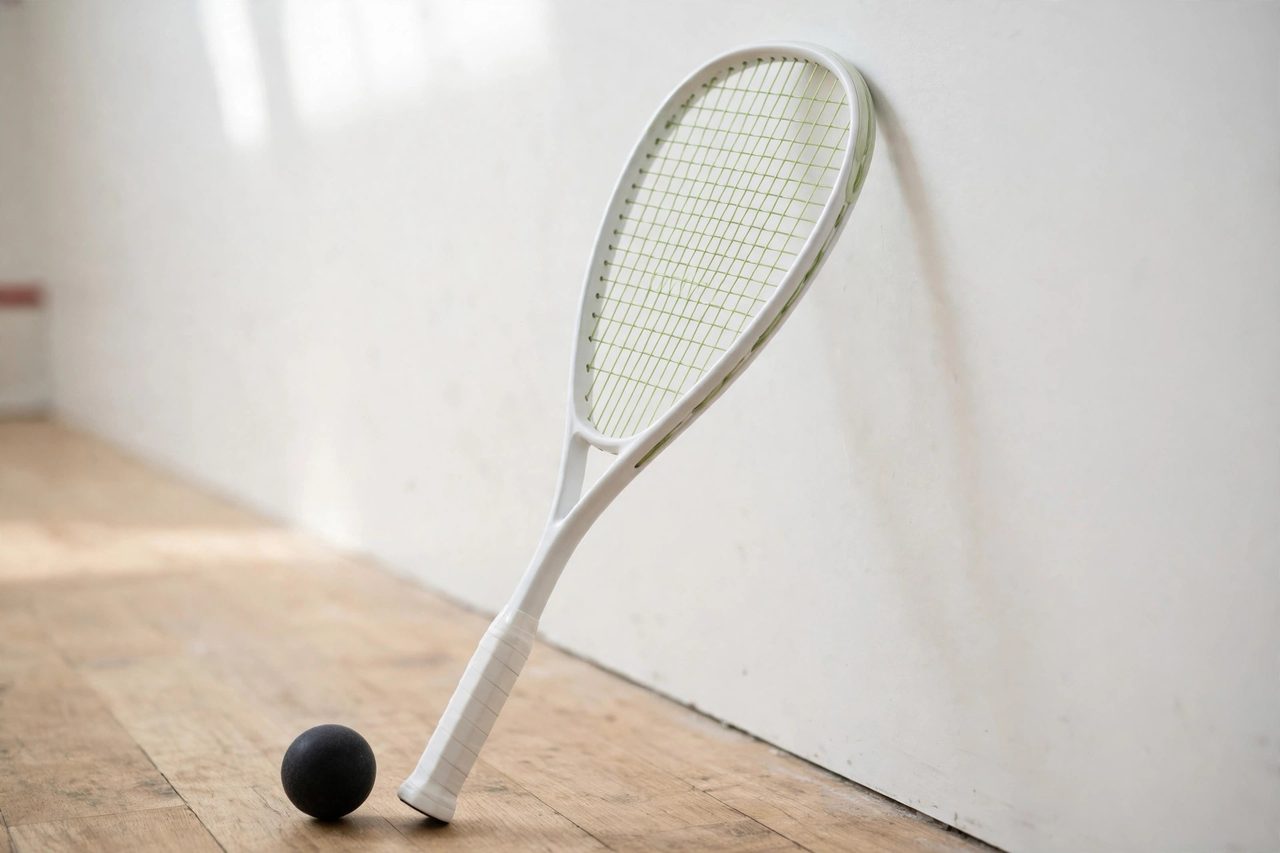
Most squash players know Tecnifibre for the Carboflex. The Slash 125 is the brand’s other answer to the same question: how do you build a racquet for attackers? Launched in 2023 as a new range, made with world No. 1 Mostafa Asal, it takes a different route to power. Same light weight, different shape, different feel.
The specs
- Frame weight: 125 g (unstrung)
- Head size: 485 cm²
- String pattern: 14 x 18
- Head: X-TOP, with no bumper — aramid fibres replace the usual plastic guard at the top of the frame
- Shaft: oversize, 390 mm²
- Factory strings: Tecnifibre 305 Green 1.20
- Length: 68.5 cm
- Player type: intermediate to advanced
Two ideas do most of the work here. The first is the open core: the open space between the handle and the head is narrow, with extra reinforcement on the outside. That is the Yoke Power Technology: a tighter throat makes the frame stiffer, so more of your swing energy goes into the ball instead of bending the frame.
The second is the head. At 485 cm² it is smaller than the Carboflex’s 500 cm² on paper, but longer in shape, which stretches the strings and makes them livelier. A bigger string bed means a bigger sweet spot. The sweet spot is the part of the strings where the ball comes off cleanest, with the most power and the least vibration. A larger one forgives shots that miss the middle.
The X-TOP head is shared with the Carboflex range. A bumper is the plastic strip that protects the top of a racquet when it scrapes the wall. Tecnifibre removed it and used tough aramid fibres instead. Less weight at the tip, nothing to crack, and the head cuts through the air a little faster.
On court: speed first, power follows
At 125 grams this is a very light frame, and it plays like one. The head moves fast. On the volley — hitting the ball before it bounces — that speed is the whole point. Quick exchanges at the front, fast hands on the backhand side, a flicked drop when your opponent is stuck at the back: it gets there first.
A head-heavy racquet is one with more weight in the head than in the handle, so the head does the work for you. The Slash 125 is light overall, so the power comes from swing speed, not from mass. You have to swing it. When you do, the long head and the stretchy 305 Green strings give the ball a lively, springy response.
The trade-off is stability. A light frame can twist a little when the ball hits off-centre, and the Slash 125 is no exception. It is steadier than most 125-gram frames thanks to that stiff throat, but if your timing is off, you will feel it. The soft, elastic 305 Green strings help: the ball stays on the strings a fraction longer, so the feel is kinder than a stiff string would give.
Touch shots are a pleasant surprise. Drops and boasts — a boast is a shot played off the side wall to wrong-foot your opponent — still land with shape. The open 14x18 string pattern, which means 14 main strings and 18 cross strings, leaves more space between the strings, so the ball grips and bites instead of sliding off flat.
The trade-offs
This is an attacking player’s racquet, and it asks for an attacking player’s game. If you like to volley, take the ball early and hunt for winners, it fits. If your game is built on patience and tight straight drives, it will feel a little too lively. Power that is always on tap punishes a loose swing: the ball that sails past the back wall is the price of a lazy shot.
Beginners should look elsewhere. The light weight and lively strings exaggerate timing errors, and this frame rewards players who already swing through the ball properly.
One thing to know before you buy: Tecnifibre refreshed the Slash range in 2025. The Slash 125’s successor is the Slash 120 Power — the same idea, five grams lighter, with the same 485 cm² head. The 125 is still on sale in many shops, often at a discount, so it is good value right now — but check which model you are actually buying.
How it compares
Inside Tecnifibre’s own range, the Slash 125 sits next to the Carboflex 125, not under it. The Carboflex is the teardrop-shaped power standard — a rounded head that funnels the strings toward the throat. The Slash is the open-core alternative: a longer head, a different balance of speed and stability, and a look all of its own in white with a neon green graphic. If the Carboflex feels like the safe pick, the Slash is the pick for players who want the same weight with a faster, sharper feel.
Against rival brands, the Slash 125’s edge is swing speed. Plenty of 125-gram racquets feel fast but flimsy; this one holds its shape through the hitting zone better than most, thanks to the reinforced throat.
Who should buy it
Intermediate and advanced club players who attack. If you volley a lot, like to take the ball in short and want maximum head speed without giving up all stability, this is your kind of frame. It suits players who generate their own pace with a full swing rather than players who want the racquet to do the heavy lifting.
The verdict
The Slash 125 is not a Carboflex with a new paint job. It is a different answer to the same brief: a light, fast, open-core frame that turns swing speed into power and stays calm enough at the front of the court to be a real weapon. The 2025 refresh means it is no longer the newest Slash, which only helps its price. If you attack and want speed above all, this is still a very good racquet.
Related articles
Butterfly Tenergy 05 Review: The Spin Classic That Still Sets the Standard
Launched in 2008 and still the most trusted rubber in table tennis: the Butterfly Tenergy 05 pairs a grippy topsheet with Spring Sponge for huge spin and a high, safe arc. What it does well, who it suits, and who should skip it.
Butterfly Dignics 09C Review: The Spin Monster That Rewards Big Swings
Tacky topsheet, hard 44-degree sponge, huge spin: the Butterfly Dignics 09C is a premium forehand rubber for players who loop hard. What it does well, who it suits, and who should skip it.
Butterfly Timo Boll ALC Review: The Blade Behind a Legend's Forehand
The Butterfly Timo Boll ALC is a 5-ply wood, 2-ply Arylate-Carbon blade of about 86 grams. It gives attacking players speed, spin and control — but it asks for good technique in return.