
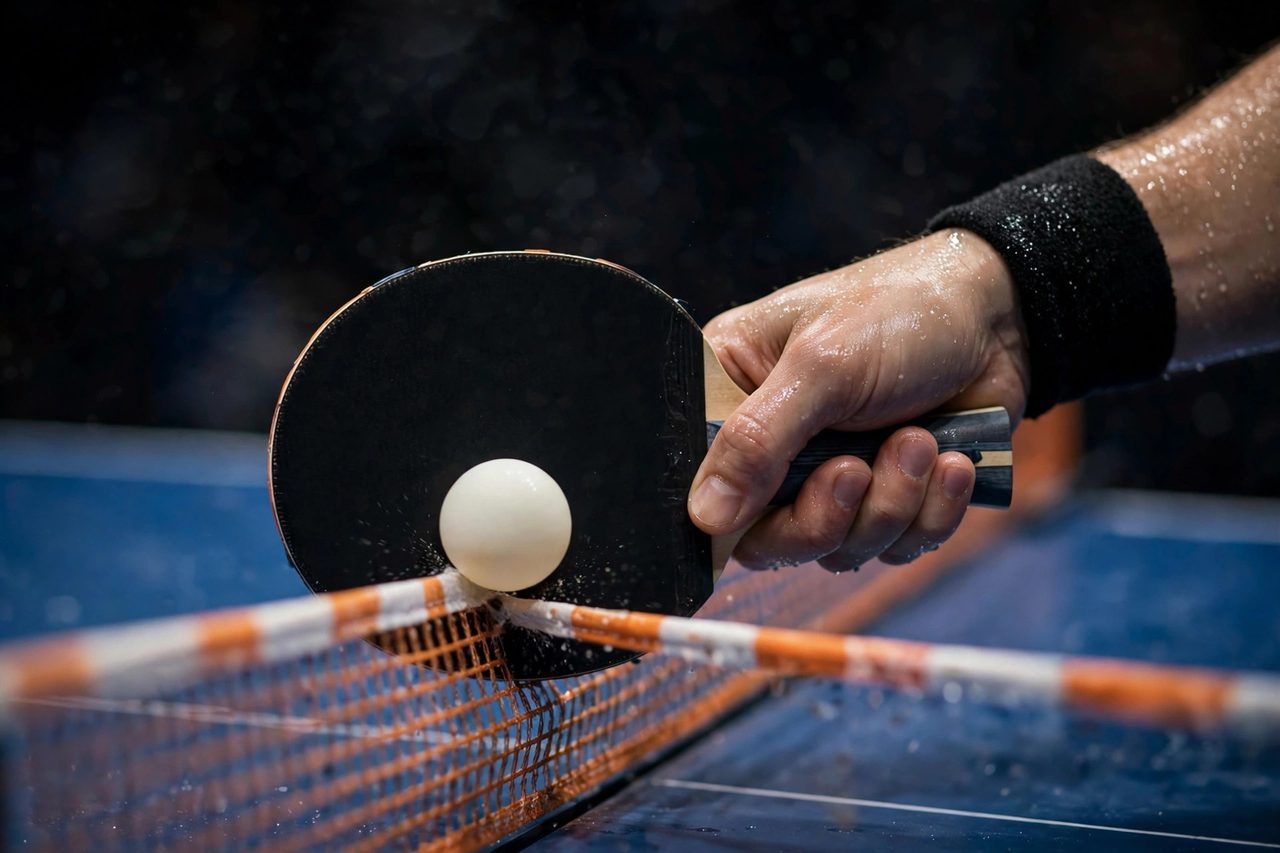
There was a time when a short serve meant a short push back. Then the banana flick arrived — the backhand topspin flick played over the table, curving like its namesake — and receive changed forever. Today, every serious player from club level up has it. Here’s how to build yours, step by step.
Why it matters
The flick lets you attack serves that used to be untouchable: short, low, loaded with spin, dying near the net. Instead of pushing them back safely and waiting to be attacked, you take the initiative on the very first ball. In the modern game, the receive is an attacking stroke — and the banana flick is its signature.
Step 1: Read it early, get in close
The flick happens over the table, which means your feet decide everything before your racquet moves. As soon as you read a short ball, step in — right-handers bring the right foot under the table, body low, weight forward. If you’re reaching, you’re late. The golden rule: the ball should be comfortably within your hitting zone, roughly above your front knee, not at full arm’s length.
Step 2: Set the racquet
Take the racquet back slightly with the wrist cocked — the blade angled so its face points a little upward and outward. Keep the elbow up and in front of your body, not pinned to your side. The wrist should feel loose and loaded, like a spring. A stiff wrist is the flick’s worst enemy: the whole stroke is wrist-driven, and tension kills both spin and control.
Step 3: Contact at the top of the bounce
Timing is the entire shot. Meet the ball at or just before the top of its bounce, when it’s at its highest and slowest relative to you. Too early and you catch it rising into the net; too late and it’s dropping away, forcing you to lift — which is how flicks end up in the bottom of the net or sailing long.
Step 4: Brush, don’t hit
This is the key distinction. A flick is not a small smash — it’s a brushing stroke. Contact the top and side of the ball, brushing up and over it rather than striking through it. For the classic “banana” shape, the wrist curves around the side of the ball as the forearm snaps forward and slightly upward, imparting the sidespin-topspin combination that gives the shot its swerving flight.
Think of wiping over the top of the ball with the racquet face, not punching it. The contact should feel like a graze. Counterintuitively, the looser and quicker the wrist action, the more spin — and spin is what brings the ball down onto the table.
Step 5: Finish small, recover instantly
The follow-through is short: the racquet finishes in front of your body, pointing roughly where you aimed. The moment the ball leaves your racquet, you’re stepping back out and resetting. Flicks happen in the chaos of the short game, and the next ball is coming immediately. Players who admire their flick get punished on ball two.
The classic mistakes
- Hitting under the ball. If you contact the bottom half, the ball goes into the net or floats. Brush the top.
- The big swing. The flick’s power comes from wrist speed, not arm length. A compact stroke is a consistent stroke.
- Contacting late. A dropping ball forces a lift. Move your feet and take it at the top.
- A locked wrist. If your wrist can’t move, you have a push, not a flick. Shake the tension out between points.
Drills that work
Start with a partner serving short backspin to your backhand. Your only job: flick it, focusing on clearing the net with spin rather than hitting winners. Once the contact feels automatic, have the server vary the spin — sidespin, no-spin, occasional long serves you must loop instead. The real skill isn’t the stroke; it’s reading which ball deserves the flick.
For solo practice, shadow the motion in front of a mirror: step in, cock the wrist, snap, recover. Ten minutes of shadow flicks builds the motor pattern faster than most players expect.
Putting it in your game
Don’t try to flick everything on day one. Start by flicking one predictable short serve per game — your opponent’s favourite, the one they serve on big points. As the contact sharpens, expand the range. Within a few months, short serves stop being a defensive chore and start being the first ball of your attack. That’s the moment the modern game opens up.
Related articles
The Forehand Block: How to Turn Defence Into Attack in Table Tennis, Step by Step
A fast ball is coming at you and you have no time to swing. The forehand block is the answer: a short, firm return that uses your opponent's speed against them.
The Squash Serve: How to Start Every Rally With an Advantage, Step by Step
The serve is the one shot in squash you fully control. Here is how it works: the rules, the lob serve, the hard low serve, where to aim, and the drills that make it reliable.
The Squash Cross-Court: How to Stretch Your Opponent and Open the Court, Step by Step
The cross-court sends the ball diagonally across the court and drags your opponent out of position. Here's when to use it, how to hit it, and the drills that make it reliable.