
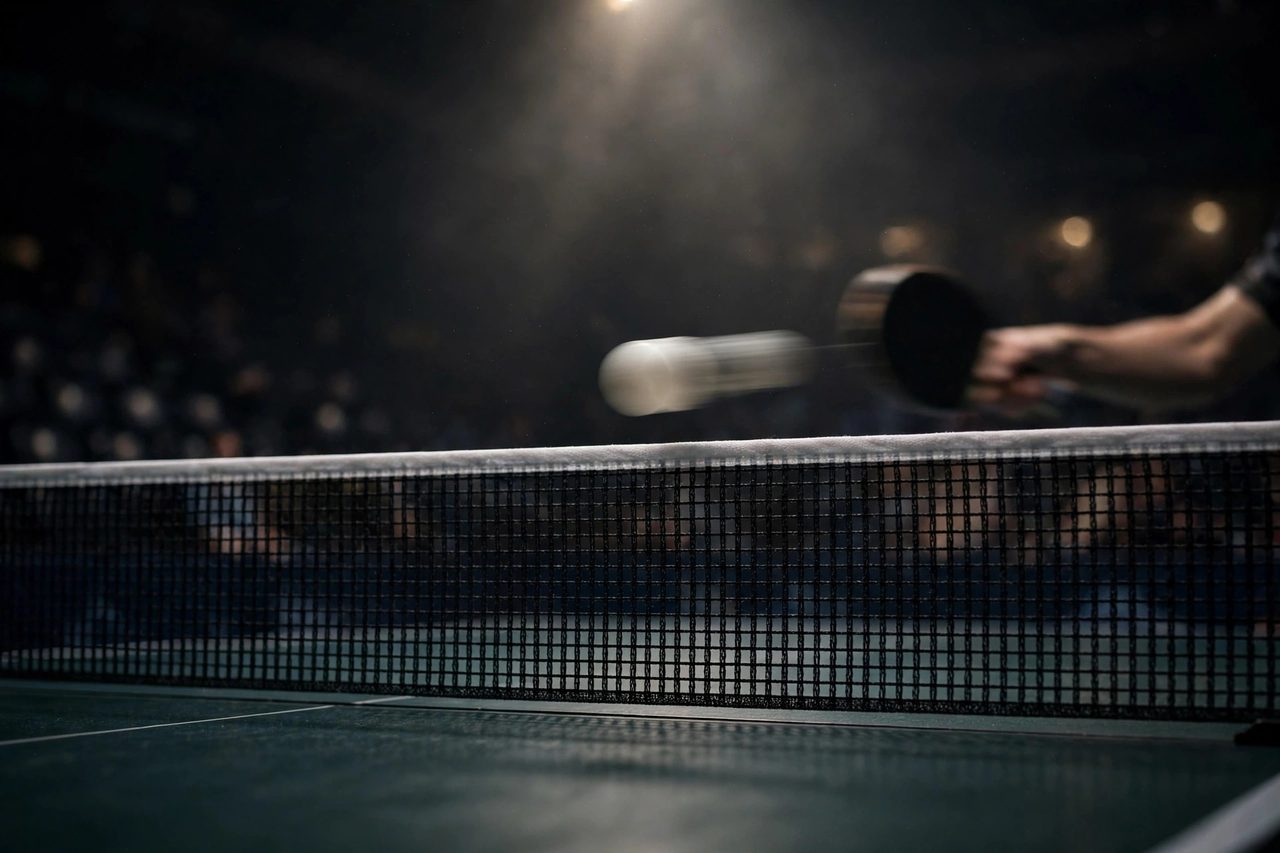
Here is the most common way a table tennis match is lost at club level. The server tosses the ball, waves the racquet around it in a blur of theatre, and the receiver — who has played for years, who can loop and block perfectly well — dumps the return into the net. Or pops it up and gets it smashed past him. Or watches it kick sideways off his racquet like it was bewitched. The point was decided by information: the server knew what was on the ball, and the receiver didn’t.
Spin is the hidden language of table tennis. It is invisible in itself — you cannot see rotation on a plain white ball moving at speed — yet it controls almost everything: how the ball curves in the air, how it behaves off the bounce, and how violently it leaps off your racquet. The good news is that the language has grammar. It can be learned, cue by cue: the physics underneath, the families of spin, the tells that give them away, and the training that turns reading from guesswork into reflex.
First, the physics: why spin bends the world
A table tennis ball weighs 2.7 grams and measures 40 millimetres across. It is so light, relative to its size, that the air is a medium it swims through — and spin is how it steers. When a player brushes the racquet across the ball, friction between rubber and surface grabs and hurls it into rotation. On a heavy loop, high-speed cameras measure spin at up to 9,000 revolutions per minute: 150 turns every second, roughly four times the spin on a baseball curveball.
A spinning ball drags a thin layer of air around with it. On the side where the surface moves with the airflow, the air speeds up and the pressure drops; on the opposite side the air slows and the pressure rises. The ball is pushed toward the low-pressure side. This is the Magnus effect, and it is not subtle. With topspin, the force points down: the ball is shoved toward the table far harder than gravity alone would pull it, which is why a fast loop can be aimed above the net and still crash-land on the far edge. With backspin, the force points up: the ball floats, stays airborne longer, and travels in a flatter line than your eyes expect. With sidespin, the force points sideways, and the ball bends in the air like a football free kick.
The second act: what spin does at the bounce
Flight is only half the story. When a spinning ball lands, its rotation meets the table’s friction, and the result is a second surprise for anyone who read the first one wrong.A topspin ball arrives spinning forward. At the bounce, its underside grips backwards against the table, so friction shoves it forward: the ball accelerates off the surface, kicking low and fast toward the receiver’s body. Players say it “jumps at you”, and they are describing real physics. A backspin ball does the opposite. Its underside slides forward, friction drags against its travel, and it slows sharply — sometimes so much that a heavily cut ball will stop, drop, or even bounce back toward the net. A ball carrying sidespin grabs the table and deflects sideways, leaping left or right off the bounce in a way that looks like a conjuring trick the first fifty times it happens to you.
This is why reading spin matters twice. You need to know what is on the ball to choose your shot — and to stand in the right place, because the bounce will move the ball somewhere your eyes did not schedule.
The families: three spins and their blends
Purists divide spin into three families, and everything you face is one of them or a mixture.
Topspin is rotation toward the opponent: the top of the ball rolls forward. Loops, drives and most modern attacking strokes live here. Topspin dips in flight, kicks off the bounce, and bites into your racquet and climbs — which is why blocking a heavy loop with an open racquet sends the ball long. Close the angle, and you tame it.
Backspin is rotation away from the opponent: the bottom of the ball rolls forward. Chops, pushes and defensive serves live here. Backspin floats in flight, dies at the bounce, and drags a passive return into the net, because the spinning surface is crawling down the face of your bat. To lift it you must open the racquet, brush up, or get underneath it with spin of your own.
Sidespin is rotation around a vertical axis, and it is the serve specialist’s favourite seasoning. It bends the ball in the air and throws it sideways off the bounce — and off your racquet too, unless you angle the bat against the kick.
Here is the catch that separates reading from merely knowing: almost no real serve is a pure spin. A good server blends. The same pendulum action can carry side-backspin in one rally and side-topspin in the next, and the difference between the two returns is net versus fly-out. There is even an exotic relative, corkspin — rotation around the axis of travel, like a rifle bullet — which barely curves in flight but explodes sideways off the bounce. Reading spin, then, is not naming a category; it is estimating a recipe: mostly back, some side, a little top. The rest of this article is about where that information hides.
Read the racquet, not the ball
The beginner watches the ball and hopes. The advanced player watches the racquet, because the ball’s secret is written at the moment of contact — on the server’s side of the net, in plain view.
Three things at contact carry almost all the information. The first is direction of travel of the racquet head. A racquet that finishes moving downward and under the ball has cut beneath it: expect backspin. A racquet that brushes up the back of the ball has lifted it: expect topspin. A racquet sweeping across the ball’s side has loaded it with sidespin, in the direction of the sweep. The second is racquet speed: spin comes from brushing speed, so a violent whipping motion means heavy rotation and a slow, pushing contact means little. The third is the angle of the face. An open face sliding under the ball is the geometry of backspin; a closed face rolling over the top is topspin’s.
Deceptive servers attack exactly here. They learn to make the same wind-up produce different contacts — “same action, different spin” — by changing only the final few centimetres: striking a different part of the ball, or snapping the wrist one way instead of the other at the last instant. The professional defence is to watch later and closer: ignore the big theatrical backswing, which is advertising, and fix your eyes on the racquet through the last fraction of the swing. The information arrives late. That is why receiving is hard — and why it is trainable, because late information is still information.
The logo myth, and what your eyes can honestly do
Every club has a veteran who swears by this method: watch the printed logo on the ball, he says, and the logo will tell you the spin. It is the sport’s most durable half-truth, and it is worth dismantling, because what replaces it is better.
At 150 revolutions per second, a logo is not a readable symbol; it is a grey smear. Nobody reads heavy spin off a ball’s stamp in real time — the human visual system simply does not sample that fast. What the logo can tell you is the opposite piece of news. On a no-spin ball — the floater, served dead with a spinning-looking action — the logo stays eerily still and crisp, because nothing is rotating. A clear, steady logo means no spin; a total blur means some spin. That is one bit of information, useful mainly against the dead-ball trick, and it is the honest limit of the method.
Direction and amount have to come from elsewhere: from the racquet, as above, and from the ball’s behaviour, which is the subject of the next section. Elite receivers are not superhuman logo-readers; they are pattern machines who combine contact, sound, arc and bounce into one instant judgement. Each of those channels is learnable on its own.
Sound and flight: the other two witnesses
Your ears are a spin channel nobody coaches. A brushing contact — the kind that manufactures spin — makes a thin, high, scratching tick, because the rubber has grazed the ball rather than struck it. A solid, driving contact makes a fuller click, and a dead-ball serve, where the ball is more pushed than brushed, sounds duller than its action suggests. When the action screams spin and the sound whispers, believe the sound: you are probably facing a floater.
Flight is the second witness. Learn the silhouettes. Topspin travels in a hump and then dives — if a ball is clearing the net comfortably yet still lands on the table, topspin put it there. Backspin travels flatter and longer than it should, holding its line, reluctant to come down. Sidespin announces itself with a visible bend, but the blends are subtler: side-backspin curves one way and grips at the bounce; side-topspin curves and then hurries. Finally, the bounce itself confirms the verdict — the kick, the skid, the sideways leap. By then it is too late for that particular ball, but not for the next one: every return you attempt is data about what that server’s action produces, and good receivers keep a running ledger through the match.
Answering: the receiver’s toolkit
Reading is worthless without replies, and each spin family has its price list. Against backspin, the ball wants to drag your return into the net, so your answers add lift. The push — an open racquet sliding under the ball, returned low with your own backspin — is the safe reply, short or long. The flick lifts a short ball with a compact upward brush. And when the ball is long, the grown-up answer is to loop it: brush up and over, replacing their spin with yours.
Against topspin, the ball wants to climb off your racquet and fly, so your answers subtract. Block with a closed angle and soft hands, letting the ball’s own energy work. Chop-block if you want to be cruel; counter-loop if you are brave and positioned.
Against sidespin, racquet angle is everything: aim your bat against the direction of the kick — if the ball wants to leap left off the bounce, angle into the curve — and keep the contact simple until the rally is honest.
And against the modern short serve, one stroke has changed the game: the chiquita, the backhand banana flick made famous by Zhang Jike, which curls around the side of the ball over the table and returns almost any short serve with topspin. It is the aggressive answer to spins that used to force a passive push — proof that yesterday’s unreadable serve is tomorrow’s attack ball.
Training the eye: a progression that works
You do not learn to read spin by being fooled at full speed in matches. You learn it the way you learn a language: vocabulary first, then sentences, then conversation.Stage one: one spin at a time. A partner serves only backspin, fifty balls, and your whole job is to say what you saw — contact, sound, flight — before you play the return. Then only topspin. Then only float. You are building a library of what each ingredient looks and sounds like, with no deception allowed.
Stage two: two spins, one action. The partner now uses the same service motion to produce two spins — say, side-backspin and side-topspin — and you must call the spin aloud before the ball crosses the net. Score yourself out of twenty. This is the core drill of receiving, and most players improve visibly within a few sessions, because the brain finally gets clean feedback on cues it was ignoring.
Stage three: hide the contact. The server now varies everything, and sometimes a screen or the server’s free arm partially hides contact — as happens, legally and otherwise, in real matches. You must read from flight and bounce alone, and hold your decision a fraction longer.
Stage four: pressure and patterns. Play return-only games: the server scores double for aces and unreturned serves; you score for every return in play. If you have a phone, film serves in slow motion and check your calls against the visible contact — an honest audit of which cues you actually used.
Robots and multiball can industrialise stages one and two, feeding a single spin at volume until the read is automatic. But keep a human in the loop for the later stages: deception is a human art, and only humans practise it.
The fluent receiver
Watch a top-level receiver closely and you will notice something odd: he looks relaxed. He is not faster-eyed than you in any biological sense. He is reading a language he has studied, in the order the information arrives — racquet, sound, arc, bounce — and he has a rehearsed answer for every sentence the server can write. The mystique of the “unreturnable” serve mostly evaporates under that kind of study.
That is learnable at any level, and it starts the next time you stand to receive. Ignore the wind-up. Watch the last few centimetres of the racquet. Listen for the tick. Note how the ball falls. Then play your answer like someone who understood the sentence — because increasingly, you will have.
Related articles
The Forehand Block: How to Turn Defence Into Attack in Table Tennis, Step by Step
A fast ball is coming at you and you have no time to swing. The forehand block is the answer: a short, firm return that uses your opponent's speed against them.
The Squash Serve: How to Start Every Rally With an Advantage, Step by Step
The serve is the one shot in squash you fully control. Here is how it works: the rules, the lob serve, the hard low serve, where to aim, and the drills that make it reliable.

The Squash Cross-Court: How to Stretch Your Opponent and Open the Court, Step by Step
The cross-court sends the ball diagonally across the court and drags your opponent out of position. Here's when to use it, how to hit it, and the drills that make it reliable.