
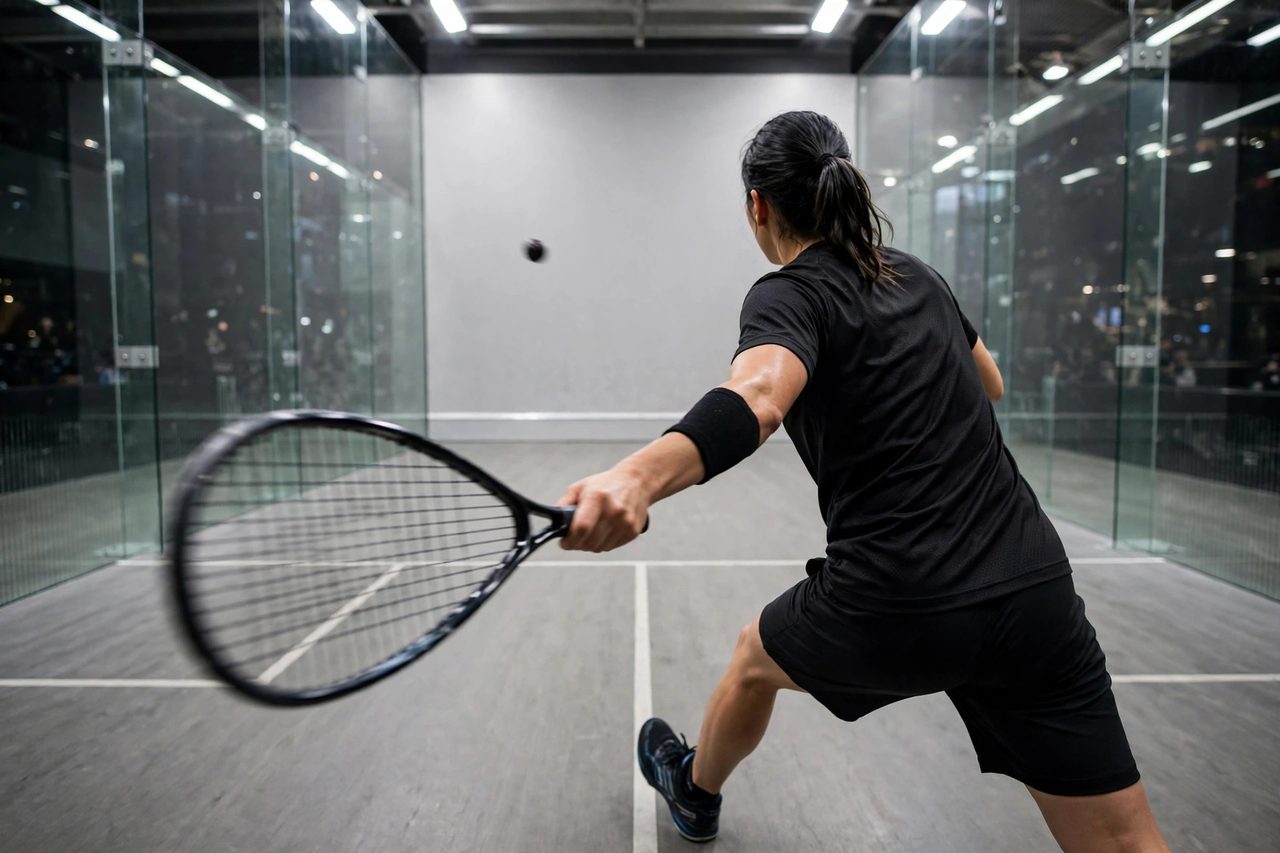
The straight drive is the shot you build your game around. The cross-court is the shot that breaks your opponent’s game open. Hit diagonally from one side of the court to the other, it drags your opponent across the floor, opens up space, and turns a rally you were surviving into one you are controlling.
A cross-court travels from one side of the court to the opposite back corner. Your opponent has to cover a lot of ground to get there — and that is the whole point.
1. When to use it — and when not to
Use the cross-court when your opponent is camped on one side of the court, or when you have been pushed wide and need time to recover. A deep cross-court gives you a long ball to get back behind while your opponent runs across the court.
It also changes the direction of the rally: after three straight drives, your opponent has settled into a rhythm, and a cross-court breaks it and forces them to move.
But there is a catch. A cross-court passes through the middle of the court, closer to your opponent than a straight drive. A short or loose cross-court is easy to cut off at the volley. So the rule is simple: only play a cross-court when you can hit it deep and wide. If you are stretched, off balance, or late to the ball, play it straight and safe instead.
2. Get into position
Move to the ball early and get side-on to the front wall, just like for a straight drive. Feet roughly shoulder-width apart, knees bent, weight on the balls of your feet. The difference is your target, not your body: you are aiming at the opposite corner, so open your shoulders slightly toward that side.
Check where your opponent is first: if they stand on the side you are hitting from, the cross-court is wide open; if they have drifted to the middle, hit it straight instead.
Get back to the T after every shot. The T is the spot in the middle of the court, marked by the lines on the floor, where you wait between shots.
3. The swing
Hold the racquet with the standard grip: shake hands with the handle, with the V between your thumb and forefinger sitting on top. Take the racquet back early, with a short and compact backswing. A big wind-up is slow — and slow gets punished in squash.
Swing through the ball in a smooth arc and meet it slightly in front of your front foot, around knee to waist height. Hit through the ball, not at it, and finish high toward the corner you are aiming at. A late, small snap of the wrist at contact adds pace and helps you steer the ball across the court. Keep the grip relaxed: a tense hand kills touch and makes the ball fly long.
4. Pick your targets
Aim high enough that the ball drops deep, but low enough that it does not sit up for a volley. A good guide: pick a spot on the front wall roughly a metre above the floor, on the opposite side from where you are standing. The ball should land in the back corner on the far side, tight to the side wall.
Width matters as much as depth. A cross-court that lands in the middle of the court is a gift — your opponent barely has to move. The perfect cross-court hugs the opposite side wall and dies in the back corner.
5. How it opens up the court
Once your opponent has chased a deep cross-court into the far corner, the court is open: drop straight into the front corner they just left, or cross-court again to the corner they came from. This one-two — cross-court deep, then drop short — is one of the oldest patterns in squash, and it still works at every level.
The reverse works too: after straight drives down one wall, your opponent creeps toward that side to cut them off, and a sudden cross-court to the far corner catches them on the wrong foot. Variety is what makes the shot dangerous, not power.
6. Common mistakes
Too short. The most common error. A short cross-court is the easiest ball in squash to attack. If you cannot reach the back corner, do not play it — hit straight instead.
Telegraphing it. If you change your swing or stare at the far corner before you hit, a good opponent reads it and moves early. Keep your preparation the same for both shots, and decide late.
Overhitting. Trying to smash it usually sends it long or wide. Pace comes from timing and clean contact, not from swinging harder.
Forgetting to recover. Players admire their own cross-court and stand still watching it. Your opponent is already moving — so should you. Get back to the T while the ball is still travelling.
7. Three drills to make it yours
Corner-to-corner rally. With a partner, hit cross-courts only, from forehand corner to backhand corner and back. The goal is not to win the rally but to keep it going: ten cross-courts in a row, deep and wide. Count your longest rally and try to beat it each week.
Boast, then cross-court. A boast is a shot that hits a side wall first, then the front wall, and lands in the opposite front corner. Play a boast, then hit a deep cross-court to the corner your partner came from.
The target game. Stick tape on the front wall where you want to aim, and another piece on the floor in the far back corner. Hit twenty cross-courts and count how many land within a step of the floor target. When you can hit fifteen out of twenty, move the target closer to the wall.
The bottom line
The cross-court is not a trick shot. It is a basic tool every squash player needs: hit it deep, hit it wide, and use it when your opponent is stuck on one side or when you need time to recover.
Related articles
The Forehand Block: How to Turn Defence Into Attack in Table Tennis, Step by Step
A fast ball is coming at you and you have no time to swing. The forehand block is the answer: a short, firm return that uses your opponent's speed against them.
The Squash Serve: How to Start Every Rally With an Advantage, Step by Step
The serve is the one shot in squash you fully control. Here is how it works: the rules, the lob serve, the hard low serve, where to aim, and the drills that make it reliable.
The Short Push: Table Tennis's Quiet Short-Game Weapon, Step by Step
The short push keeps a short ball short and low so your opponent cannot attack it. Here is how to play it, step by step — grip, stance, reading the serve, soft contact, placement, and the drills that make it stick.