
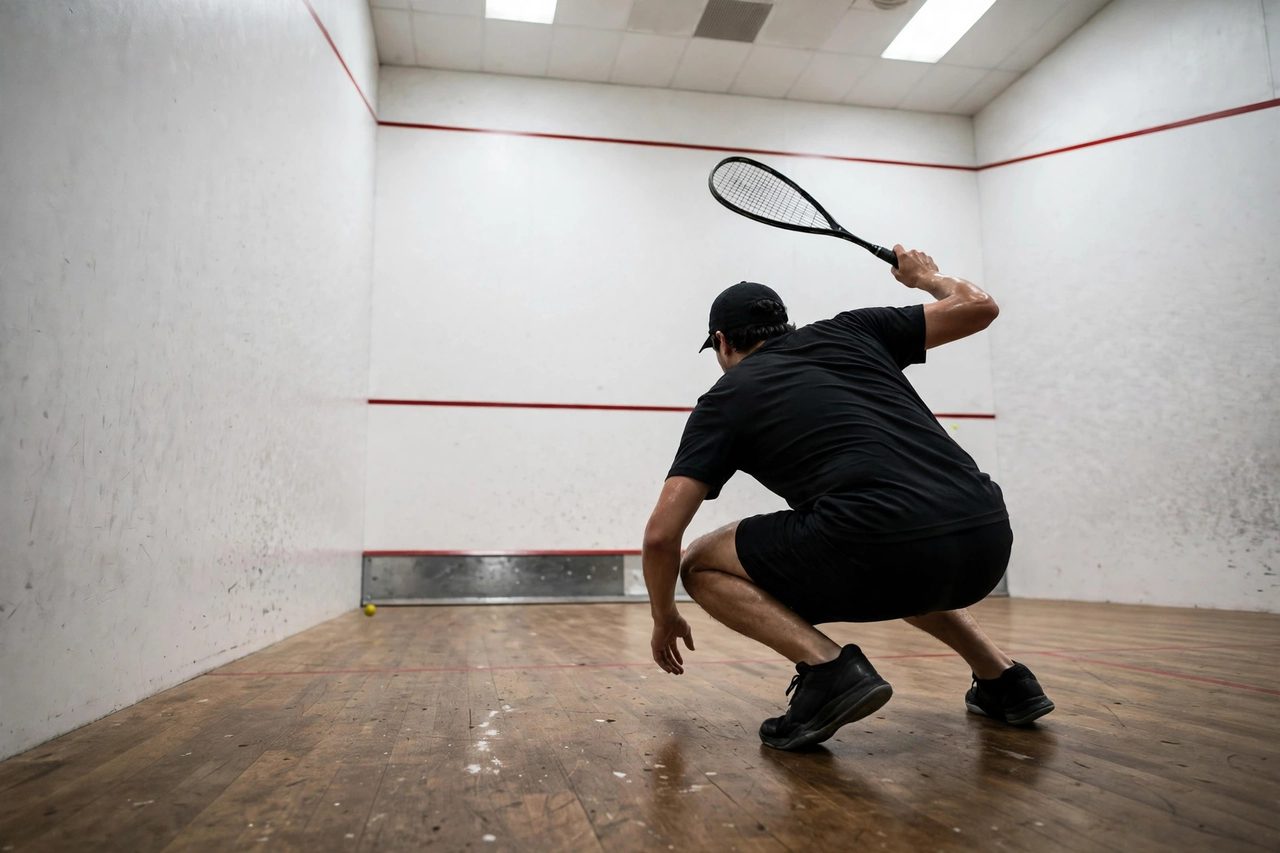
There is a particular silence that follows a great drop shot. The ball kisses the front wall, dies in the corner, and the opponent — sprinting forward from the back of the court — arrives a half-second too late, racquet outstretched, to nothing. No power, no drama, just geometry. The drop shot is squash’s softest weapon, and also one of its most misunderstood: players either overuse it, telegraph it, or avoid it entirely. Done right, it is the shot that makes everything else on the court work.
Why the drop works
Squash is a game of court position. The player who controls the T — the junction at the middle of the court — controls the rally. A good length game pushes your opponent deep, behind the service box, where every return is defensive. The drop shot is the payoff for that work: once your opponent is pinned deep, a ball that dies at the front wall forces them to cover the full length of the court, twice over if they get there at all.
That is the key insight. The drop is not a trick you play from anywhere. It is a reward for length. Play it when your opponent is behind you, off balance, or late — and it wins the rally. Play it when they are standing on the T, fresh and waiting — and it hands them the easiest winner of the match. The first rule of the drop shot is therefore not technical at all: earn it first.
The technique, step by step
Start from a sound base. As with every front-court shot, the preparation should look identical to your drive for as long as possible — this disguise is the whole shot. If your opponent can read “drop” from your backswing, the shot is dead before you hit it.
First, move early and get low. The drop is played from a crouched, balanced position, weight on the balls of your feet, racquet prepared early and held high. Arrive at the ball with time to spare; a rushed drop is almost always a loose drop, and a loose drop sits up nicely for your opponent.
Second, shorten the swing. Where the drive uses a full swing through the ball, the drop uses a compact, controlled action — think of it as a firm push or a gentle cut rather than a hit. The racquet face should be slightly open at contact, brushing under and across the ball to kill its pace. The aim is a soft landing: the ball should strike the front wall low, ideally just above the tin, and drop steeply into the corner, bouncing twice before your opponent can reach it.
Third, follow the ball in. A great drop is followed by a step toward the T, not a retreat. If your opponent does reach it, the most likely reply is a weak lift or a counter-drop — and you want to be in position for both. Players who admire their own drop shots from the front corner lose the next shot; players who recover to the T win the rally twice.
The variations
The basic drop has two essential cousins. The straight drop, played down the wall, is the safer option: the ball hugs the side wall, limiting your opponent’s angles on the retrieve. The cross-court drop, angled across the front wall, is riskier but more devastating — it sends your opponent diagonally across the court, the longest possible journey, and it opens the court behind them if they do get there.
There is also the disguised drop off a drive shape: take the full backswing of a straight drive, then at the last moment soften the wrist and feather the ball short. This is the advanced version, and it is what separates club players from professionals. It requires total confidence in your racquet control, because the margin for error is tiny. Practise it only once the basic drop is reliable.
When not to drop
The drop has three great enemies: a loose length game, a fast opponent, and your own impatience. If your previous shot did not push your opponent deep, do not drop. If your opponent is already moving forward, do not drop — play past them instead. And never drop twice in a row from the same position: the second one will be read, and the reply will be brutal.
A useful rule of thumb: drop once per rally at most, and only when you have earned the right. The best droppers in the world are not the players who drop most often; they are the players whose opponents never know when it is coming, because the threat of the drive keeps them honest.
Drills that build it
The classic drill is the boast-and-drop: your partner boasts from the back, you move forward and drop, then recover to the T. Repeat until the movement is automatic and the ball consistently dies in the corner. Then add pressure: your partner is allowed to retrieve anything that sits up, so a loose drop is punished immediately. Nothing teaches a tight drop faster than consequences.
A second drill isolates disguise. Rally straight drives with a partner, and on a random ball, drop instead — same preparation, same backswing, different outcome. If your partner moves early, your disguise failed. If they stay rooted, you have the shot.
Finally, practise the drop under fatigue. Play conditioned games where the rally must reach five shots before a drop is allowed. Tired legs make for lazy drops; learning to stay low and compact when exhausted is what makes the shot hold up in the fifth game of a real match.
The payoff
Master the drop and the whole court opens up. Opponents who fear the drop cannot camp on the back wall; they creep forward, and the space behind them grows for your length game. Opponents who respect your length cannot guard the front; they hang back, and the drop kills them. That tension — length versus drop, back versus front — is the fundamental rhythm of squash, and the drop shot is what keeps it honest.
It will never look as spectacular as a diving retrieve or a boast that kisses the nick. But watch the greats: the rallies they win most easily are the ones that end in silence, with the ball dying in the corner and the opponent arriving too late. That silence is the sound of a drop shot done right.
Related articles
The Forehand Block: How to Turn Defence Into Attack in Table Tennis, Step by Step
A fast ball is coming at you and you have no time to swing. The forehand block is the answer: a short, firm return that uses your opponent's speed against them.
The Squash Serve: How to Start Every Rally With an Advantage, Step by Step
The serve is the one shot in squash you fully control. Here is how it works: the rules, the lob serve, the hard low serve, where to aim, and the drills that make it reliable.
The Squash Cross-Court: How to Stretch Your Opponent and Open the Court, Step by Step
The cross-court sends the ball diagonally across the court and drags your opponent out of position. Here's when to use it, how to hit it, and the drills that make it reliable.