
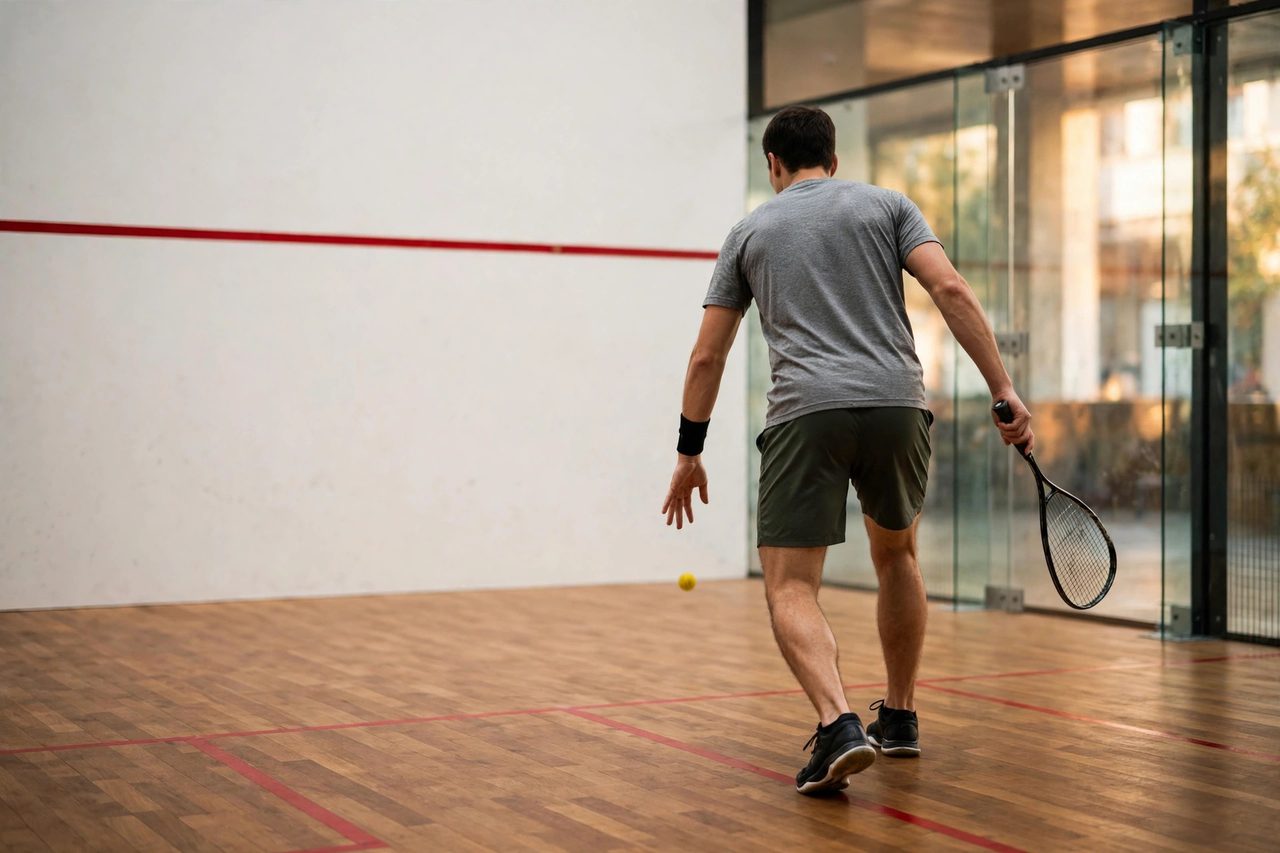
Every point in squash starts with a serve, and nobody is rushing you. The ball is in your hand, your opponent is waiting, and you choose how the point begins. A good serve will not win the point alone, but a bad one hands your opponent an easy attack before the rally has even started. A rally is the back-and-forth exchange of shots after the serve.
The rules first
You serve from inside one of the service boxes — the small marked squares on the floor, one on each side of the court. Your foot must stay inside the box, with at least part of it touching the floor when you hit the ball. You switch sides each time you win a point.
The ball must hit the front wall above the service line, the red line across the front wall about halfway up. Hit below it and the serve is a fault, so the point goes to your opponent. After the front wall, the ball must land in the opposite quarter of the court — the back corner diagonally across from where you served. Land short of the short line, or out, and that is a fault too.
One fault loses the point — there is no second serve in squash. So the first job of any serve is simple: get it in.
Step 1: Stand in the box
Stand inside the service box, feet about shoulder-width apart, sideways to the front wall. If you are right-handed, stand on the right side of the box with your left shoulder pointing at the front wall. Hold the ball in your free hand and the racquet ready at about waist height.
Step 2: Drop, don’t throw
Hold the ball out in front of you and simply let it drop. Do not throw it up — a throw makes the timing harder and the contact point less predictable. The ball only needs to fall a short distance, about knee height, before you hit it. Watch it all the way down.
Step 3: Swing smooth and finish high
Swing the racquet in a smooth arc and meet the ball just in front of your front foot, at about knee height. The power comes from your shoulder and a small turn of your body, not from a wild arm swing.
Follow through toward the front wall, with the racquet finishing high. A full follow-through keeps the ball on line and helps it travel deep.
Then move. As soon as you have served, get back to the T, the spot in the middle of the court where the lines cross. It is the best place to wait for the return. A serve is only finished when you are in position for the next shot.
The lob serve: your best friend
The lob serve is the serve most coaches teach first, and most good players still use most of the time. You hit the ball high on the front wall with a gentle arc, so it floats over your opponent and drops deep into the back corner.
A lob is a high, slow, arcing shot. The point of the lob serve is time. A high ball takes longer to reach the back wall, which gives you time to get to the T. It also lands deep, pushing your opponent back and making their return harder.
Aim high on the front wall — well above the service line — and soft enough that the ball drops steeply into the corner.
The hard low serve: the change of pace
The hard low serve is the opposite idea. You drive the ball fast and flat, just above the service line, aiming for the side wall so it skids into the back corner. It gives your opponent very little time to react.
Use it sparingly. It is a surprise weapon, not a default. Hit it every time and your opponent will stand closer and volley it. And because it is fast and flat, a small miss means a fault.
Where to aim
For the lob, aim for the back corner on your opponent’s backhand side — most players are weaker there, and a ball tight to the side wall is awkward to return. For the hard serve, aim at the side wall halfway down the court, so the ball dies in the corner. The golden rule for both: tight and deep beats fast and risky.
Common mistakes
- Serving too fast, too soon: beginners rush the serve like it is a race. Slow down. You control the pace.
- Hitting below the service line: the most common fault. Aim higher than you think.
- Serving down the middle: a ball in the middle of the court is easy to attack. Aim for the side wall.
- Forgetting to move after the serve: the serve is not over when you hit the ball. Move.
- Blocking your opponent: after serving, get out of the way. If you stop your opponent reaching the ball, they can ask for a let — when the point is replayed because a player was blocked.
Three simple drills
1. Twenty in a row. Serve 20 lob serves from the right box, then 20 from the left. Count only the ones that land in the opposite back quarter. Aim for 18 out of 20 before moving on.
2. The towel target. Put a small towel in the back corner, tight to the side wall. Serve 10 lobs and see how many land within a racquet’s length of it.
3. Serve and move. Serve a lob, then sprint to the T before the ball bounces for the second time. Do this 10 times. It builds the key habit: serve, then move.
The serve is the only shot you hit without pressure, and it sets up everything that follows. Give it the same attention as your drives, and the rest of your game gets easier.
Related articles
The Forehand Block: How to Turn Defence Into Attack in Table Tennis, Step by Step
A fast ball is coming at you and you have no time to swing. The forehand block is the answer: a short, firm return that uses your opponent's speed against them.
The Squash Cross-Court: How to Stretch Your Opponent and Open the Court, Step by Step
The cross-court sends the ball diagonally across the court and drags your opponent out of position. Here's when to use it, how to hit it, and the drills that make it reliable.
The Short Push: Table Tennis's Quiet Short-Game Weapon, Step by Step
The short push keeps a short ball short and low so your opponent cannot attack it. Here is how to play it, step by step — grip, stance, reading the serve, soft contact, placement, and the drills that make it stick.