
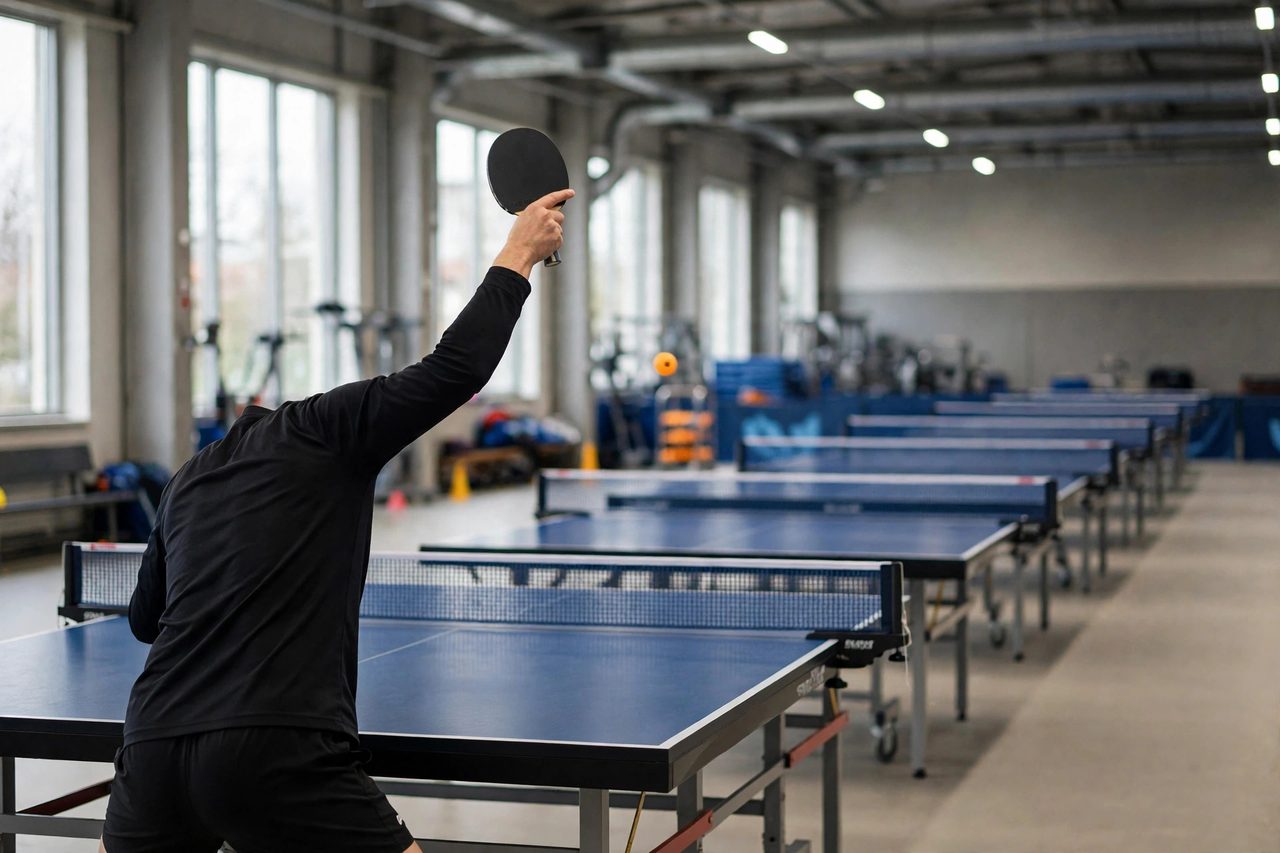
The backhand loop is one of the most satisfying shots in table tennis. It takes a ball that is dropping below the table, or loaded with spin, and turns it into a fast, spinning attack. When it clicks, it feels like magic. When it does not, the ball goes into the net or flies off the end of the table. This guide breaks the shot down into steps you can practise one at a time.
First, what is a loop? A loop is an attacking shot that brushes up the back of the ball to create topspin. Topspin is when the ball rotates forward, top over bottom, which makes it dip down onto the table and then jump forward after it bounces. A backhand is a shot played on the opposite side of your body from your racquet hand — for a right-handed player, that is the left side. So a backhand loop is a topspin attack played from your backhand side.
Step 1: Get your grip and stance right
Start with a shakehand grip, the most common grip in table tennis. Hold the racquet like you are shaking someone’s hand, with your thumb on one side of the handle and your fingers wrapped around the other. Your grip should be relaxed. If you squeeze the handle too hard, your wrist locks up, and a locked wrist cannot brush the ball properly.
Stand close to the table, with your feet a little wider than your shoulders. Your right foot should be slightly forward if you are right-handed — the opposite if you are left-handed. Bend your knees and lean forward a little from your waist. You want to feel athletic and ready to move, like a goalkeeper waiting for a penalty. Your racquet should be in front of your body, roughly at table height, with the racquet face slightly closed. A closed racquet face means the top of the racquet is tilted forward, pointing slightly down towards the table. This is what lets you brush up the ball instead of hitting through it flat.
Step 2: Read the ball and move into position
The backhand loop is usually played against a ball with backspin or a ball that is dropping low. Backspin is the opposite of topspin: the ball rotates backwards, which makes it float and drop, and makes it want to dive into the net when you hit it. That is why a loop is the right answer. The upward brush of the loop lifts the ball over the net and cancels out the backspin.
Move your feet so the ball is roughly in front of your stomach, not stretched out wide to your side. This is the most common mistake beginners make. They reach for the ball instead of moving to it. If you are reaching, your swing will be weak and wild. Take a small step, get your body behind the ball, and everything else gets easier.
Step 3: Drop the racquet and swing up
Here is the heart of the shot. As the ball comes towards you, drop your racquet down below the height of the ball. Your wrist should be loose and slightly cocked back. Then swing forward and upward, brushing up the back of the ball. Think of it like brushing the ball from 6 o’clock to 12 o’clock on a clock face. You are not hitting the ball flat, like a slap. You are grazing it, so the rubber grips the ball and spins it.
Your forearm does most of the work, with your wrist adding a snap at the end. Your body should rotate slightly and your weight should shift forward as you swing. The finish is important: your racquet should end up high, near your forehead or just past it, with your elbow relaxed.
Step 4: Aim and adjust
For your first attempts, aim for the middle of the table, deep towards your opponent’s backhand side. Deep means near the end line, the white line at the far edge of the table. As you get more confident, you can aim wider, to the corners, or faster down the line. Down the line means straight ahead, parallel to the side of the table, instead of diagonally across it.
Different balls need different adjustments. Against heavy backspin, you need a bigger upward brush and a slightly more open racquet face, meaning the racquet tilts back a little. Against a higher ball with less spin, you can swing more forward and hit a bit flatter.
Common mistakes
The first mistake is swinging too hard. A loop is about spin, not power. If you swing at full speed, your timing has to be perfect, and it rarely is. Start at about 70 percent effort and focus on clean contact. Speed comes later, once the brush feels natural.
The second mistake is standing too far from the table. The loop works best when you are close, so you can take the ball early and keep the rally short. If you drift back, the ball drops lower, and the shot gets much harder.
The third mistake is a stiff wrist. Your wrist is the engine of the loop. Keep it loose, like you are shaking water off your hand. A loose wrist creates spin almost by itself.
A simple practice drill
Here is a drill you can do with a practice partner. Ask them to push the ball to your backhand. A push is a soft defensive shot played under the ball, which gives it backspin. Your job is to loop every third ball and push the other two back.
The backhand loop takes time, but it is worth the patience. Once you can loop a backspin ball on your backhand side, you stop being pushed around by opponents who play soft defensive backspin shots. Instead of fearing those balls, you start attacking them. And that is when table tennis gets really fun.
Related articles
The Forehand Block: How to Turn Defence Into Attack in Table Tennis, Step by Step
A fast ball is coming at you and you have no time to swing. The forehand block is the answer: a short, firm return that uses your opponent's speed against them.
The Squash Serve: How to Start Every Rally With an Advantage, Step by Step
The serve is the one shot in squash you fully control. Here is how it works: the rules, the lob serve, the hard low serve, where to aim, and the drills that make it reliable.
The Squash Cross-Court: How to Stretch Your Opponent and Open the Court, Step by Step
The cross-court sends the ball diagonally across the court and drags your opponent out of position. Here's when to use it, how to hit it, and the drills that make it reliable.