
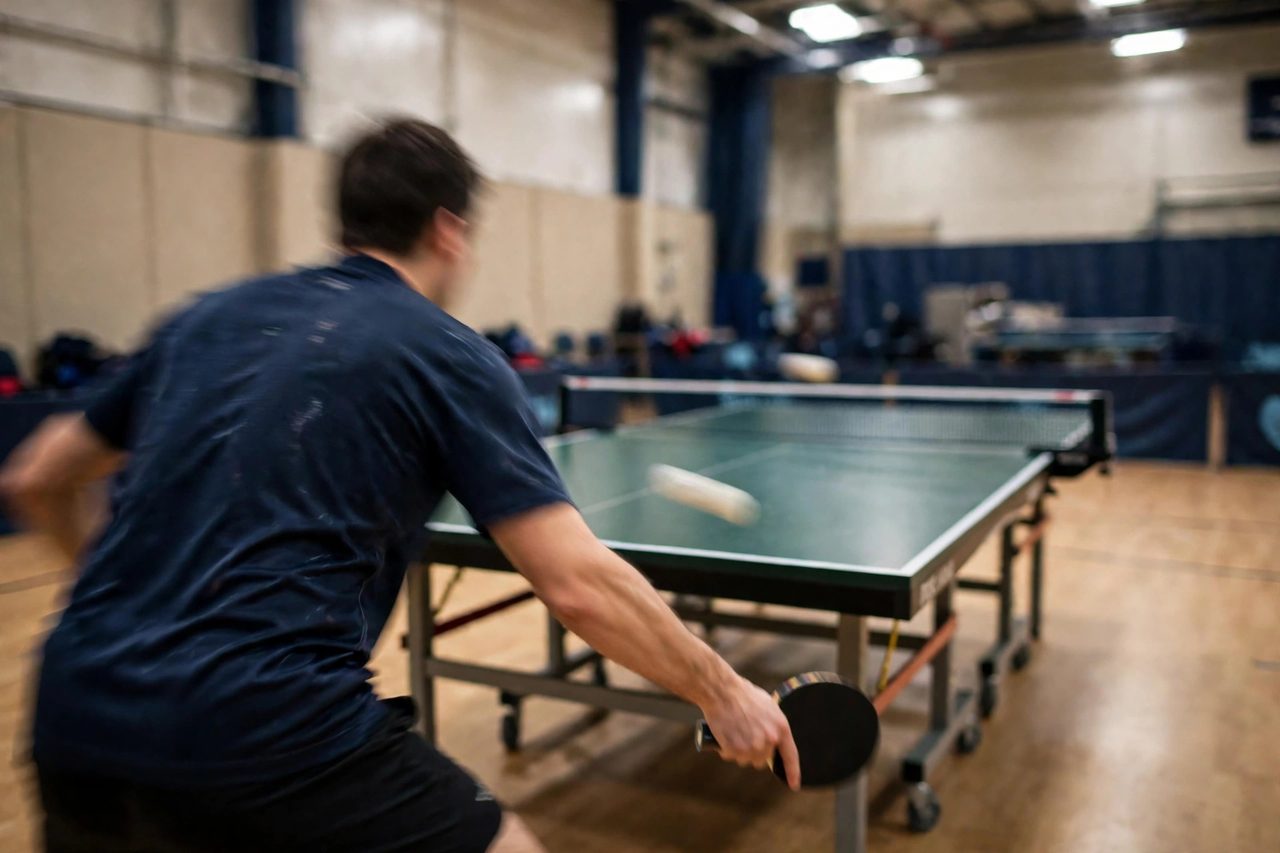
Watch a top table tennis match and you will see most players standing close to the table, hitting fast and flat. Then, every so often, someone steps back, takes a big swing down the back of the ball, and sends it floating back with so much spin that the attacker nets the next shot. That is the chop.
A chop is a defensive shot played with backspin. Backspin means the ball spins backwards as it flies, so when it bounces on your opponent’s side, it grips the table and stays low, and when your opponent hits it, the spin drags their racquet down. Get it right and even the hardest attacker starts missing.
Choppers are rare at the top level, but the chop is a shot every player should understand. It teaches you timing, spin and patience, and it is the best way to survive when someone is attacking you hard.
Step 1: step back and get low
The chop is played from well behind the table — two or three metres back, not close in. You need space because the ball is coming at you fast, and you need time to swing.
Stand with your feet wide apart, knees bent, and your weight slightly forward. Staying low matters: a chop hit from a tall, stiff position will float long. Think of it like sitting into the shot.
Step 2: open the racquet and brush down the back of the ball
This is the heart of the shot. Hold your racquet with the face open — tilted back, like a small ramp facing the sky. As the ball arrives, swing down and forward, brushing the bottom half of the back of the ball.
Do not hit through the ball. The word “brush” is the key: you want the rubber to grip the ball and drag down its back, creating spin, rather than smacking it flat. A good chop feels like you are peeling the ball downwards.
Contact should happen slightly below the top of the bounce, as the ball is starting to fall. Too early and you will drive it into the net. Too late and it will sail long.
Step 3: use your whole body
A chop is not an arm shot. Start the swing with your racquet high, turn your shoulders, and let your legs and waist drive the motion. Your arm finishes low, pointing towards the floor in front of you.
The swing is long and smooth, almost like a golf swing in slow motion. Beginners often chop with a short, jabbing motion, and the ball dies in the net. Give the swing room and let the spin do the work.
Step 4: vary it
A chop that always looks the same is easy to attack. The best choppers mix three things:
- Depth. Sometimes chop deep to the corners, sometimes drop one short. An attacker hates changing distance.
- Spin. Sometimes brush hard for heavy backspin, sometimes brush less so the ball comes back with almost no spin. The “float” ball — a chop with very little spin — is the trickiest of all, because your opponent expects backspin and lifts the ball straight into the net or off the end.
- Placement. Chop mostly to your opponent’s weaker side, usually the backhand, and save the wide forehand chop for when they are out of position.
The mistakes everyone makes
The classic beginner error is chopping too close to the table. From there, you have no time, and the ball goes into the net. Step back. The second error is hitting the ball instead of brushing it — a flat contact kills the spin and sends the ball long. The third is standing up straight. Bend your knees, every single time.
A drill to start with
Find a partner and ask them to loop — to hit heavy topspin balls — at you from mid-distance. Topspin is the opposite of backspin: the ball spins forwards, dips sharply, and kicks up off the table. Your job is simply to chop every ball back on the table, ten in a row. Do not worry about winning the point. Just feel the brush, feel the ball grip the rubber, and watch how it floats back.
Once you can do ten in a row, try the variation game: chop two heavy, one float, and see if your partner can tell the difference. When they start missing, you will understand why defenders, even in a sport built for attackers, never truly go away.
Related articles
The Forehand Block: How to Turn Defence Into Attack in Table Tennis, Step by Step
A fast ball is coming at you and you have no time to swing. The forehand block is the answer: a short, firm return that uses your opponent's speed against them.
The Squash Serve: How to Start Every Rally With an Advantage, Step by Step
The serve is the one shot in squash you fully control. Here is how it works: the rules, the lob serve, the hard low serve, where to aim, and the drills that make it reliable.
The Squash Cross-Court: How to Stretch Your Opponent and Open the Court, Step by Step
The cross-court sends the ball diagonally across the court and drags your opponent out of position. Here's when to use it, how to hit it, and the drills that make it reliable.