
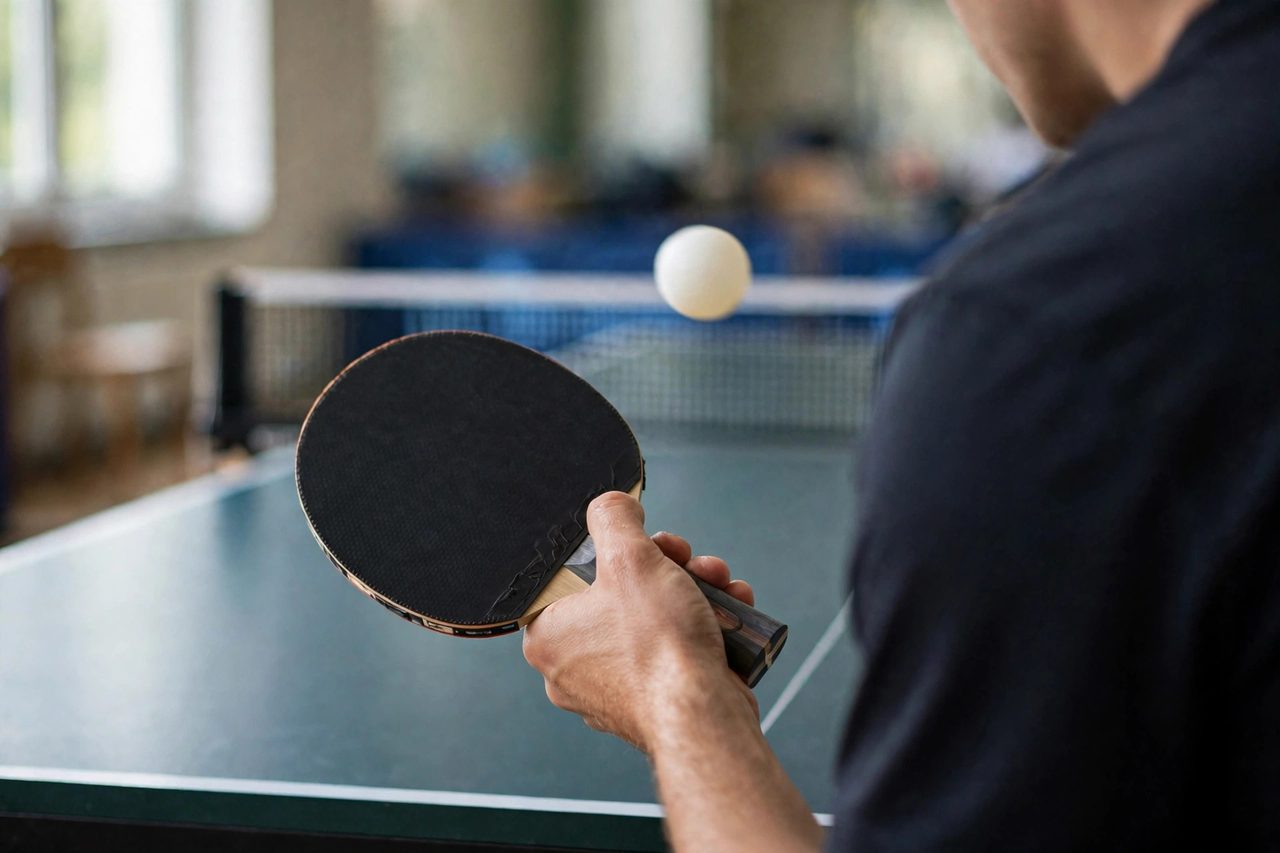
Your opponent has just smashed a fast topspin ball at you. You have a fraction of a second to react — no time for a big swing. This is when the forehand block saves you.
First, what is a block? A block is a short, firm return against a fast attacking ball. Instead of swinging, you hold your bat steady and let the ball bounce off it. Topspin is when the ball rotates forward, top over bottom, which makes it dip, then jump forward after the bounce. A forehand block is played on the same side of your body as your bat hand — for a right-handed player, that is the right side. The clever part: you use your opponent’s speed. They give you the power. You just send it back.
When to use it
Use the block when a fast ball is coming at your forehand side and you are close to the table. It works best against a loop. A loop is an attacking shot that brushes up the back of the ball to create heavy topspin. When someone loops at you, a block is the simplest, calmest answer.
Do not use it against a slow, high ball — that is an invitation to attack with your own loop or smash. And do not step back to block. The block is a close-to-the-table shot. If you drift back, the ball drops low and the block stops working.
Step 1: Get your stance right
Stand close to the table, about an arm’s length away. Your feet should be a little wider than your shoulders, knees bent, weight on the balls of your feet. Lean forward slightly from your waist, ready to move in any direction.
Hold your bat up in front of your body, roughly at chest height, on your forehand side, elbow relaxed. This is your ready position. From here, the block is a tiny movement, not a big one.
Step 2: Set the bat angle
Bat angle is the secret of a good block. Against topspin, close your bat face slightly. A closed bat face means the top of the bat tilts forward, pointing a little down towards the table. This stops the ball from flying up and off the end of the table, which is what topspin wants it to do.
How closed? Against a very fast, spinny loop, close the bat a bit more. Against a slower topspin ball, keep the bat more upright. Start with a slight tilt and adjust by feel.
Step 3: The small push forward
Here is the shot itself. As the ball comes towards you, meet it just after the bounce, while it is still rising or at the top. This is called taking the ball early: it gives your opponent less time to recover and keeps you in control of the rally.
Push your bat forward a short distance — about 15 centimetres, no more — and slightly down. That is it. No big backswing, no full swing. Your forearm does the work, wrist firm but not stiff. Think of it as a firm nudge, like closing a door with your hand.
The contact should feel solid and short. Ball into the net? Your bat was too closed, or you pushed down too much — open the bat a little. Ball flying long? Your bat was too open, or you pushed too hard — close it a little, or push less.
Step 4: Place it well
A block is not just about getting the ball back — where you put it matters. The easiest good placement is deep to your opponent’s backhand corner. Deep means near the end line, the white line at the far edge. A deep block is hard to attack, because your opponent has to play it from further back.
As you get more confident, try blocking down the line. Down the line means straight ahead, parallel to the side of the table, instead of diagonally across it. It can catch your opponent moving the wrong way. But keep it simple at first: deep and safe beats clever and wild.
Common mistakes
The first mistake is swinging too big. This is the most common one. The ball is already fast. You do not need to add power. A big swing also takes time you do not have. Keep the movement small.
The second mistake is blocking too late. If you wait until the ball is dropping, it is already too low. You end up lifting it, and it floats up for an easy smash. Take it early, just after the bounce.
The third mistake is a stiff arm. If your whole arm is tense, the ball bounces off the bat like it hit a wall. Stay relaxed: a firm wrist and a relaxed arm give you control and feel.
Three simple drills
Drill 1: Block, block, block. Ask a practice partner to loop the ball to your forehand, again and again, at a steady speed. Your only job is to block it back — not to win the point, just to keep it on the table. Ten in a row is a good first target.
Drill 2: Block to a corner. Same as drill 1, but aim every block deep to your partner’s backhand corner. Try to land the ball near a small target there, like a coin.
Drill 3: Block, then attack. Your partner loops to your forehand. You block it back. If they loop again, block again. But the moment they give you a slower or higher ball, attack it with your own loop or smash. This is the real skill: knowing when to block and when to switch to attack. The block buys you time until that chance comes.
The forehand block looks boring next to a big loop or a smash. It is not — it is the shot that keeps you in the rally when your opponent is trying to finish it. Learn it, and fast balls stop scaring you — they start becoming chances.
Related articles

The Squash Serve: How to Start Every Rally With an Advantage, Step by Step
The serve is the one shot in squash you fully control. Here is how it works: the rules, the lob serve, the hard low serve, where to aim, and the drills that make it reliable.

The Squash Cross-Court: How to Stretch Your Opponent and Open the Court, Step by Step
The cross-court sends the ball diagonally across the court and drags your opponent out of position. Here's when to use it, how to hit it, and the drills that make it reliable.

The Short Push: Table Tennis's Quiet Short-Game Weapon, Step by Step
The short push keeps a short ball short and low so your opponent cannot attack it. Here is how to play it, step by step — grip, stance, reading the serve, soft contact, placement, and the drills that make it stick.