
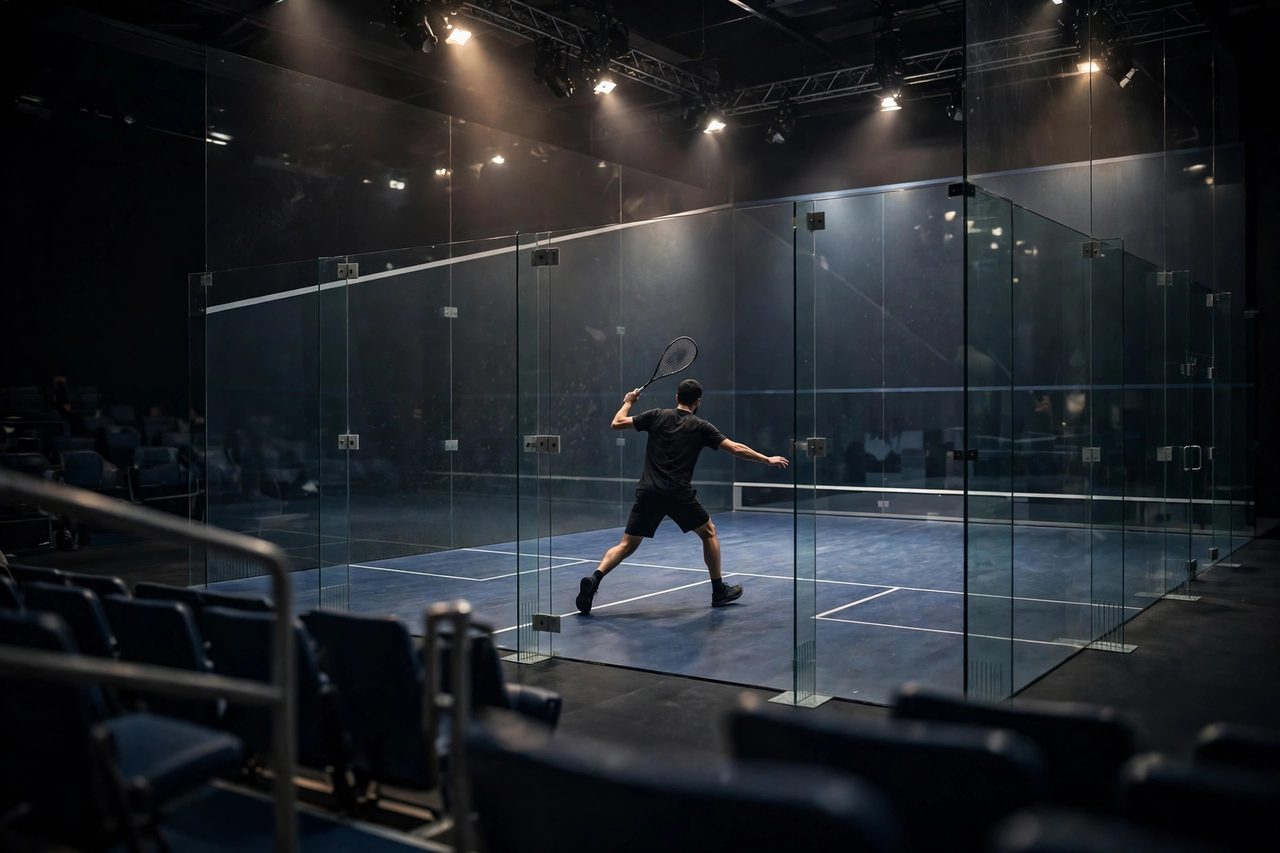
Saturday night at Squash Zone in Redwood City is finals night at the Silicon Valley Open, and both title matches carry a story worth staying up for. In the men’s final, France’s Victor Crouin returns to the scene of last year’s defeat, this time against 19-year-old Egyptian Mohamad Zakaria. In the women’s final, Malaysia’s Sivasangari Subramaniam hunts a first Silicon Valley title against Egypt’s Farida Mohamed, who has reached her first Gold-level final. The finals begin at 7pm local time, live on SQUASHTV.
This is a Gold event on the PSA Squash Tour — the tier below Platinum, worth 1,800 ranking points to each winner — and the week has already delivered its share of drama. The top seeds are gone, the home hopes are gone, and what remains are four players who earned their place the hard way: through five-game epics, straight-game statements, and one very long Friday night.
The men’s final: Crouin v Zakaria
Victor Crouin, the third seed, is back in the Silicon Valley final for a second successive year. Twelve months ago he left empty-handed. On Friday he made sure of a second chance, beating top seed and recent Egyptian Open champion Diego Elias 3-2 in 69 minutes: 11-3, 7-11, 4-11, 11-8, 11-3.
It was not pretty, and Crouin did not pretend otherwise. “It’s good to be in the final again,” he said afterwards. “Another tough one, going all the way to the fifth game. It definitely wasn’t the best squash from either of us, with a lot of stop-and-start play and arguments with the referee, but as always, I’m happy to find a way to get through.” That last line is the Crouin story in miniature: the Frenchman, the world No. 5, has made a career of finding ways through matches that refuse to flow.
Across the court stands the future — or at least a large part of it. Mohamad Zakaria, 19, the reigning World Junior Champion, dismantled fifth seed Mohamed Elshorbagy 3-0 in the semi-finals, 11-3, 11-7, 11-7 in just 44 minutes. Elshorbagy is a former world No. 1 and one of the most decorated players of his generation; Zakaria made him look ordinary. It is the Egyptian teenager’s second Gold event final, and the manner of the win — relentless, composed, utterly unbothered by the occasion — will have made every player in the draw take note.
The contrast is the draw. Crouin is the grinder, the tactician, the man who has been here before and knows exactly what last year felt like. Zakaria is the power and the pace, the junior champion stepping into the senior spotlight with nothing to lose. Crouin will try to slow the ball, to drag rallies into the corners, to make the teenager think. Zakaria will try to do what he did to Elshorbagy: hit through everything, early and hard, before the thinking starts.
The women’s final: Sivasangari v Farida Mohamed
The women’s final pairs the world No. 4 against the world No. 20, the returning finalist against the first-timer — and on Friday’s evidence, it is anything but a formality.
Sivasangari Subramaniam, the third seed, reached the final by ending the dream run of India’s 18-year-old Anahat Singh, winning 3-1 (5-11, 11-6, 11-4, 11-7) in 37 minutes. It was a rematch of the Aichi-Nagoya Asian Games final from last month, which Sivasangari also won, and it showed her at her most clinical: after dropping the first game, she took control of the middle of the court and never gave it back. She was last year’s runner-up here, beaten in the final by American Olivia Weaver, and she arrives in this final as the player with the most to correct.
Farida Mohamed’s route was the night’s great escape. The eighth seed beat home favourite Marina Stefanoni 3-2 — 11-3, 4-11, 11-6, 6-11, 11-8 in 49 minutes — to reach her maiden Gold event final, having already knocked out second seed Weaver in the quarter-finals. “It was a very tough one mentally, I would say,” Mohamed admitted. “I’m okay physically but mentally it took a lot. A lot was happening. I tried to stay composed. I lost my mind a little bit but I just reminded myself that staying composed was going to get me the win. So, I’m really proud of myself today.”
That composure will be tested again. Sivasangari’s game is built on length, width and patience — the classic Malaysian school, all accuracy and attrition. Mohamed, like so many of the Egyptian generation, attacks first and asks questions later. If she can impose her pace early, the final becomes a shootout. If Sivasangari settles into her rhythm, it becomes a war of attrition, and few players in the world win those against her.
What the finals will decide
Beyond the trophies, there is ranking currency at stake. A Gold title is worth 1,800 points — enough to reshape the edges of the top ten and, for Zakaria and Mohamed, to announce that their breakthroughs are not one-week stories. For Crouin, a win would be a third final of the season converted and a measure of revenge for last year. For Sivasangari, it would be a first Silicon Valley title to go with an Asian Games gold, and confirmation that she belongs in the conversation at the very top of the women’s game.
The week began with upsets — the defending men’s champion gone early, the top women’s seed gone in round two — and it ends with four finalists who survived all of it. Whatever happens on Saturday night in Redwood City, the Silicon Valley Open has already done what a Gold event is supposed to do: it has given the tour’s next generation a stage, and the next generation has taken it. Now, under the lights, comes the part that actually counts.
Related articles
Asal Survives a Wild Final to Win His First China Open as Sivasangari Takes the Title Without Playing
Mostafa Asal beat Mohamad Zakaria in a stop-start 108-minute final in Shanghai, while Sivasangari Subramaniam won the women's title after Satomi Watanabe fell ill.
Five Seeds Fall in One Wild Night at the China Open
Defending champion Mohamed Abouelghar lost 3-0 to world No. 56 Simon Herbert, former world No. 1 Mohamed ElShorbagy went out 3-0 too, and three more seeds fell on a chaotic second-round day at the China Open in Shanghai.
Makin Fights Back From Two Games Down to Keep His Pittsburgh Crown
Top seed Joel Makin lost the first two games of the Pittsburgh Open final, then won the next three to beat Marwan ElShorbagy 3-2 and defend his title.