
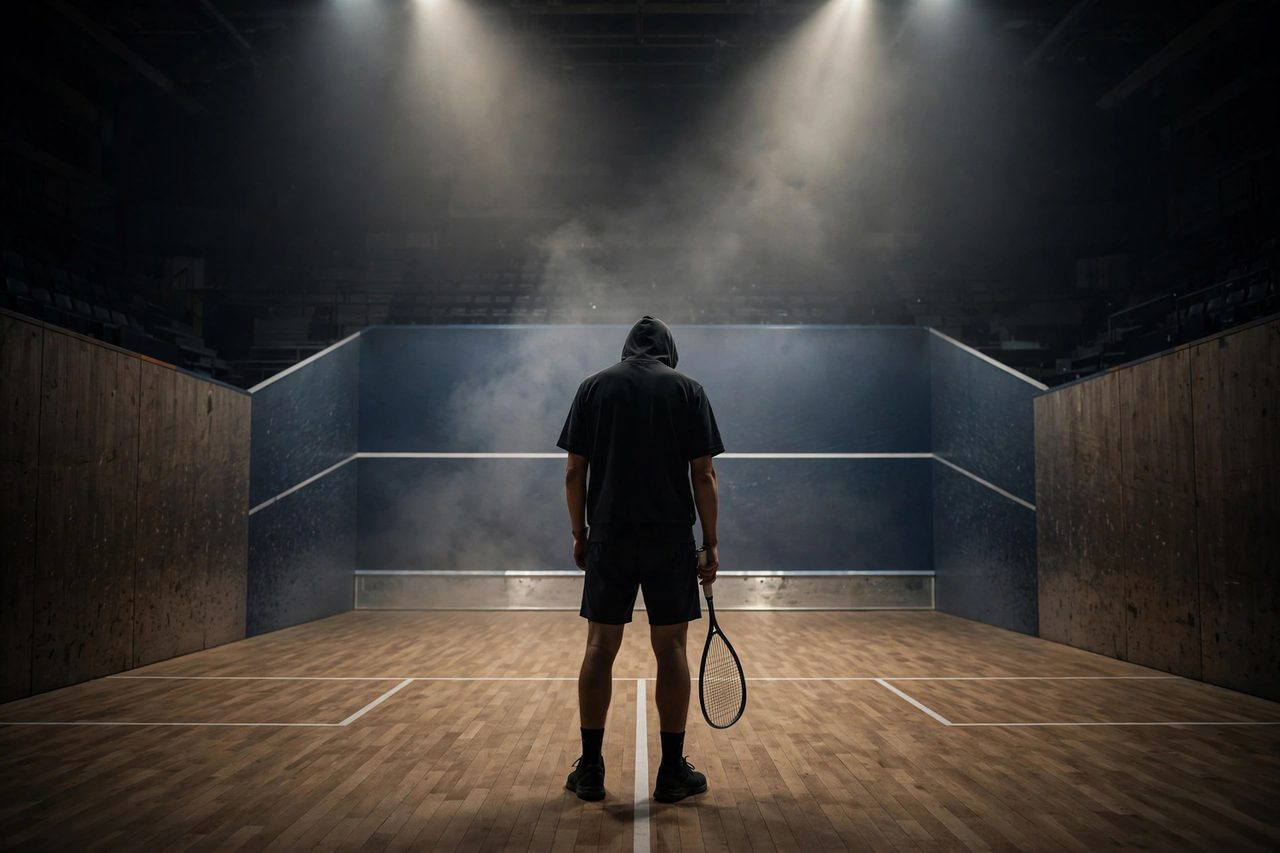
Every sport has a player its rivals love to lose to. In squash, for the best part of a decade, that player was Ali Farag.
Farag retired in May 2025, ranked world No. 2, less than two weeks after reaching his fifth World Championship final. He walked away with 46 tour titles, four world titles, and 238 weeks at world No. 1 — the fifth-longest reign at the top in men’s squash history. He won 445 of his 553 matches on tour and reached 81 finals. His fellow players voted him the winner of the PSA Spirit of Squash Award seven times.
The PSA is squash’s professional tour. The Spirit of Squash Award is voted for by the players themselves, and it goes to the player who best represents the sport’s values: fairness, respect, and grace under pressure. Winning it once is an honour. Winning it seven times tells you everything about how Farag played the game.
The engineer
Farag was born in Cairo on 22 April 1992. He grew up in Egypt’s squash system, but his path took an unusual turn: he went to Harvard University in the United States, where he studied mechanical engineering and graduated in 2014.
At Harvard, he was close to unbeatable. He won two individual national college titles and finished his college career with a 52-2 win-loss record. He also helped Harvard win its first team national title in 17 years in 2014. His coach at the time said he played “with the utmost fairness and integrity” and called him the best possible example of a No. 1 player.
That combination — an engineer’s brain and a champion’s game — shaped everything that followed. Farag did not overpower opponents. He out-thought them. He moved beautifully, rarely wasted energy, and seemed to always have one more option than the player across the court.
The champion
Farag’s first major title came at the 2017 US Open, on a night that made sporting history: his wife, fellow Egyptian star Nour El Tayeb, won the women’s title at the same event. They became the first married couple to win the men’s and women’s titles at the same major tournament on the same day. They repeated the feat at the 2023 Manchester Open, this time with their baby daughter Farida watching.
The world titles followed: Chicago in 2019, Chicago again in 2021, Cairo in 2022, and Chicago once more in 2023. Four world championships put him alongside Amr Shabana as one of only two Egyptian men to win the sport’s biggest prize four times.
Around those peaks, he collected nearly everything else: four Tournament of Champions titles in New York, three US Opens, three Qatar Classics, three Egyptian Opens, three El Gouna titles, the British Open in 2023, and the Tour Finals in 2024.
His nickname among fans was “Mr. Fantastic”, and it fit. He could stretch for balls that looked lost, then turn defence into attack in a single shot. His matches against Mostafa Asal, Mohamed ElShorbagy and Diego Elias defined an era of men’s squash.
The goodbye
Farag’s final season had a fitting shape. He reached the 2025 World Championship final in Chicago, losing to Asal, and then announced his retirement days later, on his own terms, at 33.
“I always knew this day would come and I knew it would be very emotional. And it is, but in a good way,” he said. “Squash has been my passion, my identity and my purpose for as long as I can remember, but there was always another part of me, a family man. Now I’m a husband and a father to two beautiful young girls. I’ve always believed in balance, and I feel like the balance has shifted now.”
The tributes that followed said the same thing in different ways. The head of the World Squash Federation said that “besides being one of the greatest players in the history of the sport, it is perhaps his grace on and off court that will be most fondly remembered.”
Squash is heading to the Olympics at Los Angeles 2028, and its new generation — Asal, Elias, Zakaria — is already fighting over the throne Farag left behind. They are faster, louder, and more explosive than he ever was. But none of them has yet matched the standard he set for how a champion carries himself. That is why, even in retirement, Ali Farag remains the measuring stick.
Related articles
Squash's New Guard: The Young Players Rewriting the Sport's Old Order
Five seeds fell in a single day in Shanghai. A 19-year-old is already world No. 5. An 18-year-old just beat an eight-time world champion. Squash has a new guard — and it is not waiting its turn.
Ma Long: The Dragon Who Ruled Table Tennis for Fifteen Years
Six Olympic golds, three world singles titles, 64 months at world No. 1 — Ma Long is the greatest men's table tennis player ever. This is the story of the Dragon, and what comes after him.
Hugo Calderano: The Brazilian Who Broke Table Tennis's Old Map
World No. 2 in February 2026, World Cup champion in 2025, Olympic semifinalist in Paris — Hugo Calderano is the greatest player the Americas has ever produced, and he did it from a sport his continent barely played.