
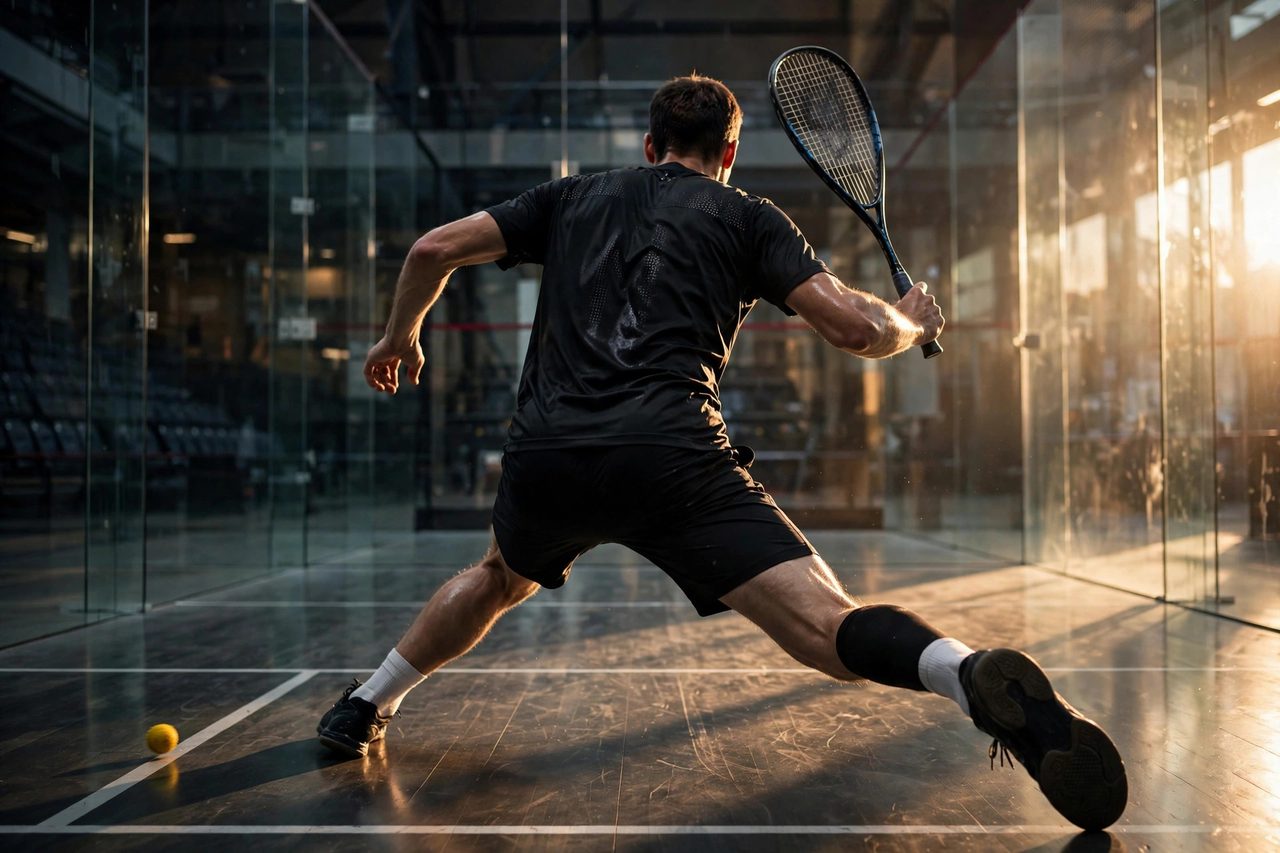
Squash has always been ruled by a small club of countries: Egypt, England, France, Australia, Pakistan. Peru was never part of that story. Then Diego Elías came along, and the story changed.
Elías, born in Lima on November 19, 1996, is the first South American ever to reach world No. 1 in squash, and the first to win the World Championship. In a sport where the top of the rankings has belonged almost entirely to Egyptians and Europeans for decades, that is not a small thing. It is a door kicked open.
A kid from Lima
Elías grew up in a country where football is king and squash courts are rare. His father, José Manuel Elías, was a squash player and coach himself, and he put a racquet in his son’s hand early. The young Diego was good, fast. Very fast.
The junior results piled up: he won the World Junior Championship twice, the British Junior Open twice, and the US Junior Open at under-15, under-17 and under-19 level. A “junior” title means an age-group world or national title for players under 19. Winning one is a big deal. Winning that many is a sign.
But junior success does not always turn into senior success. Plenty of teenage stars fade. Elías did the opposite. He got better, year after year, in a steady climb rather than a sudden explosion.
The climb
His first big senior title came in October 2021, when he won the Qatar Classic in Doha. The Qatar Classic is a Platinum event, the top tier of the PSA Squash Tour. A Platinum title means beating the best players in the world across a full week. It was his announcement: he was not just a promising junior anymore.
In 2022 he added the US Open title in Philadelphia, another of the sport’s great prizes. In January 2023 he won the Tournament of Champions in New York, one of squash’s most famous stages, played in the glass court inside Grand Central Terminal. Three months later, in April 2023, he reached world No. 1.
No South American had ever done that before. Not in squash. It was the kind of milestone that changes what kids in Lima think is possible.
World champion
The biggest prize of all came in June 2024, at the World Championship in Chicago. Elías beat defending champion Ali Farag of Egypt in a five-game final: 11-9, 7-11, 11-8, 6-11, 11-6. Farag is one of the greats of the modern game, a four-time world champion. Beating him in a final, over five games, is about as hard as squash gets.
Elías’s game is built on physical power and tactical intelligence. He is tall, strong, and he moves beautifully for a big man. He can hit the ball hard, but his real gift is patience: he is happy to rally long, wait for the right ball, and then strike. His nickname among fans is “the Peruvian Puma,” though he is far too calm on court for the animal to fit perfectly. He wins matches by thinking, not by roaring.
Still hungry
Elías is not a finished story. In June 2025 he won the British Open, beating world No. 1 Mostafa Asal in the final. The British Open is the sport’s oldest and most respected tournament, first played in the 1930s. Winning it put his name on a trophy that carries the whole history of the game.
He reached the semi-finals of the 2026 World Championship in May, and he was the top seed at last week’s Silicon Valley Open, where he lost a five-game semi-final to France’s Victor Crouin. That loss stung — Crouin went on to lose the final — but it also showed where Elías stands: still in every big conversation, still a threat to win any tournament he enters.
Off court, Elías has made Toronto his second home. He has trained there for years, working with Canadian squash legend Jonathon Power, and he is a regular at the city’s National Squash Academy. It is a long way from Lima, but so is the top of the world rankings.
Why he matters
Every sport needs a player who breaks the map. Before Elías, a kid in Peru dreaming of squash’s top spot was dreaming of something nobody from his continent had ever done. Now it has been done, twice over: world No. 1, and world champion.
Elías did not just open a door for himself. He showed a whole continent that the door exists. The next Peruvian star, and the next South American one, will grow up knowing it is possible — because Diego Elías already did it.
Related articles
Squash's New Guard: The Young Players Rewriting the Sport's Old Order
Five seeds fell in a single day in Shanghai. A 19-year-old is already world No. 5. An 18-year-old just beat an eight-time world champion. Squash has a new guard — and it is not waiting its turn.
Ma Long: The Dragon Who Ruled Table Tennis for Fifteen Years
Six Olympic golds, three world singles titles, 64 months at world No. 1 — Ma Long is the greatest men's table tennis player ever. This is the story of the Dragon, and what comes after him.
Hugo Calderano: The Brazilian Who Broke Table Tennis's Old Map
World No. 2 in February 2026, World Cup champion in 2025, Olympic semifinalist in Paris — Hugo Calderano is the greatest player the Americas has ever produced, and he did it from a sport his continent barely played.