
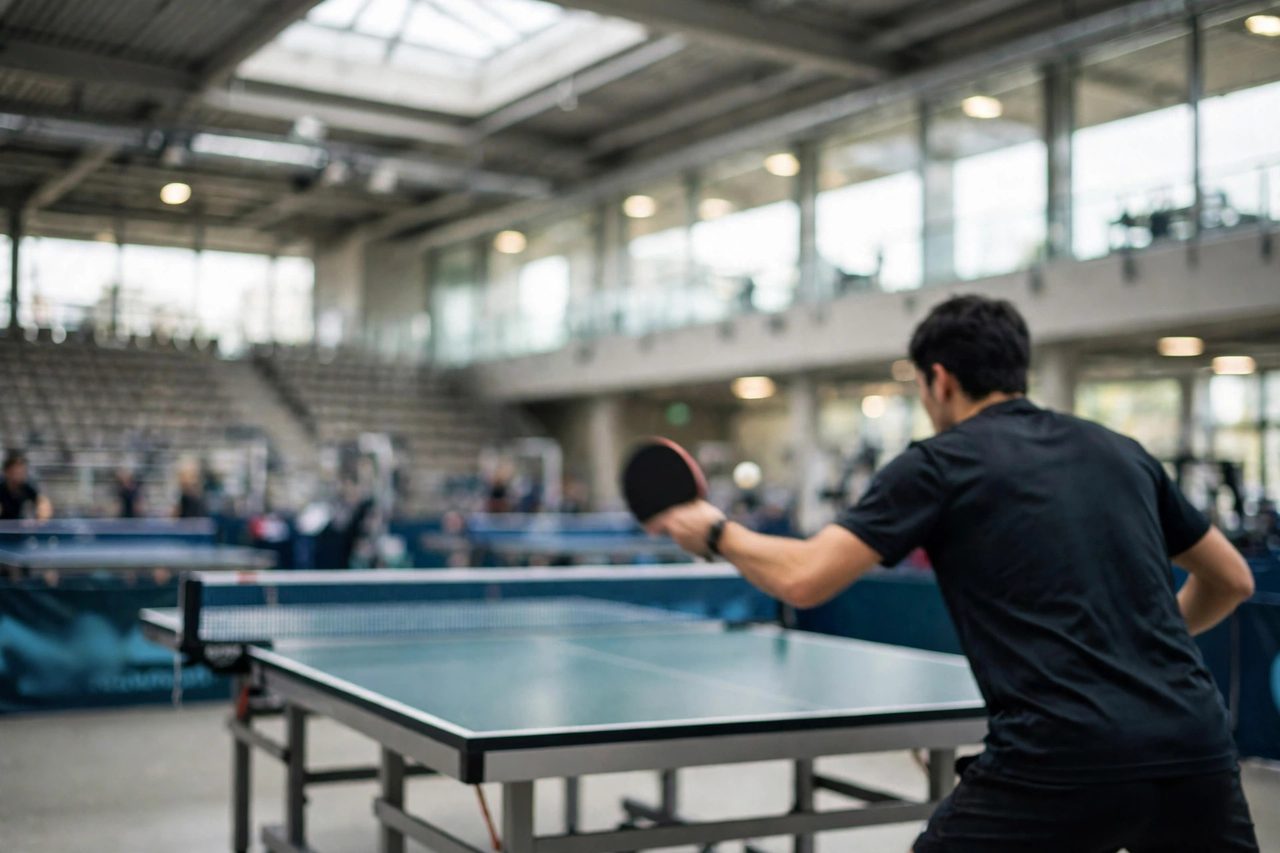
Some players chase one big title their whole career. Fan Zhendong has won all of them.
The Chinese star is the Olympic champion, a two-time world champion and a four-time World Cup winner. In Paris in 2024, he completed the set. That put him in one of the smallest clubs in sport.
And yet, in 2026, he is not sitting at the top of the world rankings. He is not even on them. He walked away from the ranking list — and went to play club table tennis in Germany instead. This is the story of a player who won everything, then chose a different path.
The Grand Slam
In table tennis, a Grand Slam means winning the three biggest singles titles: the Olympic Games, the World Championships and the World Cup. Only eleven players in the history of the sport have done it.
Fan completed his on 4 August 2024. He beat Sweden’s Truls Möregårdh 4-1 in the Olympic final in Paris to win the singles gold. He became the sixth man — and the eleventh player overall — to complete the Grand Slam.
He had been building towards that moment for years. He won his first World Cup in 2016, when he was 19. He added three more, in 2018, 2019 and 2020. Then came the World Championships: Houston in 2021, Durban in 2023.
The Olympic gold was the missing piece. At the Tokyo Games in 2021, he had taken silver in the singles and gold with the Chinese team. In Paris, he finally won the singles title — and added another team gold too. That gave him three Olympic gold medals in total.
The kid who was always next
Fan was born on 22 January 1997 in Guangzhou, in southern China. He joined the Chinese national team at 15, one of the youngest players ever to make the squad. Fans nicknamed him “Xiao Pang”, which means “Little Fatty”.
For years, he was the next big thing in a team full of legends. His biggest rival was his own teammate, Ma Long. Ma Long is the greatest men’s player the sport has seen, with two Olympic singles golds of his own. Fan lost big finals to him more than once.
But Fan kept coming. In April 2018, at 21, he became the youngest man ever to reach world No. 1. He stayed at or near the top for years after that.
How he plays
Fan plays right-handed with a shakehand grip. That means he holds the bat the way you would shake someone’s hand — the most common grip in the sport.
His game is built on attack from both sides. Most players have one strong wing and one weaker one. Fan hits hard from his forehand and his backhand, and he moves so fast that opponents rarely get a quiet ball.
His main weapon is topspin. That is a shot where the ball spins forwards as it flies, so it dips down fast and kicks up off the table. Fan’s topspin is heavy, fast and relentless. He uses it to take control of the rally early, then keeps the pressure on until his opponent makes a mistake.
It is a simple plan, and it is very hard to stop.
Walking away from the rankings
In December 2024, a few months after his Olympic gold, Fan made a surprising announcement. He was withdrawing from the world rankings.
He was not retiring. The problem was the tour’s rules. WTT, the body that runs the professional tour, asks top players to play a set number of events each year. If they skip events without an approved medical reason, they face fines and zero points.
Fan said he could not accept that system. He stepped off the ranking list rather than pay fines for missing events. His teammate Chen Meng, the women’s Olympic champion, did the same. So did Ma Long.
It was a strange sight: the reigning Olympic champion, with no ranking at all.
A new life in Germany
Instead of chasing tour events, Fan went to Germany. For the 2025-26 season he joined 1. FC Saarbrücken, in the Bundesliga — Germany’s top league, one of the strongest club leagues in the world.
It worked. Saarbrücken won the German Cup, the Champions League and the German league title. Fan was voted the league’s Player of the Season, with 94 percent of the vote, after a 20-3 record in league matches.
In July 2026 he moved to Borussia Düsseldorf, Germany’s most famous table tennis club, on a one-year contract. He started the new season in fine form, winning his first eight Bundesliga singles matches. He missed part of the autumn, then returned on 15 November — and took his first league defeat of the season a week later, on 22 November, against Eduard Ionescu.
It is a very different life from the one he had in China. Club table tennis means team matches, small halls and a regular weekly rhythm. For a player who spent a decade under the brightest lights in the sport, it looks like a fresh start.
Where does he stand?
At 29, Fan Zhendong has nothing left to prove. He has the Olympic gold, the world titles and the World Cups. He has been world No. 1. He has beaten the best players of his generation.
The question now is what he wants next. A return to the world tour would mean rejoining the ranking system he walked away from. Staying in Germany means team titles, big crowds and a calmer schedule.
Either way, his place is secure. Table tennis has had faster players and flashier players. Few have been as complete. Fan Zhendong could do everything — attack from both sides, defend when he had to, and win the biggest match of his life when it mattered most.
He won it all. Now he gets to choose what comes next.
Related articles
Squash's New Guard: The Young Players Rewriting the Sport's Old Order
Five seeds fell in a single day in Shanghai. A 19-year-old is already world No. 5. An 18-year-old just beat an eight-time world champion. Squash has a new guard — and it is not waiting its turn.
Ma Long: The Dragon Who Ruled Table Tennis for Fifteen Years
Six Olympic golds, three world singles titles, 64 months at world No. 1 — Ma Long is the greatest men's table tennis player ever. This is the story of the Dragon, and what comes after him.
Hugo Calderano: The Brazilian Who Broke Table Tennis's Old Map
World No. 2 in February 2026, World Cup champion in 2025, Olympic semifinalist in Paris — Hugo Calderano is the greatest player the Americas has ever produced, and he did it from a sport his continent barely played.