
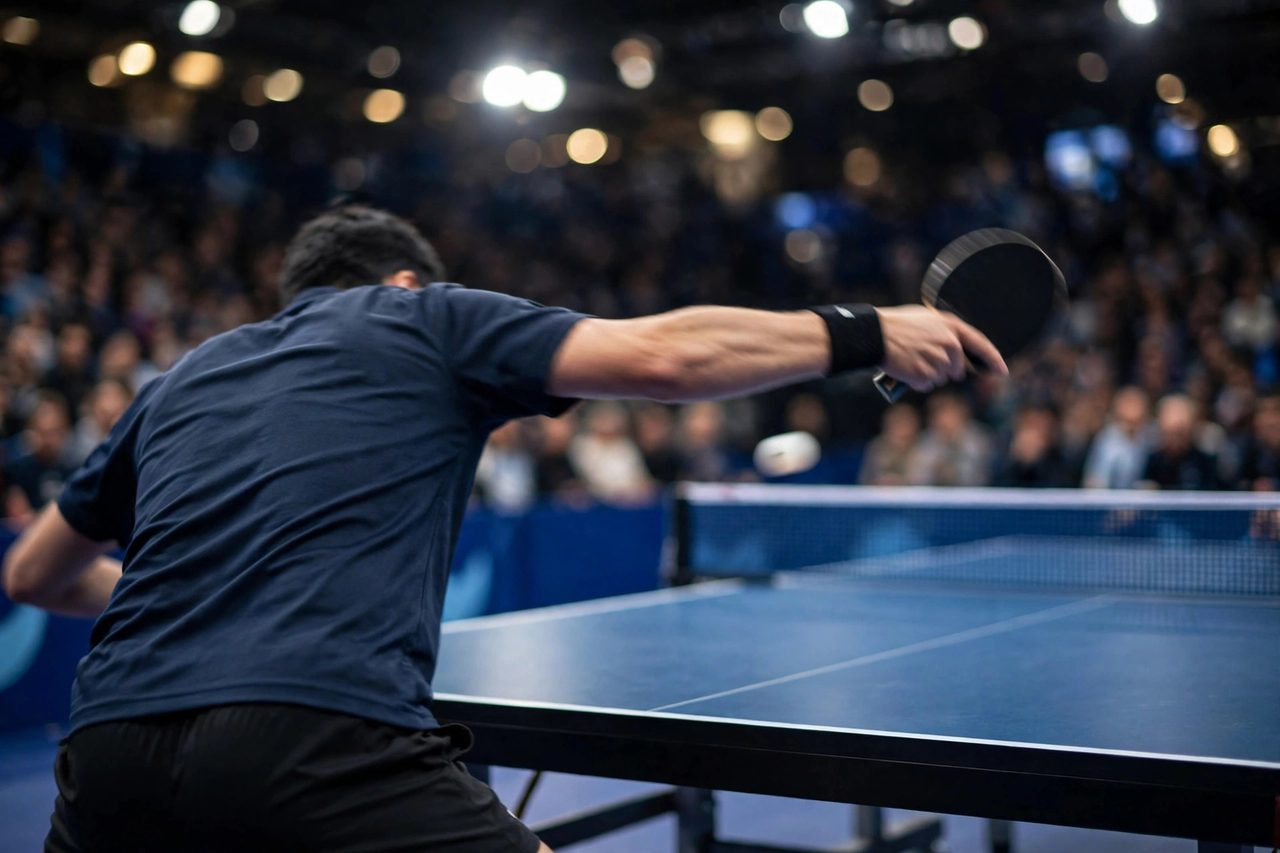
For most of table tennis history, the top of the sport belonged to two places: Asia and Europe. Then came Hugo Calderano, a kid from Rio de Janeiro who decided that map was wrong.
Today Calderano sits at world No. 7. Earlier this year, in February 2026, he climbed to world No. 2 — the highest ranking any player from the Americas has ever reached. He is a World Cup champion, a World Championships silver medallist, and the first player from the Americas to reach an Olympic semifinal. No Brazilian, no South American, nobody from his whole continent had ever done any of that before.
The kid from Rio
Hugo Marinho Borges Calderano was born on June 22, 1996, in Rio de Janeiro, into a family of physical education teachers. He picked up a racquet at eight years old. By 14, he had already outgrown what Rio could offer him, so he left home for São Caetano do Sul, near São Paulo, to train full-time with the Brazilian national team.
The rise was fast. In 2013, still a teenager, he became the youngest player ever to win a leg of the ITTF World Tour — the old global circuit that came before today’s WTT tour — and the first player to win singles titles on both the junior circuit and the senior World Tour in the same year. A year later he took bronze at the Youth Olympic Games in Nanjing, China.
At 18 he made the move so many young players from outside the sport’s heartlands have to make: he crossed the Atlantic to play club table tennis in Germany, joining Ochsenhausen in the Bundesliga, Germany’s top league, where he played from 2014 to 2021 and returned in 2023.
How he plays
Calderano is right-handed and uses a shakehand grip. That just means he holds the racquet the way you would shake someone’s hand — the most common grip in the sport, and the one that lets him attack hard from both sides.
And attack he does. His game is built on power. His forehand loop — a fast, heavy topspin shot that arcs over the net and dives onto the table — is one of the most feared in the men’s game. Where many top attackers crowd the table, Calderano is happy to step back and work from mid-distance, giving himself a split second more to load up that forehand. He also has a high-toss serve, throwing the ball high before striking it, which helps him start points on the attack.
It is a style built for big occasions. When the rallies get long and the pressure rises, Calderano does not back off. He swings harder. That mindset carried him through the week that changed everything.
The week that changed everything
April 2025, Macao, the ITTF Men’s World Cup. To win it, Calderano had to beat the three best players on the planet, one after another. In the quarterfinal he beat Japan’s Tomokazu Harimoto, then world No. 3, 4-1. In the semifinal he came back from 3-1 down to beat China’s Wang Chuqin, then world No. 2, 4-3. In the final he beat China’s Lin Shidong, then world No. 1, 4-1.
He became the first player from outside Asia and Europe ever to win the World Cup, and the first non-Chinese winner since 2017. A month later, at the World Championships in Doha, he went one better in a different way: beating China’s Liang Jingkun in the semifinal to become the first player from outside Asia and Europe to reach a World Championships final. He took silver, losing the final to Wang Chuqin.
Add Paris 2024, where he finished fourth after becoming the first player from the Americas to reach an Olympic semifinal, and you get a player who kept breaking barriers that had stood for decades.
The 2026 season
This year has kept the story going. In February, Calderano won the ITTF-Americas Cup in San Francisco, beating America’s Kanak Jha 4-1 in the final — his 17th continental singles title since 2014. That same month, he and Bruna Takahashi became the first non-Chinese pair to win a Grand Smash mixed doubles title, beating the world No. 1 pair, South Korea’s Lim Jonghoon and Shin Yubin, in the Singapore Smash final. A Grand Smash is the biggest tier of event on the WTT tour, the sport’s main professional circuit.
In April he was back on the World Cup podium in Macao, taking bronze as the only non-Asian medallist. In July he won the WTT Star Contender in São José dos Campos in Brazil — his third straight WTT singles title on home soil — and added a mixed doubles silver with Takahashi. By July the pair had climbed to world No. 2 in mixed doubles.
September brought a fourth final of the season at WTT Champions Macao, where he lost 4-1 to Sweden’s Truls Möregårdh. October brought a semifinal at the China Smash in Beijing, beating France’s Félix Lebrun 4-1 before losing 4-3 to Chinese Taipei’s Lin Yun-ju. And days ago, at WTT Champions Montpellier, he reached another semifinal, losing 4-3 to South Korea’s Jang Woo-jin on November 1. In October he also claimed his seventh Pan American Championships singles title in Lima — his 18th individual continental title since 2014.
Why he matters
Calderano matters for a reason bigger than his trophy cabinet. For most of its history, the elite of this sport has been narrow: a handful of Asian and European countries. A Brazilian at world No. 2 changes what a kid in Rio, or Lagos, or Lima, thinks is possible.
At 30, Calderano is no longer the teenage prodigy. He is the veteran standard-bearer of a whole continent, still ranked in the world’s top 10, still reaching finals, still swinging hard. The map of table tennis looks different because of him. And he is not done redrawing it yet.
Profile data via Hugo Calderano’s official site and ITTF/WTT records
Related articles
Squash's New Guard: The Young Players Rewriting the Sport's Old Order
Five seeds fell in a single day in Shanghai. A 19-year-old is already world No. 5. An 18-year-old just beat an eight-time world champion. Squash has a new guard — and it is not waiting its turn.
Ma Long: The Dragon Who Ruled Table Tennis for Fifteen Years
Six Olympic golds, three world singles titles, 64 months at world No. 1 — Ma Long is the greatest men's table tennis player ever. This is the story of the Dragon, and what comes after him.
Félix Lebrun: France's Table Tennis Star Is Still Only Getting Started
Félix Lebrun is 20, world No. 2, an Olympic bronze medallist and now the European singles champion. The scary part for his rivals is how much better he can still get.