
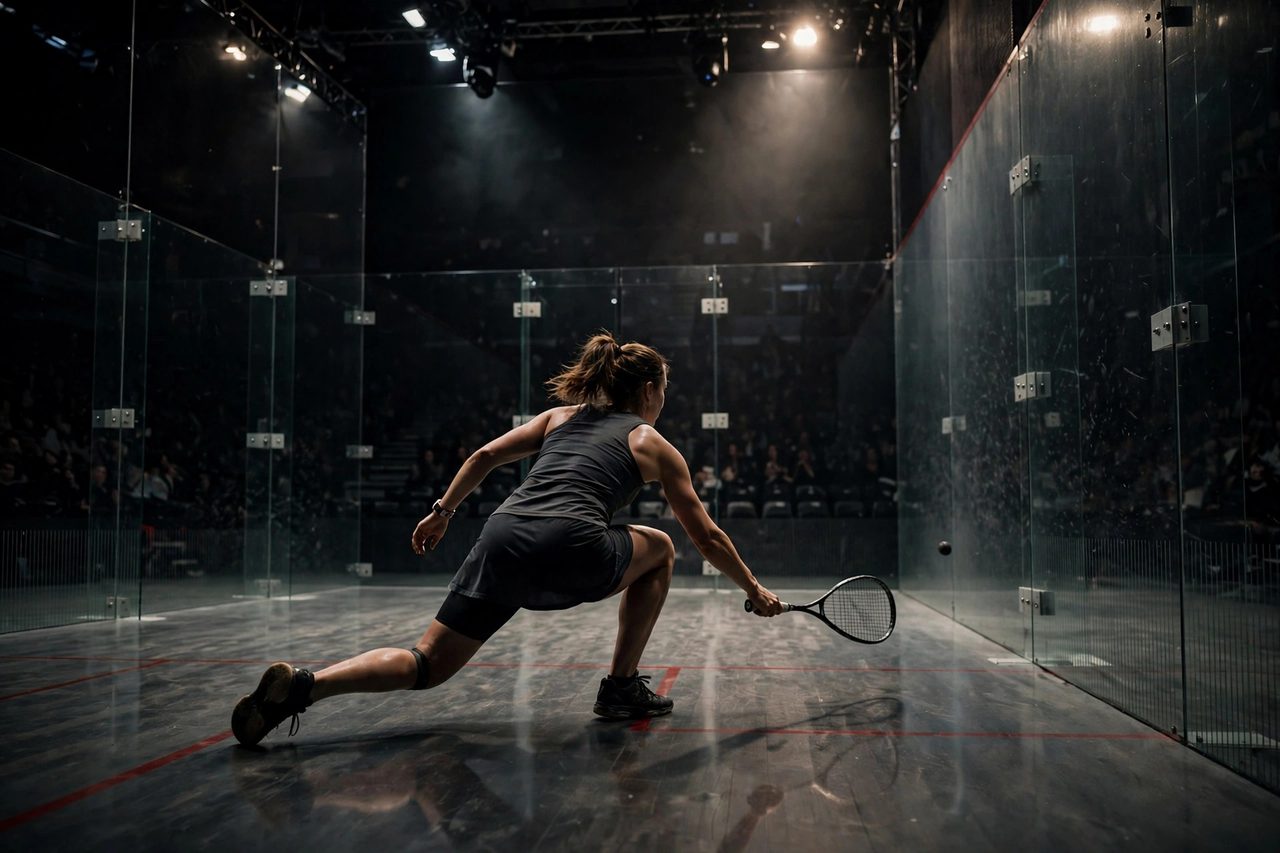
This week, Nour El Sherbini lost 3-0 to a teenager. Anahat Singh, 18, beat the eight-time world champion in straight games (11-8, 11-8, 11-7) in the second round of the Silicon Valley Open, in just 30 minutes. Eight days earlier, El Sherbini had gone out of the Egyptian Open quarter-finals, 3-1 to compatriot Nouran Gohar.
For most players, two defeats would be a footnote. For El Sherbini, they raise a question the sport has been avoiding: how much longer does the queen reign?
The record
The numbers need no embellishment. El Sherbini has won the World Championship eight times — in 2015, 2016, 2018-19, 2019-20, 2020-21, 2022, 2023 and 2025 — tying Nicol David’s all-time record. She has contested ten consecutive world finals. She has spent years as world No. 1, first reaching the summit in 2020, and collected more than 40 PSA titles along the way. With Egypt, she has won five World Team Championship golds.
Born in Alexandria in 1995 and turned professional in 2009 at the age of 14, she grew up inside the Egyptian machine that has defined modern squash — and became its most decorated product. Her nickname, “The Warrior Princess,” fits the game: ferocious competitor, impossibly smooth mover, a player whose racquet seems to find angles the court shouldn’t allow.
The eighth world title, won in Chicago in 2025 against Hania El Hammamy (11-5, 11-9, 4-11, 11-7), felt like the coronation of a career. Ten straight finals. Level with David. At 29, she looked like she could keep going indefinitely.
The game
What made El Sherbini different was never just the winning — it was the completeness. She volleys as well as anyone who has played the women’s game, takes the ball impossibly early, and constructs rallies with a chess player’s patience before striking with a sprinter’s violence. Against her at her best, opponents described the same sensation: the court shrinking, the options disappearing, the match slipping away in straight games that felt closer than they were.
That aura is precisely what made the Singh defeat so startling. Straight-game losses to teenagers don’t happen to El Sherbini. The Indian teenager controlled the pace, refused to be bullied, and never let the Egyptian play the match on her terms — the exact formula, inverted, that El Sherbini has used on a generation of opponents.
The challengers
The timing is uncomfortable. Egyptian squash is producing its next wave exactly as its greatest champion enters her thirties. Nouran Gohar, already a fixture at the top, beat her in Giza. Hania El Hammamy took her to four games in a world final and keeps improving. And now Singh — not Egyptian at all — has shown that the blueprint for beating El Sherbini exists and can be executed by an 18-year-old.
Add the calendar: squash makes its Olympic debut at Los Angeles 2028, and the qualification race is already shaping the season’s psychology. Every result is now read through the lens of LA. A champion of El Sherbini’s stature will want to be at those Games — but the road there runs through players who no longer fear her.
A difficult autumn
The Silicon Valley defeat didn’t come out of nowhere. El Sherbini’s autumn has been bumpy: she lost the 2026 World Championship final in Giza, then went out of the Egyptian Open quarter-finals to Gohar in four games. Three significant setbacks in quick succession is unfamiliar territory for a player whose career has been defined by winning the matches that matter most.
None of this means the end — champions of her calibre have rebuilt from worse. But it does mean the aura of inevitability, the sense that El Sherbini simply doesn’t lose these matches, has cracked. And in a sport as psychological as squash, that matters almost as much as the results themselves.
What history says
Great champions get asked this question eventually, and the honest answer is always the same: nobody knows. El Sherbini has reinvented her game before — she has survived injuries, form dips and the arrival of younger rivals, and responded by winning more world titles. Her movement, her reading of the game and her big-match temperament don’t vanish overnight.
But the sport’s arithmetic is unforgiving. At 30, every season brings a new 18-year-old with nothing to lose and everything to prove. Singh was simply the first to make the statement in straight games.
El Sherbini’s legacy is beyond debate: eight world titles, a record tied, a decade defining the women’s game. The only question left is whether the next chapter is one more coronation — or the beginning of the handover. The answer, as always with the Warrior Princess, will come on court.
Related articles
Squash's New Guard: The Young Players Rewriting the Sport's Old Order
Five seeds fell in a single day in Shanghai. A 19-year-old is already world No. 5. An 18-year-old just beat an eight-time world champion. Squash has a new guard — and it is not waiting its turn.
Ma Long: The Dragon Who Ruled Table Tennis for Fifteen Years
Six Olympic golds, three world singles titles, 64 months at world No. 1 — Ma Long is the greatest men's table tennis player ever. This is the story of the Dragon, and what comes after him.
Hugo Calderano: The Brazilian Who Broke Table Tennis's Old Map
World No. 2 in February 2026, World Cup champion in 2025, Olympic semifinalist in Paris — Hugo Calderano is the greatest player the Americas has ever produced, and he did it from a sport his continent barely played.