
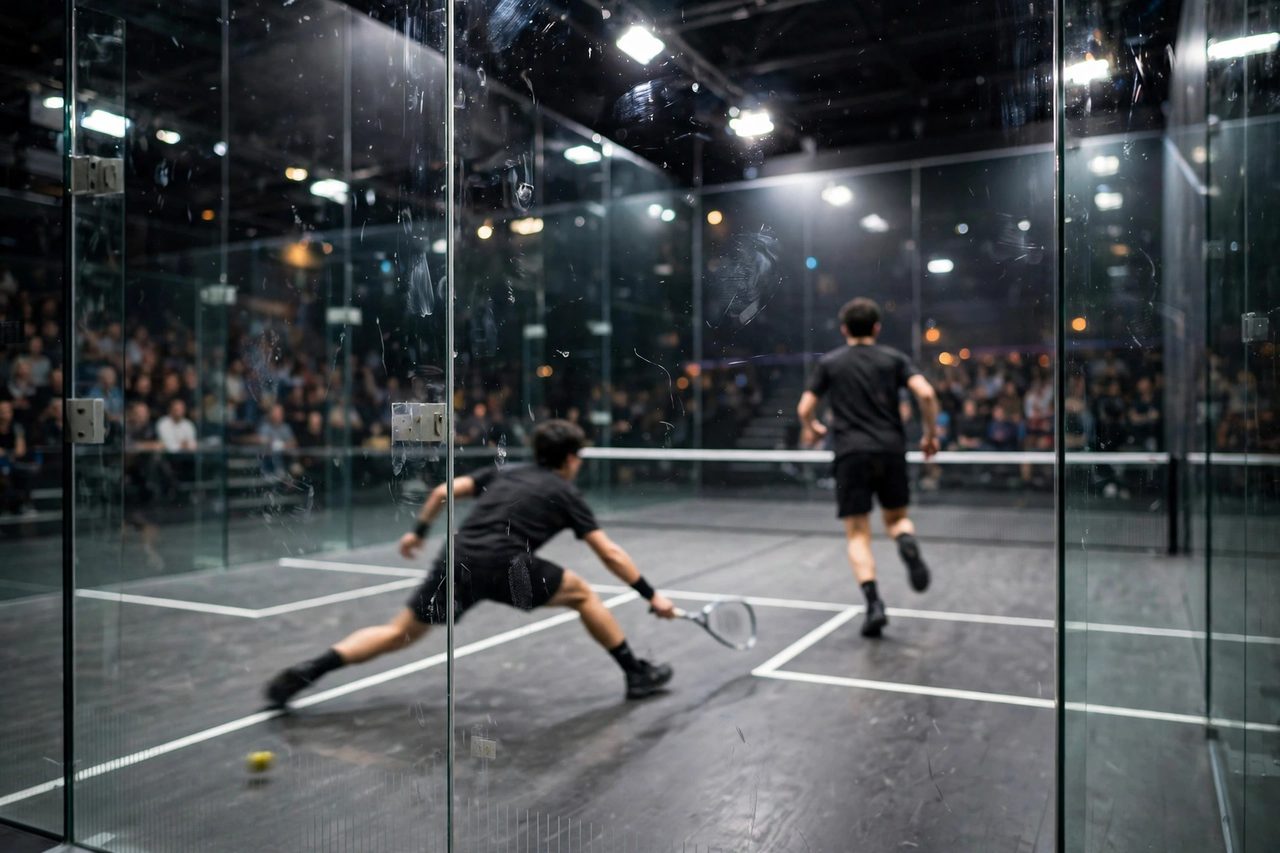
Squash has a pecking order. Or at least, it used to.
On Wednesday in Shanghai, five of the sport’s biggest names lost on the same day: a defending champion, a former world No. 1, and a former world No. 1 on the women’s side — all beaten in straight games.
The short version: the young players are no longer coming. They are here. And this week made it impossible to ignore.
One wild Wednesday in Shanghai
The China Open is a Gold event on the PSA Squash Tour — the professional circuit where the world’s best play. A Gold event is one of the biggest stops on that tour. Matches are best-of-five games: the first player to win three games takes the match.
A “seed” is a ranking given to the top players in a draw, based on their world ranking, and seeds are placed apart so they should not meet early. When a seed loses early, it is called an upset. On Wednesday, November 18, there were five of them.
First, Simon Herbert of England beat Mohamed Abouelghar of Egypt 3-0. Herbert is ranked No. 56 in the world — a long way from the top. Abouelghar is the defending champion, ranked No. 18 and seeded fifth. The games were 11-9, 11-6, 11-9, and the match took 33 minutes. It was a clean win over the man who won this event last year, sending Herbert into his first Gold quarter-final — the round of the last eight.
Then Greg Lobban of Australia beat Mohamed ElShorbagy 3-0. ElShorbagy is a former world No. 1 and the winner of the China Open in 2024. He was seeded fourth. Lobban beat him 11-9, 11-4, 13-11 in 42 minutes — in his first event playing for Australia, after switching from Scotland.
The women’s draw had its own shocks. Sin Yuk Chan of Hong Kong, ranked No. 30, beat Tinne Gilis of Belgium, the third seed, 3-1: 10-12, 11-9, 11-4, 11-3, in 37 minutes — on her China Open debut. She lost the first game, then won the next three.
Marina Stefanoni of the United States, ranked No. 12 and seeded fifth, beat Nouran Gohar of Egypt 3-1: 11-6, 4-11, 11-4, 12-10, in 46 minutes. Gohar is a former world No. 1 who had reached the US Open final in Philadelphia only days earlier, in her comeback season after giving birth.
And Ryunosuke Tsukue of Japan beat Gregoire Marche of France, the sixth seed, 3-0: 11-7, 11-6, 11-5. The match took just 27 minutes.
Five favourites beaten, none of the matches going to a deciding fifth game. The young players did not just win. They won clearly.
This did not come out of nowhere
Shanghai was the loudest day of the changing of the guard. But it was not the first.
Three weeks earlier, at the Silicon Valley Open in California — also a Gold event — the same story played out. It ended on October 24 and 25 with two young champions.
The men’s title went to Mohamad Zakaria of Egypt, 19 years old. He beat Victor Crouin of France 3-0 in the final, 11-5, 11-8, 11-3, in 55 minutes. It was his second Gold title in just four Gold events. A teenager is already winning the sport’s big events almost as fast as he enters them. He is now ranked world No. 5.
The women’s title went to Sivasangari Subramaniam of Malaysia, who beat Farida Mohamed of Egypt 3-0, 11-7, 11-6, 11-8, in 31 minutes. Sivasangari is now ranked world No. 4, and she has said she wants to break into the world’s top three before the Los Angeles Olympics in 2028.
But the result that said the most came earlier that same week, on October 21. Anahat Singh of India, 18 years old and ranked No. 15 in the world, beat Nour El Sherbini 3-0: 11-8, 11-8, 11-7, in 30 minutes.
El Sherbini has won the World Championship eight times — a record she shares with the great Nicol David — and played in ten straight world finals. She is one of the greatest squash players who has ever lived. And an 18-year-old beat her in straight games.
Singh did not stop there. She came back from 2-1 down to beat Salma Hany 3-2 and reach her first Gold semi-final — the round of the last four — becoming the first Indian woman to reach a Gold semi-final since 2019.
One upset is a bad day. Two is a coincidence. A whole autumn of them is a pattern.
Meet the new guard
So who are these players? They are not one group, and they do not come from one country. The new guard is global, arriving from every direction at once.
Mohamad Zakaria, 19, Egypt, world No. 5. Egypt has ruled men’s squash for years, and Zakaria is its next star. He plays fast, attacks early, and does not seem to feel the weight of the occasion. Two Gold titles in four events is the kind of start that usually belongs to a future world No. 1. The question is how high he can climb, and how fast.
Anahat Singh, 18, India, world No. 15. Singh’s win over El Sherbini was the single most startling result of the autumn. She beat a legend 3-0, in half an hour, then backed it up by reaching the semi-finals. Singh plays with the freedom of someone who has nothing to lose — because at 18, she doesn’t.
Simon Herbert, England, world No. 56. Herbert’s win over the defending champion was the biggest of his career, and it took him to his first Gold quarter-final. Players ranked in the fifties do not usually beat defending champions 3-0. Herbert did it by playing his own game and refusing to be impressed by the name across the court.
Greg Lobban, Australia. Lobban’s win over ElShorbagy came in his first event playing for Australia, after switching from Scotland. Changing countries is a big call: new colours, new team-mates, new expectations. Lobban marked the move by beating a former world No. 1 in straight games.
Sin Yuk Chan, Hong Kong, world No. 30. Chan’s win over the third seed, Tinne Gilis, came on her China Open debut. She lost the first game, then took the next three, and the last two were not close. Chan played like she owned the court.
Marina Stefanoni, United States, world No. 12. Stefanoni is part of a golden moment for American squash — Team USA has called this a golden era for its women’s game, and she is at the heart of it. Beating Gohar, a former world No. 1, days after Gohar reached a US Open final, is a career marker.
Ryunosuke Tsukue, Japan. Tsukue’s 27-minute win over the sixth seed, Gregoire Marche, was the quickest of the five Shanghai upsets. Tsukue did not just beat a seed. He swept him aside.
None of these players is a one-week story. They are all ranked, established, and getting better. What changed is that they have stopped losing to the big names — and started beating them in straight games.
The old guard is not finished — but the aura is gone
The players losing these matches are not finished. Far from it.
ElShorbagy has been near the top of men’s squash for a decade. Gohar reached a US Open final days before losing in Shanghai. El Sherbini is an eight-time world champion. Great players bounce back.
But something has changed. In squash, the aura matters. For years, the top players won matches before they started. Younger players walked on court already half beaten, because they had grown up watching these champions on television. They played not to lose and waited for the champion to make a mistake. The champion rarely did.
That is over. The new guard grew up watching the same champions — and decided they could beat them. Singh did not play El Sherbini like a fan meeting her hero. Herbert did not play Abouelghar like a man facing the defending champion. He played him like a man who wanted his quarter-final place.
Changing-of-the-guard moments rarely look like a clean handover. They look like this: a few strange results, then a few more, then a day when five happen at once.
The old guard still has the trophies, the experience and the big-match calm. What it no longer has is fear on the other side of the court — and in a sport as fast and as mental as squash, that is a lot to lose.
Why squash rewards youth right now
Why now? Four reasons, all pointing the same way.
The first is fitness. Squash is one of the hardest sports in the world on the body. A match is a series of short, violent sprints, with barely any rest between rallies. At 18 or 19, a player recovers faster and can hold top speed for longer. The margins at the top are tiny. A fraction of a second decides whether you reach a ball or watch it die in the corner.
The second is fearlessness. Young players have less to lose. They have no ranking to protect and no reputation to defend. They can swing freely. Older champions carry the weight of every match. That freedom shows up in the big points. Look at Shanghai: 13-11 in the third game for Lobban against ElShorbagy, 12-10 in the fourth for Stefanoni against Gohar. Those are the tight games, where nerves decide everything — and the young players won them.
The third is depth. There are simply more good young players than there used to be. Squash is growing in more countries, with better coaching and junior systems. The talent is no longer concentrated in two or three countries. It is everywhere — and so are the upsets.
The fourth is information. Every match on the tour is filmed, analysed and shared. A young player today can study a champion’s game in detail before ever facing them. They know where ElShorbagy likes to hit his backhand and how Gohar builds a rally. The champions used to be a mystery. Now they are homework. That does not make them easy to beat. But it makes them beatable.
Put those four things together and you get an autumn like this one. The sport has not got weaker at the top. It has got stronger everywhere else.
The bridge generation
Meanwhile, the middle ground is held by the US Open champions. At Philadelphia on November 7, Paul Coll of New Zealand and Amina Orfi of Egypt lifted the titles. They are established stars, but not the old guard either — proven champions still young enough to be part of the future. So it is not old versus young. It is a squeeze: the champions are pressed from above by Coll and Orfi, and from below by Zakaria, Singh and the rest. Every seed is a target now.
The road to Los Angeles
There is one more reason this moment matters so much, and it is the biggest one of all. Squash will make its Olympic debut at the Los Angeles Games in 2028. After decades of trying, squash is going to the Olympics.
The Olympics bring new fans, new money, new attention and new pressure. The players who will represent their countries in Los Angeles are being decided right now. Every Gold event, every ranking point, every win over a top player moves someone closer to an Olympic place.
That is why the young players are pushing so hard — and why the established stars are fighting to hold them off. An Olympic place is a once-in-a-career prize. For a 19-year-old like Zakaria, Los Angeles could be the first of several Olympics. For a champion in their thirties, it might be the only one.
Sivasangari wants to be in the world’s top three by the time the Games arrive. Singh, at 18, has time on her side — but she is not waiting. She is already beating the players she will need to beat in Los Angeles. The qualification race is happening now, one upset at a time. And millions of people who have never watched squash will see it for the first time in 2028 — a sport in the middle of a generational fight.
What to watch next
The China Open continues, and the upset-makers now have to do the hard part: back it up. Beating a champion once is a headline. Beating the next player, and the one after that, is a career. Herbert, Lobban, Chan, Stefanoni and Tsukue all have quarter-finals to play. The question is whether Wednesday was a peak or a platform.
Zakaria’s question is different. Already world No. 5 and already winning Gold titles, can he go higher — and how quickly? The gap between No. 5 and No. 1 looks big on paper. On current form, it does not.
Singh’s question is whether she can do it again. One win over El Sherbini makes you a story. Two makes you a rival.
And the old guard’s question is the oldest one in sport. ElShorbagy, Gohar and El Sherbini have all rebuilt their games before. The question is whether they can do it fast enough, against opponents who are only getting better.
Squash’s old order is not coming back. The young players are not asking for permission. They are taking the matches, the rankings and the headlines — one upset at a time.
Wednesday in Shanghai was not an accident. It was an announcement. The new guard has arrived. And squash will never be the same.
Related articles
Ma Long: The Dragon Who Ruled Table Tennis for Fifteen Years
Six Olympic golds, three world singles titles, 64 months at world No. 1 — Ma Long is the greatest men's table tennis player ever. This is the story of the Dragon, and what comes after him.
Hugo Calderano: The Brazilian Who Broke Table Tennis's Old Map
World No. 2 in February 2026, World Cup champion in 2025, Olympic semifinalist in Paris — Hugo Calderano is the greatest player the Americas has ever produced, and he did it from a sport his continent barely played.
Félix Lebrun: France's Table Tennis Star Is Still Only Getting Started
Félix Lebrun is 20, world No. 2, an Olympic bronze medallist and now the European singles champion. The scary part for his rivals is how much better he can still get.