
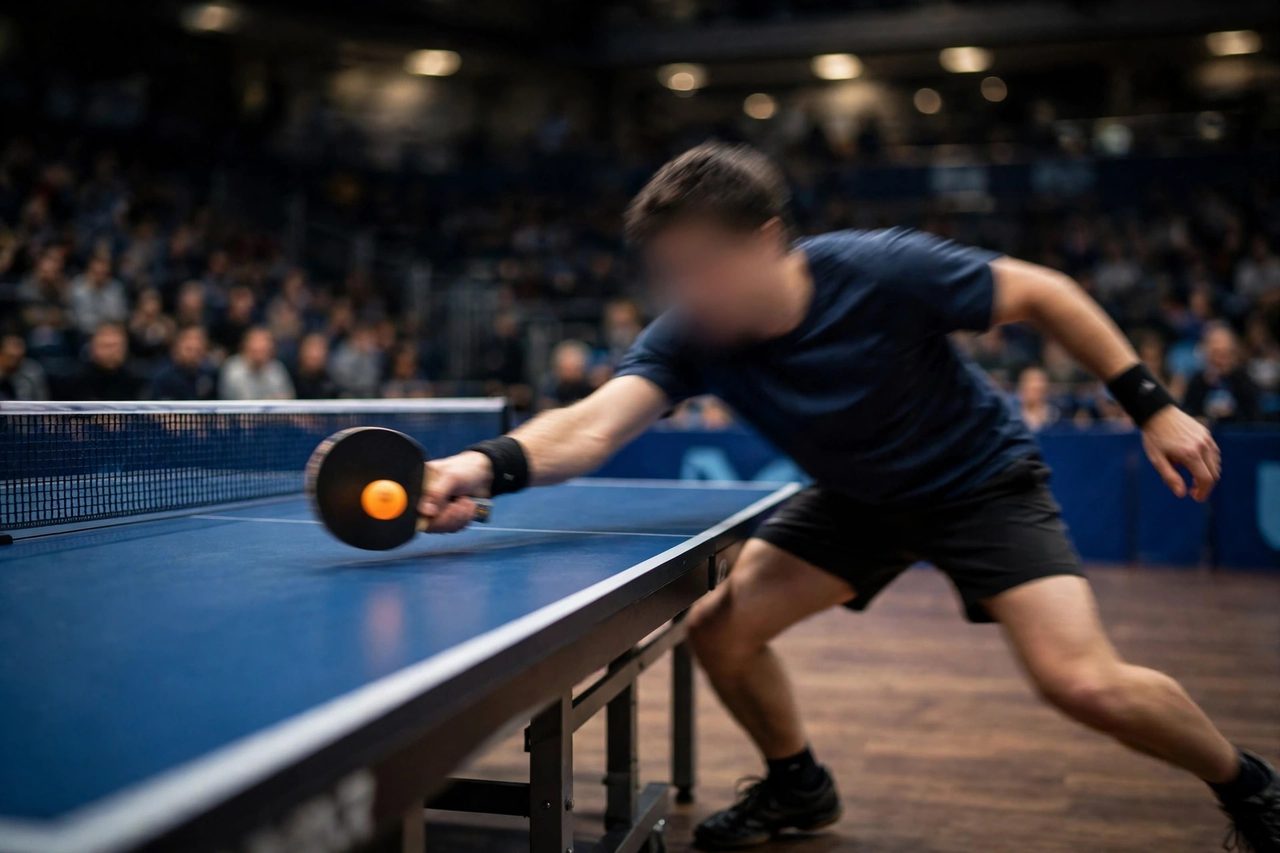
There is a sound that follows Tomokazu Harimoto around the world, and you hear it before you see him. “Cho!” — the roar after a big point, part celebration, part declaration — has been his signature since he was a child beating adults. It is fitting, because Harimoto has never done anything quietly. He announced himself as a prodigy, grew up in front of the cameras, and has spent a decade carrying the same impossible job: being the player most likely to beat China.
Born on 27 June 2003 in Sendai, Japan, to Chinese parents who were both professional players, Harimoto — born Zhang Zhihe — picked up a racquet at the age of two, playing at the kitchen table at home. He became a naturalised Japanese citizen as a schoolboy, changing his name legally, so that he could represent Japan. By 12 he was on the Japanese junior national team; by 13 he was playing senior internationals. The records fell so fast they barely had time to be printed.
The records
The list reads like a dare. Youngest winner of an ITTF World Tour under-21 event, at 12, at the 2016 Japan Open. Youngest winner of a senior World Tour men’s singles title, at 14, at the 2017 Czech Open — beating Germany’s Timo Boll in the final. Youngest winner of the ITTF World Tour Grand Finals, at 15, in 2018, a year in which he also beat Ma Long in the Japan Open semi-final and Zhang Jike in the final, then won the Japanese national title. He reached a career-high world No. 2 in November 2022, at 19.
What gets lost in the record book is how public all of it was. Most prodigies develop in private; Harimoto developed on television, with every loss dissected and every celebration — the “Cho”, the fist-pumps — turned into a talking point. Opponents learned his game while he was still learning it himself. Coaches built plans for a teenager the way they built them for champions. That he survived that glare, let alone thrived in it, is arguably his greatest achievement.
The game
Harimoto plays right-handed shakehand, close to the table, at a tempo that borders on frantic. His backhand, taken early off the bounce, is the engine of his game: compact, violent, and capable of redirecting the fastest balls in the sport. He plays on the rise, hunting the ball before it drops, compressing rallies into a blur of exchanges that leave opponents no time to set up. It is high-risk table tennis by design — when it flows, it is the most watchable style in the men’s game; when it misfires, the errors come in clusters.
That style has always been both his weapon and his ceiling. Against the Chinese system, which thrives on absorbing pace and extending rallies, Harimoto’s tempo is a genuine threat — he has beaten the very best of them, repeatedly. But the same aggression that wins him matches can cost him matches against disciplined defenders and counter-punchers who let him beat himself. His career has been a long negotiation between those two truths.
The second act
If the first act was the prodigy, the second has been the contender. Harimoto won team bronze at the Tokyo Olympics in 2021, and spent the early 2020s as a permanent fixture in the world top five. Then came 2025, his best season in years: victory at WTT Champions Yokohama, beating Wang Chuqin in the final, and then the biggest title of his career — the WTT Finals in Hong Kong, where he beat Truls Möregårdh 4-2 in the final to become the first non-Chinese player to win the event.
That Hong Kong title mattered beyond the trophy. For years, the question around Harimoto was whether the prodigy would ever become a champion of the biggest events. Yokohama and Hong Kong answered it. He followed up in 2026 with a runner-up finish at the Asian Cup and semi-final runs at WTT Champions events in Doha and Chongqing, and he now sits at world No. 3 — still, at 23, younger than most of the players he is chasing.
What remains
Harimoto’s story is often told as a story about China — the hope, the foil, the nearly-man. That framing sells him short. He is also a story about longevity: a child star who did not burn out, who rebuilt his game in public, who kept winning while the sport changed around him. His younger sister Miwa is now a star in her own right, and the Harimoto name has become a dynasty rather than a curiosity.
The biggest prizes still elude him — a World Championships singles title, an Olympic singles medal — and the road to Los Angeles 2028 runs straight through the Chinese team he has spent his life trying to beat. But if there is one player outside China with the game, the temperament and the sheer accumulated experience to do it, it is the one who has been roaring “Cho!” since he was tall enough to reach the table. He grew up in public. The best part of the story may still be ahead.
Related articles
Squash's New Guard: The Young Players Rewriting the Sport's Old Order
Five seeds fell in a single day in Shanghai. A 19-year-old is already world No. 5. An 18-year-old just beat an eight-time world champion. Squash has a new guard — and it is not waiting its turn.
Ma Long: The Dragon Who Ruled Table Tennis for Fifteen Years
Six Olympic golds, three world singles titles, 64 months at world No. 1 — Ma Long is the greatest men's table tennis player ever. This is the story of the Dragon, and what comes after him.
Hugo Calderano: The Brazilian Who Broke Table Tennis's Old Map
World No. 2 in February 2026, World Cup champion in 2025, Olympic semifinalist in Paris — Hugo Calderano is the greatest player the Americas has ever produced, and he did it from a sport his continent barely played.