
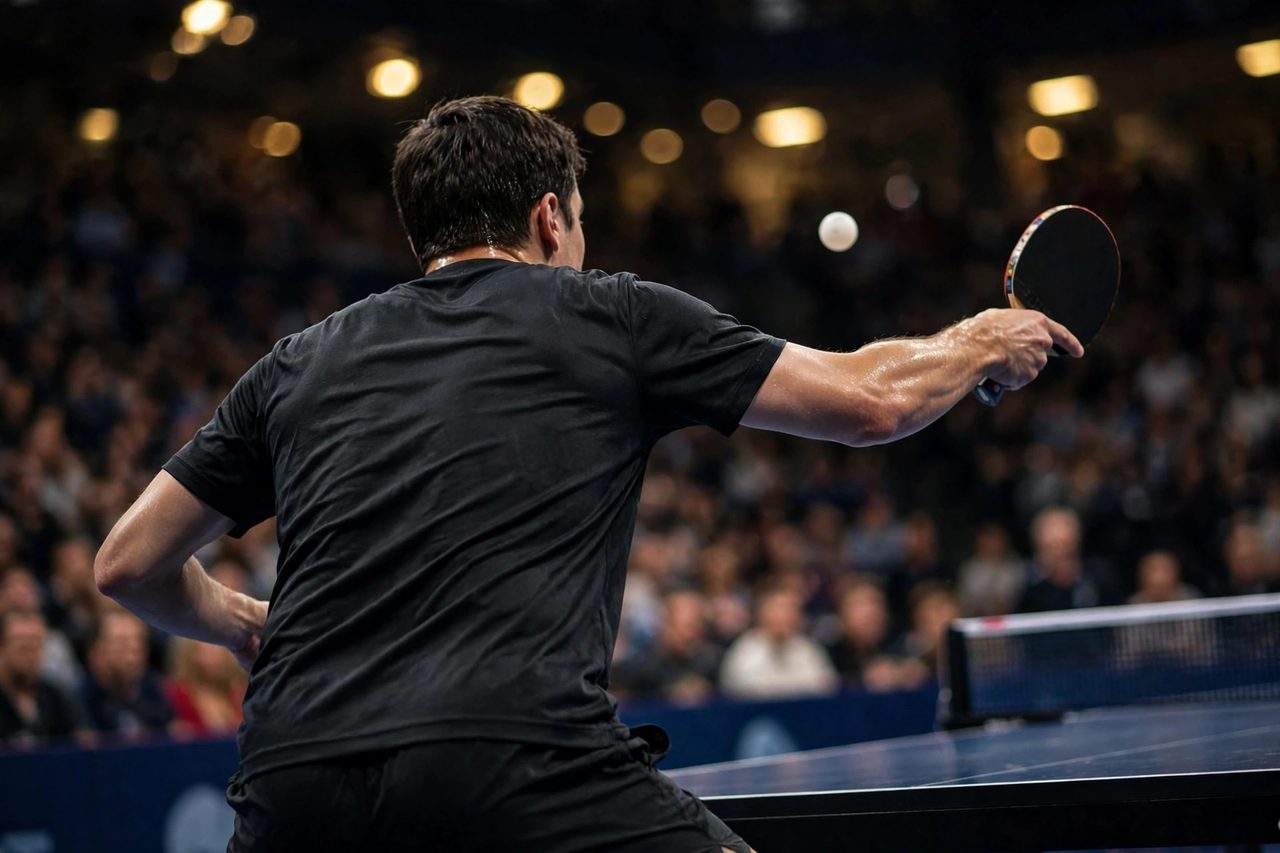
Wang Chuqin is the kind of player who makes table tennis look easy and terrifying at the same time. He is left-handed, fast, loud, and emotional on court. When he wins a big point, the whole arena knows about it. When he loses one, they know that too. He has been world No. 1, won Olympic gold, and finally became world singles champion in 2025. He is also still only 26. This is the story of how he got there.
A racquet for his health
Wang was born on May 11, 2000, in Jilin City in north-east China. As a young child he was often ill, and his parents gave him a table tennis racquet when he was seven years old to help him get stronger and healthier. It worked better than anyone could have guessed. By the time he was a teenager, he was one of the best young players in China, which is saying something. China is the deepest table tennis country in the world. To stand out there, you have to be special.
He plays left-handed with a shakehand grip. A shakehand grip is the most common way to hold a racquet, like shaking someone’s hand. It lets you play strong forehands and backhands without changing your grip much. Wang’s forehand is his biggest weapon. He plays with a DHS W968 blade and DHS Hurricane rubbers, the same kind of setup used by many of China’s top players. A blade is the wooden part of the racquet, and the rubbers are the sticky sheets glued to each side that grip the ball and create spin. Spin is when the ball rotates in the air, which makes it dip, jump or curve in ways that are hard to read.
His nickname among fans is “Datou”, which means “big head”. He is known for wearing his heart on his sleeve, and that has made him one of the most popular players in the sport.
The climb to No. 1
Wang joined the Chinese national team in December 2015, when he was 15. From there, his rise was steady rather than sudden. He won junior titles, then senior titles, then started beating the biggest names in the sport. On July 4, 2023, he reached world No. 1 in men’s singles for the first time.
At the Hangzhou Asian Games in 2022, which were actually played in 2023, he became the first Chinese man ever to win four gold medals at a single Asian Games. The Asian Games are a huge multi-sport event, like the Olympics but just for Asia, and table tennis is one of its biggest sports. Winning four golds there, in singles, doubles, mixed doubles and the team event, was a historic achievement.
Paris: gold, heartbreak, and a broken racquet
The Paris Olympics in 2024 gave Wang the highest highs and the lowest low of his career, all in the same week. He won gold in the mixed doubles with Sun Yingsha, and gold again in the men’s team event with Ma Long and Fan Zhendong. Two Olympic gold medals is a career most players would dream of.
But in the singles, it went wrong. He lost early, in the round of 32, to Sweden’s Truls Moregard. Part of the story was his racquet. After his mixed doubles win, a photographer accidentally stepped on his racquet and broke the handle. Wang had to switch to a spare racquet, and he later said it simply felt different. In table tennis, players are deeply attached to their racquets. A different racquet, even a tiny bit different, can change how every shot feels.
The months after Paris were hard. He lost early at the China Smash in 2024, again to a lower-ranked player, and his ranking slipped.
The world title he had to wait for
In May 2025, Wang finally won the World Championships singles title in Doha. The World Championships are the biggest individual event in table tennis, held every two years, and the singles title is the one every player wants most. He beat Brazil’s Hugo Calderano in the final. Calderano is the best non-Chinese player of his generation, so beating him in a world final meant something extra. Wang also won the mixed doubles in Doha, and he became the first left-handed Chinese man to win the world singles title since 1993.
In 2026 he added another huge title, winning the World Cup singles in Macao. The World Cup is a smaller, invitation-only event for the world’s best players. In the final he beat Japan’s Sora Matsushima in a seven-game thriller, coming from behind after Matsushima led 3-2. It was the kind of win that shows what Wang does best: when the pressure is highest, he finds another gear.
What makes him special
Wang’s game is built on speed and aggression. He stands close to the table and takes the ball early, before it has time to drop. That gives his opponents less time to react, but it also means he has almost no margin for error. When it works, it is beautiful. When it does not, the mistakes come in bunches.
He is also one of the most watchable players alive. He shouts, he pumps his fist, he argues with himself. Some players hide their emotions. Wang puts his on show. Young fans love him for it. He feels less like a machine and more like a person, even though his talent is anything but ordinary.
The one big prize still missing is Olympic singles gold. He has team gold and mixed doubles gold, a world title and a World Cup. The singles gold at the Olympics is the last line on the list. He will be 28 at the next Olympics, right in his prime. If he gets there, and if his racquet stays in one piece this time, nobody will want to face him.
Related articles
Squash's New Guard: The Young Players Rewriting the Sport's Old Order
Five seeds fell in a single day in Shanghai. A 19-year-old is already world No. 5. An 18-year-old just beat an eight-time world champion. Squash has a new guard — and it is not waiting its turn.
Ma Long: The Dragon Who Ruled Table Tennis for Fifteen Years
Six Olympic golds, three world singles titles, 64 months at world No. 1 — Ma Long is the greatest men's table tennis player ever. This is the story of the Dragon, and what comes after him.
Hugo Calderano: The Brazilian Who Broke Table Tennis's Old Map
World No. 2 in February 2026, World Cup champion in 2025, Olympic semifinalist in Paris — Hugo Calderano is the greatest player the Americas has ever produced, and he did it from a sport his continent barely played.