
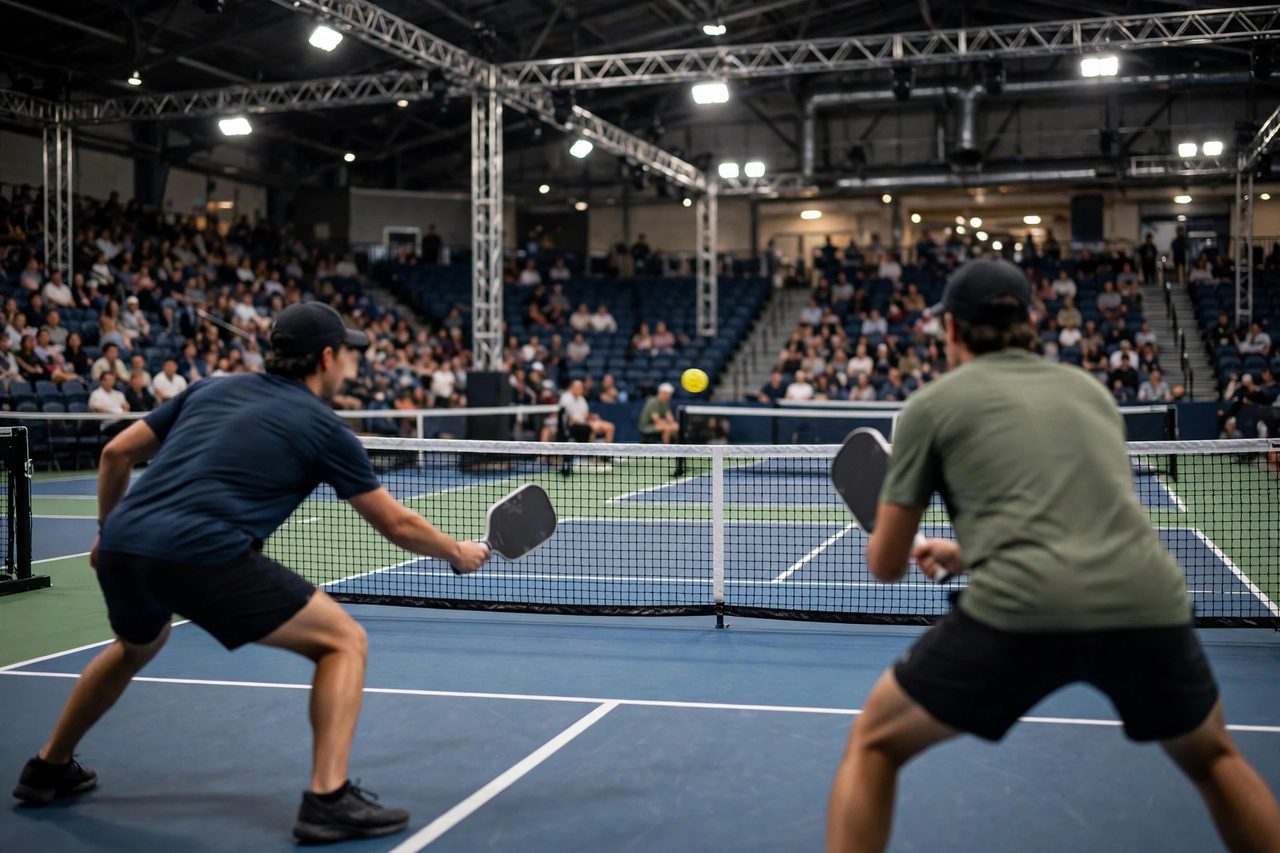
In the autumn of 2023, the two biggest organisations in professional pickleball did something that would have been unthinkable in a mature sport: they spent the winter trying to sign each other’s players with ever-larger cheques, announced a merger, fell out bitterly, asked the players to hand money back, and then — weeks after warning that the whole league might not survive — closed the merger anyway, with $75 million of new investment behind it. The tour wars lasted barely two years. They also created the structure professional pickleball still lives with today: one owner, two brands, and a generation of players who learned what their signatures were worth.
To understand how a sport played with a plastic ball in public parks got here, you have to start with the fact that, for a while, there were simply two good ideas competing for the same future.
Act one: two tours, two ideas
The Professional Pickleball Association — the PPA Tour — came first, founded in 2019 by Connor Pardoe. Its model was borrowed from tennis and golf: a travelling circuit of tournaments, individual rankings, singles and doubles brackets, with prize money for whoever won on Sunday. It was the format the players already understood, and as participation exploded during the pandemic, the PPA became the sport’s default stage, signing its stars — players like Ben Johns and Anna Leigh Waters — to exclusive contracts.
Major League Pickleball was the challenger idea. Launched in September 2021 by Steve Kuhn, a hedge-fund manager turned pickleball evangelist, MLP rejected the bracket entirely. It was a team league: franchises, drafts, co-ed squads of two men and two women, and a fast, made-for-television scoring format. Its first event was held in November 2021 in Dripping Springs, Texas, with eight teams and what was then the richest purse in the sport’s history.
The two formats were not natural enemies. One sold individual glory, the other sold team identity and the fantasy of owning a franchise. What made them enemies was money — specifically, how much of it suddenly wanted in.
One more thing made the economics unusual: the customers were also the content. PPA events were built as festivals, with thousands of amateur players paying entry fees to compete in their own brackets at the same venue, on the same weekend, as the professionals. Industry estimates put the amateur fields at some 27,000 players a year across the combined calendar — a revenue base no other young sport possessed, and one that made the professional tier look fundable even before television money arrived. Pickleball’s pros were, in effect, headlining a travelling convention of their own fans. That model would matter later, when the bills came due.
The celebrity land grab
In January 2022, Tom Dundon — a billionaire investor who owns the NHL’s Carolina Hurricanes and built his fortune in finance — bought the PPA. The tour’s title sponsor became Carvana, the used-car giant in which Dundon was a central figure. The sport’s centre of commercial gravity shifted overnight: pickleball now had serious owners on both sides.
On the MLP side, the rush was for teams. The first franchises had changed hands in 2021 for around $100,000 each. By the summer of 2023, the league’s chief executive was telling CNBC that valuations had reached as high as $10 million — a hundredfold increase in under two years. The buyer list explained why. LeBron James, Kevin Durant, Tom Brady (alongside tennis champion Kim Clijsters), Drew Brees, Patrick Mahomes, Naomi Osaka and Nick Kyrgios all took ownership stakes, joined by hedge funds, team owners from other sports and Anheuser-Busch, which bought a team outright. Every famous name made the next famous name easier to sign, and each new valuation made the last one look cheap.
It was thrilling, and it rested on a fragile assumption: that revenues would grow as fast as valuations. In the meantime, both leagues needed the one asset that could not be manufactured — the players.
The VIBE episode
The first shot of the war looked, briefly, like peace. In November 2022, the PPA announced a team league of its own: the VIBE Pickleball League, a direct copy of MLP’s concept, with Dallas Mavericks owner Mark Cuban unveiled as its first team owner on 3 November. Six days later, on 9 November, VIBE was gone — merged into MLP in a “strategic merger” that put all team pickleball under one brand, with Cuban’s team among those absorbed. Kuhn and Dundon issued a joint statement about unifying the sport.
Read it one way and it was statesmanship. Read it another way and it was a warning: the PPA had demonstrated it could build a rival team league in a week, and both owners now knew exactly what escalation would look like. The PPA’s individual tour and MLP coexisted for the next year as partners who did not entirely trust each other, while the sport’s calendar awkwardly split between their events and the players shuttled between formats.
The arms race
The breaking point came in the summer of 2023. Merger talks between the two organisations — aimed this time at combining everything, tour and league alike — appeared to stall, and in August both sides reached for the same weapon: guaranteed player contracts. Each league raced to lock up the top professionals with multi-year deals at numbers the sport had never seen, fearing that if the merger failed, whoever held the players held the sport.
It worked, in the worst way. By the time the spending stopped, both organisations were carrying player commitments far beyond what their revenues could support. Sports Business Journal’s later account described the two sides as buried under the weight of hugely overvalued contracts with no clear path to financial viability. The September announcement that the PPA Tour and MLP would merge — a deal meant to end the war — instead became the starting gun for an audit of what the war had cost.
The merger that nearly died
The autumn of 2023 was grim. The merger, announced in September, stalled amid what CNBC later called a bitter falling out between the organisations. The new combined company needed the players to accept reduced terms, and in December the request landed: many professionals were asked to take significant pay cuts on the contracts they had signed only months earlier. The players responded by organising a collective and hiring lawyers. When MLP wrote to players claiming that more than 85 percent of its top players had accepted reductions, players and agents who were polled put the real figure closer to a quarter or a third.
The leadership that had started the war did not survive it. Steve Kuhn resigned from MLP in October 2023. The league’s chief executive and its commissioner also departed in the restructuring that followed. And hanging over everything was a deadline: players were warned that if the merger was not completed by 31 January 2024, the new agreements would be void and MLP’s future viability would be uncertain. Several players, meanwhile, said publicly that they were still waiting to be paid for past tournaments.
For a few weeks, the most likely outcome looked like collapse — two leagues, one player pool, no workable finances and a sport whose professional tier might simply fold back into the amateur festivals it came from.
The February resolution
It did not collapse. On 29 February 2024, the PPA Tour and Major League Pickleball announced that the merger had closed, creating a single holding company — the United Pickleball Association — that wholly owns both brands. The rescue came with $75 million of new investment from a group led by private-equity firm SC Holdings, together with D.C. Pickleball Team owner Al Tylis, Dundon, the Pardoe family and existing MLP team owners.
The terms told the story of the winter. More than 150 professionals signed new multi-year contracts with the combined company — on restructured economics, after the pay-cut fight — and the two brands kept their separate identities: the PPA Tour for individual competition, MLP for the team game, on a single coordinated calendar. The new company projected that combined player payouts in 2024 would rise by nearly 250 percent compared with 2023, a figure that was possible only because 2023’s base had been so chaotic. The war had ended, as most wars do, when both sides accepted a peace neither would have chosen at the start.
What the peace is worth
Two seasons on, the scoreboard is genuinely impressive. The combined operation reported a record 2024 and a bigger 2025: MLP said sponsor revenue more than doubled in 2025, with ticket revenue up 94 percent and attendance up 52 percent, while the PPA Tour’s television and streaming numbers climbed steeply. CBS’s broadcast of the 2025 MLP finals averaged just under half a million viewers — the most-watched pickleball match since the merger. The combined World Championships event in 2025 drew more than 60,000 spectators across the week, and the leagues’ own streaming channel, Pickleballtv, racked up tens of millions of minutes viewed. Franchise values kept climbing after the peace, too: a majority stake in the LA Mad Drops changed hands at a $13 million valuation, and the Palm Beach Royals arrived as an expansion team at a $16 million valuation. The $100,000 teams of 2021 had become eight-figure assets.
Player pay tells a more complicated story. At the very top, the money is real: Ben Johns put his own annual earnings at roughly $2.5 million in 2024, and Anna Leigh Waters has been reported to earn more than $3 million a year once her league contract and endorsements are combined. Industry estimates put the combined leagues’ total player compensation in the tens of millions of dollars a year. But the distribution is brutally top-heavy. Below the stars sits a long tail of touring professionals for whom prize money, small contracts and sponsorships add up to a modest living at best — and, as player-turned-analyst Zane Navratil has documented in his public breakdowns of tour economics, players outside the contracted ranks can spend more chasing the tour than they earn from it.
That gap — millionaires at the top, hopefuls paying their own way at the bottom — is the tour wars’ true legacy. The arms race set a price for the stars that the peace has kept, while everyone else negotiates in a market the merged company now controls alone.
What it means for the sport now
The structural result is simple to describe. Professional pickleball’s two great formats now answer to one boardroom. The calendar is coordinated, the top players are contracted to play both formats, sponsors and broadcasters negotiate with a single counterparty, and the only significant rival left standing, the APP Tour, operates outside the UPA’s tent with a smaller footprint. For a sport that nearly tore itself apart, the stability is real. Schedules no longer collide, and a young player turning professional now signs one contract instead of choosing a side in somebody else’s war.
The risks are the mirror image of the benefits. A monopoly buyer of playing talent sets its own prices — the players’ short-lived collective of December 2023 was an early sign that labour relations will be a permanent theme. Franchise valuations in the teens of millions still run far ahead of what teams earn from tickets and sponsors, so the celebrity owners are betting on growth, not income. And the whole structure depends on the participation boom continuing to convert casual players into viewers.
But step back, and the tour wars look less like a scandal than a compressed childhood. Tennis took a century of schisms to reach its modern structure; pickleball did its feuding in about thirty months, in public, at internet speed. The sport that emerged in February 2024 — unified, capitalised and on national television — is the one now trying to conquer the world. The wars were the price of getting there. Whether the peace was worth it depends on which line of the pay scale you stand on.
Related articles
Dubai P1: The Upset-Filled Week That Ended With Two New Champions
The Dubai P1 served up the wildest quarter-finals of the padel season, with the world No. 1s out and three first-time semi-finalists — then two new champions lifted the trophies.
How the FIP Tournament Ladder Works
Bronze, Silver, Gold and Platinum: a simple guide to padel's ladder below Premier Padel, and how players climb it.
Spain vs Argentina: The World Cup Final Padel Has Been Waiting For
Two finals, one rivalry, and a farewell: Spain and Argentina meet for both world titles in Doha, in a team event that turns padel's individual stars into national teammates.