
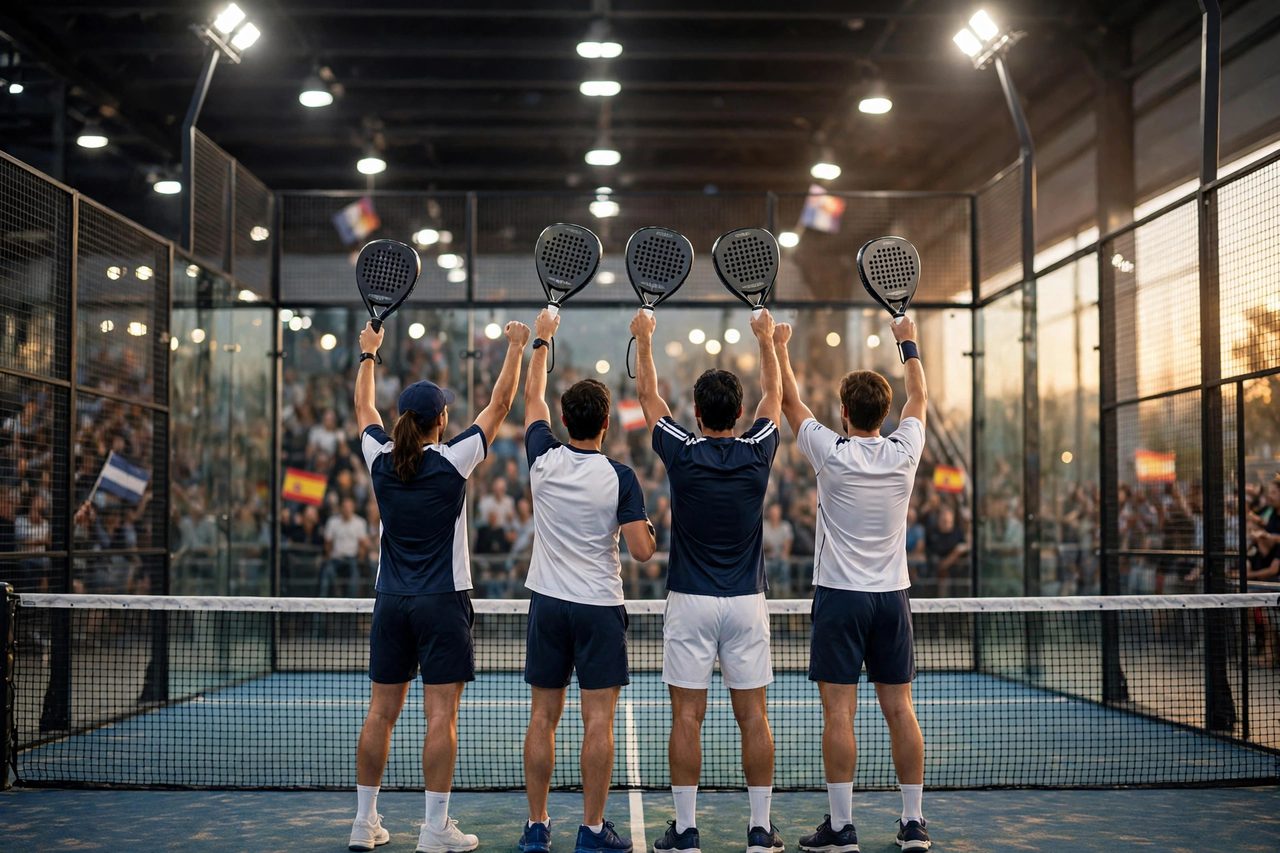
There is a day in every sport when the calendar stops being a list of dates and becomes a single match. For padel, that day is today. In Doha, at the Khalifa International Tennis and Squash Complex, Spain and Argentina will play for the world title — twice. The women’s final comes first, at 14:00 local time. The men’s final follows, not before 18:00. Same two countries. Same court. Two world titles on the line on the same day.
It is the final everyone expected. Spain and Argentina are the only two countries that have ever won this event, and this year the last day carries extra weight: for Spain’s Paquito Navarro, one of the most loved players of his generation, this is his last World Cup.
A World Cup in a sport of pairs
Padel is, week to week, an individual sport. Players travel the world in pairs, chasing points on the Premier Padel tour. A pair wins together and loses together, and the rankings belong to the pair. Then, once every two years, the sport stops and becomes something else entirely: a tournament of nations.
The FIP World Cup is padel’s world championship for national teams, run by the FIP, the sport’s world governing body. This is its 18th edition. Sixteen men’s teams and sixteen women’s teams came to Doha on Monday, 2 November, split into four groups of four. The top two in each group moved on to the quarter-finals on Thursday, then the semi-finals on Friday, and now the finals on Saturday.
Here is how a match between two countries works. It is called a tie, which is the team-sport word for one whole contest between two nations. Each tie is made up of three doubles matches — each one is sometimes called a rubber. The first country to win two of the three matches wins the tie. If a tie is already decided after two matches, the third is usually not played.
Each country brings a squad of eight players. On tour, you play with your one partner, week after week. At the World Cup, the captain picks three pairs from eight players, and the pairs change from tie to tie. A player can sit out one day and play the deciding match the next, and a lower-ranked player can become a hero by winning the one match that decides a tie.
There are no ranking points here. The prize fund is a record €1.2 million, split equally between the men’s and women’s events. But nobody in Doha is talking about the money. They are talking about the shirt. Arturo Coello, Spain’s biggest star, put it simply during the week when he said the emotion of playing for your country is like nothing else in the sport. For one week, the best players in the world stop being tour rivals and become teammates — while their usual partners wear the other shirt.
Thirty-four years, two winners
The first World Cup was played in 1992, in Madrid and Seville, and Argentina won it. That set a pattern that has never broken: in 34 years and 18 editions, only two countries have ever lifted the trophy, Argentina and Spain. Nobody else. Not once.
The men’s count tells the story. Argentina have won 12 men’s titles. Spain have won four. The women’s count is closer: Spain lead nine titles to eight, and the balance of power keeps shifting.
Argentina owned the early years. They won the first three men’s titles, in 1992, 1994 and 1996, all against Spain in the final. Spain’s first men’s title came in 1998, in Mar del Plata, on Argentine soil. Argentina then won the next four, before Spain took 2008 and 2010. Spain’s men had to wait eleven years between titles, from 2010 to 2021, when they finally won again in Doha, beating Argentina 2-0 in the final.
The women’s story runs the other way: Argentina won the early titles, but Spain have won every women’s World Cup since 2014 — six in a row, and their 2024 win in Doha was their ninth title overall. Today they play for a seventh straight crown.
The event has not always run smoothly: the 2018 edition in Asunción was never played, after organisational problems stopped it before the finals, and the 2020 edition was pushed back to 2021 by the pandemic and played in Doha. Through all of it, the final has almost always come down to the same two flags.
That is why today feels less like a surprise and more like a destiny: the two best padel nations on earth, on the same court, twice in one day, for everything.
The week in Doha
The group stage ran from Monday to Wednesday, and the favourites did what favourites do: they won. Spain’s men opened with a 3-0 win over Sweden, although Yanguas and Goñi were given a scare in one match, losing a first set before fighting back. Spain’s women swept their group, beating Germany, Great Britain and Brazil without dropping a set. Argentina’s men and women did the same.
In Thursday’s quarter-finals, Spain’s men beat Brazil 2-0 and Argentina’s men beat Germany 3-0. Portugal reached the last four by beating the Netherlands 2-0, and Italy edged a tight quarter-final against Sweden 2-0 in front of a full house. The shape of the week was clear: the two giants, and two proud chasing nations trying to crash the party.
Friday was semi-final day, and both finals were decided in straight ties. In the men’s draw, Spain beat Portugal 2-0 in an Iberian derby. Goñi and Yanguas lost the first set to the Deus brothers, then turned the match around to win 4-6, 6-3, 6-2. Then Navarro and Juan Lebrón sealed the tie with a 6-2, 6-4 win.
Argentina’s men were just as clean, beating Italy 2-0. Martín Di Nenno and Leo Augsburger opened with a 6-1, 6-1 win, and Tapia and Chingotto closed it out 6-3, 6-2.
The women’s semi-finals told the same story: Spain beat France 2-0, and Argentina beat Italy 2-0. Neither finalist has dropped a single set in Doha. Something has to give today.
One medal is already decided: Italy’s women took bronze on Saturday morning, beating France for third place, their fourth straight World Cup podium. The men’s third-place match, Italy against Portugal, is played on Saturday too.
The women’s final: a streak on the line
The women’s final starts at 14:00 in Doha — midday in Paris, 03:00 in the morning in Los Angeles — so if you are reading this over breakfast on the west coast of America, it is already under way. The line-ups were announced on Friday night, and they are exactly the heavyweight card the occasion deserves.
Spain will open with Ariana Sánchez and Andrea Ustero against Argentina’s Aranzazu Osoro and Martina Fassio. The second match is the one everyone is talking about: Paula Josemaría and Gemma Triay, Spain’s superstar pair, against Delfi Brea and Claudia Jensen, Argentina’s best. If the tie is still level after two matches, Bea González and Claudia Fernández will play Virginia Riera and Julieta Bidahorria in the decider.
The numbers say Spain should win. They have not lost a set all week, they have won the last six World Cups, and they have the deeper squad. But the last final between these two teams, in this same venue two years ago, was closer than the 2-0 score suggests: Triay and Fernández won the first match 6-3, 6-2, and then Josemaría and Sánchez had to come back from a set down against Brea and Jensen to seal the title. Argentina pushed them to the edge.
Triay knows it. “We must be careful,” she said before the final, warning that Argentina are stronger than they were in 2024. That is not false modesty. Argentina’s women have grown through the week, and Brea and Jensen are a pair who can beat anyone on their day. Spain’s streak is real, but streaks are made to be attacked, and Argentina have been waiting two years for this second chance.
Spain’s women have ruled this event for a decade, but their dominance has never made the final boring. It has made it a test: every two years, Argentina arrive with a plan to end the streak, and Spain have to prove the streak means something. Today is the seventh exam.
The men’s final: revenge and a split pair
The men’s final begins not before 18:00 in Doha — 16:00 in Paris, 07:00 in the morning in Los Angeles. It is the match the whole sport has been waiting for.
Argentina are the defending champions. They beat Spain 2-1 in the final in Doha in 2024, in front of a roaring crowd: Spain won the first match, when Coello and Coki Nieto won 6-1, 6-2, and then Argentina took the next two. It was Argentina’s second straight final win over Spain, after Dubai in 2022. Spain’s men have not beaten Argentina in a World Cup final since 2021.
So this is a revenge match for Spain, and a defence for Argentina. Argentina’s men are chasing a 13th world title, which would stretch a record nobody else is close to. Spain are chasing their fifth, and their first since 2021.
But there is a twist that makes this final unlike any before it. On the professional tour, the world number one pair is Agustín Tapia of Argentina and Arturo Coello of Spain. They play together, week after week, and they win almost everything. Today they play on opposite sides. If the captains pick them against each other, the two best players in the world will try to beat the partner they trust most. It has never happened in a World Cup final before.
Spain will have to do it without one of their stars: Ale Galán, the world number three, missed the tournament, and Javi Leal took his place in the squad. Argentina’s Fede Chingotto summed up Spain’s depth with a joke before the final — asked about Galán’s absence, he said Spain have three teams. It was a compliment, and it was also true: losing a player of Galán’s class barely slowed Spain down. They lost only two sets all week.
That depth is also Argentina’s problem. Tapia and Chingotto are one of the great pairs in the sport, and Di Nenno and Augsburger were ruthless in the semi-final. But to win a tie against Spain, Argentina need two of their three pairs to beat Spain’s three, and Spain have no weak link. In 2024, Argentina found a way. Today, they have to find it again.
Paquito’s last dance
And then there is Paquito. Francisco Navarro, known to everyone in padel simply as Paquito, is 37 and the most experienced player in Spain’s squad. He has played in World Cups for more than a decade, and he played the deciding match of the 2024 final, alongside Yanguas, and lost it. He has won the World Cup before, and he has lost finals to Argentina. This one, the FIP itself says, is his last dance.
FIP’s own preview of the final carried that phrase in its headline, and Paquito’s own words said the rest: he feels privileged to be here, one more time, with one more final to play. A farewell is only a farewell if it matters, and this one could not matter more. Win, and he leaves the national team as a world champion. Lose, and his last match in a Spain shirt is another final lost to Argentina.
Paquito has already given the week one of its best moments, and it had nothing to do with winning. In the semi-final against Portugal, he and Lebrón were sitting on the bench when the referee made a call against the Portuguese pair, the Deus brothers. The two Spaniards spoke up, told the referee the call was wrong, and handed the first set to their opponents. Fair play in its purest form, in a semi-final, with a place in the final at stake. That is who Paquito is: he plays hard, he plays fair, and he plays for the shirt.
Whatever happens today, that moment will last longer than the score. But Paquito would trade it in a second for a win.
What today decides
By tonight in Doha, padel will have two world champions. Spain’s women can make it seven titles in a row, a run no team in the sport has ever matched. Argentina’s women can end that run and win their first title in more than a decade. Argentina’s men can make it three straight final wins over Spain and a 13th crown. Spain’s men can take revenge for 2024 — and send Paquito out a champion.
Both finals are played on the Central Court at the Khalifa complex, and both are streamed live on the FIP YouTube channel. The women’s final started at 14:00 Doha time; the men’s final starts not before 18:00. If you are watching from Europe, the evening is yours. If you are watching from the Americas, set an alarm.
Padel is a young sport, still growing, still explaining itself to the world. It does not have a century of World Cup finals to look back on. It has 34 years, two countries, and a rivalry that has never needed anyone else. That is what a World Cup is for: not just a trophy, but a day when a whole sport agrees on what matters.
Spain against Argentina. For the title. Twice. Enjoy it.
Sources: FIP (padelfip.com), Padel Addict, World Padel Network, QNA via Fana News. Final results were still to be decided at the time of writing on Saturday morning Pacific time; the finals are played on Saturday 7 November in Doha.
Editor’s note (9 November 2026): the finals have now been played. Spain’s women beat Argentina 2–0 to win a seventh straight world title, and Spain’s men beat Argentina 2–1 to complete the double. Read the reports: Spain’s Women Win a Seventh Straight Padel World Cup and Spain’s Men Beat Argentina to Complete a Padel World Cup Double.
Related articles
Dubai P1: The Upset-Filled Week That Ended With Two New Champions
The Dubai P1 served up the wildest quarter-finals of the padel season, with the world No. 1s out and three first-time semi-finalists — then two new champions lifted the trophies.
How the FIP Tournament Ladder Works
Bronze, Silver, Gold and Platinum: a simple guide to padel's ladder below Premier Padel, and how players climb it.
How the APP Tour Works
The APP Tour is pickleball's open tour, where pros and amateurs play the same events and anyone can climb the ladder.