
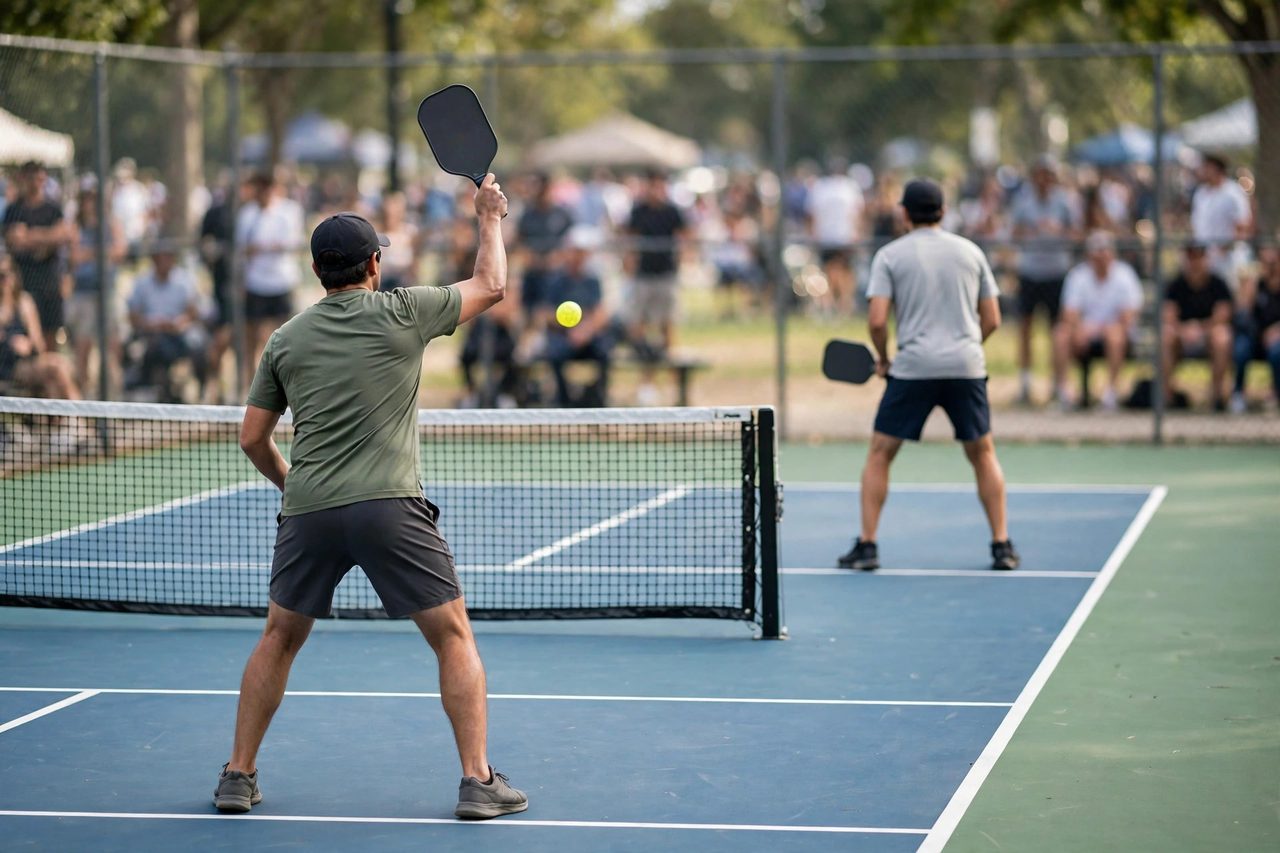
If the PPA Tour is pickleball’s VIP room, the APP Tour is the big open house. The Association of Pickleball Players — the APP — runs a tour where pros and amateurs play the same events, in the same venues, on the same weekend. Anyone can sign up. Anyone can climb.
The basics
The APP was founded in 2019 by Ken Herrmann. It started life as the Association of Pickleball Professionals, then changed its name to the Association of Pickleball Players — a small change that says a lot about what the tour is for. It is built for every player, not just the stars.
It is also the only pro and amateur pickleball tour fully and officially sanctioned by USA Pickleball. Sanctioned simply means approved by the sport’s national governing body, the organisation that sets the official rules in the United States. That link matters, because APP results feed into qualification for the USA Pickleball National Championships, the sport’s biggest amateur event.
Who plays, and how open is it really?
This is the APP’s biggest difference from the PPA Tour. The PPA is built around signed pros. To play its main draws, most players need a contract, and the biggest names are locked in. The APP works the other way round: its events are open to any player, whatever their level, and pros and amateurs compete side by side.
A typical APP Tour stop has divisions from the 3.0 skill level — a beginner-to-intermediate rating — right up to the pros, so a weekend player can enter the same event as a touring pro and maybe even face them.
In 2025 the calendar had nearly 50 competitions across the United States, 14 of them nationally televised.
The event tiers
Not every APP event counts the same. The calendar is built in layers:
- APP Tour events. The regular stops, like the APP Sacramento Open or the APP Chicago Open. These are the bread and butter of the season, with pro divisions and big amateur fields.
- APP Tour Majors. The four biggest events of the year. They carry bigger prize money, more TV time and more ranking points than a regular stop.
- Golden Ticket tournaments. Eight events on the 2025 calendar carried this label. A Golden Ticket is a free pass: winning one earns you a spot at the USA Pickleball National Championships.
- The APP Tour Championships. The season finale, held December 3–6 in 2026, where the year’s best players settle the titles. The tour also runs special events alongside the main calendar, like the APP Women’s Open and the U.S. Collegiate Championships for university players.
The AARP Champions division
Pickleball is famous for its older players, and the APP built a whole tour for them. The AARP Champions division is for pros aged 50 and over, and the AARP Masters division is for players aged 60 and over. In 2026, these divisions compete across ten APP Tour events, starting with the AARP Open in Seattle on March 26–29.
For many senior pros, this is the main stage. It is also one of the most popular parts of the tour, because the players in it are often the sport’s most recognisable names — people who have been playing since pickleball was a backyard game.
Next Gen: the youth pipeline
At the other end of the age range sits the APP Next Gen Series. Next Gen is a development programme for players aged 16 to 23. Think of it as the tour’s academy: young players compete for prize money, get mentoring from top APP pros, and build experience against real competition.
In 2025 the programme ran four Next Gen Series events and four Next Gen II events. The best young players can also earn a place on the APP Next Gen National Team — six men and six women — who represent the United States in international and professional APP competitions.
How the rankings work
A ranking is simply a player’s position on a leaderboard. The APP ranking works on a simple idea: your best 10 events from the last 365 days count.
That means two things. First, playing more does not automatically help you. If you already have ten counting results, an eleventh event only counts if it is better than your worst one. Second, results expire. A great finish from a year ago drops off, so players have to keep performing to stay near the top.
Points depend on two things: the tier of the event and how far you go in it. A Major is worth more than a regular Open, and winning is worth more than reaching the quarter-finals. The rankings update after every event, so the leaderboard is always fresh. The PPA counts a player’s best 14 results instead of 10, and its points are not interchangeable with the APP’s — a big total on one tour says nothing about your standing on the other.
How a match works on the APP
The APP plays the same basic game as everywhere else, with a few twists of its own. In pro doubles and mixed doubles, matches are best of three games to 11 points, and you must win by two. Lose early, though, and you are not done: the APP runs a back draw, a second bracket for players who lose in the main draw, played as a single game to 15.
Pro singles is different again. Points are scored on every rally, not just when you serve — that is called rally scoring — and matches are best of three games to 15, win by two.
Why it matters
The APP is not trying to be the PPA. It does not have the same prize money, and its biggest stars are not household names in the same way. What it has is something the sport needs just as much: a ladder — one system, one ranking and the same events for a teenager in Next Gen, a 55-year-old in the AARP Champions division, and an amateur entering their first tournament.
Related articles

Dubai P1: The Upset-Filled Week That Ended With Two New Champions
The Dubai P1 served up the wildest quarter-finals of the padel season, with the world No. 1s out and three first-time semi-finalists — then two new champions lifted the trophies.
How the FIP Tournament Ladder Works
Bronze, Silver, Gold and Platinum: a simple guide to padel's ladder below Premier Padel, and how players climb it.
Spain vs Argentina: The World Cup Final Padel Has Been Waiting For
Two finals, one rivalry, and a farewell: Spain and Argentina meet for both world titles in Doha, in a team event that turns padel's individual stars into national teammates.