
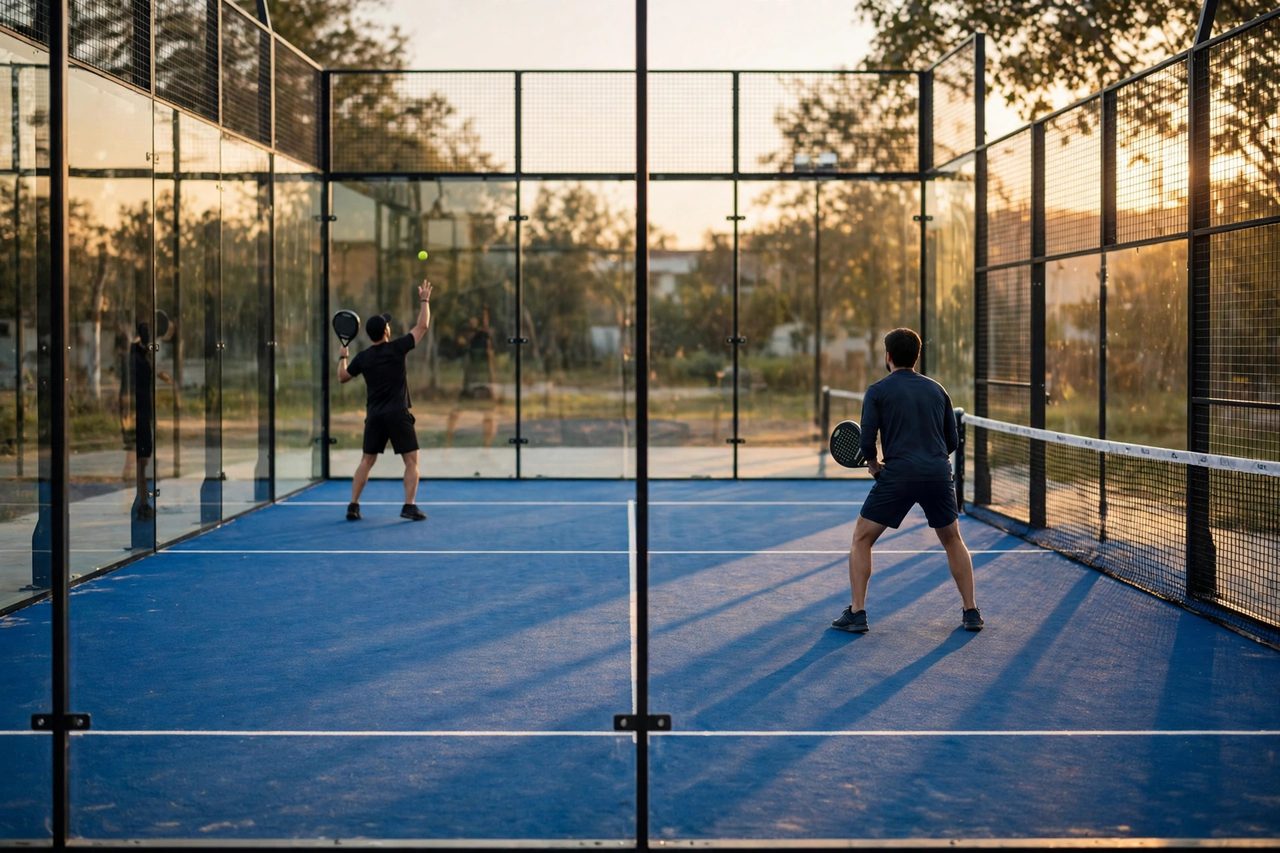
Padel looks simple from the outside. The best players in the world play Premier Padel, the main tour, and everyone else watches. But how does a player get there? There is no single jump from local courts to the biggest stages. There is a ladder, with clear steps, and every pro on the main tour has climbed it.
The ladder is run by the FIP. That stands for the International Padel Federation, the sport’s world governing body. It writes the rules of padel, keeps the world ranking, and runs its own circuit underneath Premier Padel. That circuit is called the CUPRA FIP Tour, and it is where the climb begins.
The top of the ladder
First, the top. Premier Padel is the main world tour, launched in 2022. Its events come in three sizes. A Major is the biggest event of all. There are four of them in a season — in 2026, they are in Rome, Paris, Kuwait and Acapulco — and the winners take 2,000 ranking points each. Ranking points are the points that decide a player’s place in the world ranking: the more you win, the more you earn, and the higher you climb.
Below the Majors sit the P1 events, worth 1,000 points to the winners, and the P2 events, worth 600. There are ten P1s and nine P2s on the 2026 calendar.
Only the best-ranked pairs get straight into these events. A pair is two players who play together, and padel is always played as doubles. Lower-ranked pairs have to play qualifying first. Qualifying is a mini-tournament held before the main event, where lower-ranked players fight for the last few places in the main draw — the tournament itself. If your ranking is too low even for qualifying, you do not get in at all. That is why the ladder below matters so much.
The four rungs below
The CUPRA FIP Tour has four levels, from smallest to biggest. It started in 2019, and by the end of 2025 it had staged 805 tournaments in 61 countries.
| Level | Points for the winners | Prize money (roughly) |
|---|---|---|
| FIP Bronze | 40 | €7,000 – €10,000 |
| FIP Silver | 80 | €15,000 – €30,000 |
| FIP Gold | 150 | €50,000 – €80,000 |
| FIP Platinum | 300 | €120,000 – €150,000 |
A Bronze is the smallest rung: a local event, often in a country where padel is still growing, with a small prize pot and 40 points for the winners. A Silver doubles that to 80 points, a Gold pays 150, and a Platinum — the top of the FIP Tour — pays 300 points and a prize pot of up to €150,000. One Platinum title is worth half a P2 title on the main tour, and more than seven Bronze titles put together.
Who plays each level
Each level has its own crowd. Bronze and Silver events are where young players get their first taste of international padel: a junior coming out of a national youth setup, or a local pro who dominates the courts at home. Gold events are a step up — the players here are usually ranked in the world’s top 100 or just outside it. A Gold title can move a player a long way, because 150 points is a serious chunk of a ranking. Platinum events are the shop window of the FIP Tour, with strong fields that often include players who also play Premier Padel.
How a player climbs
Here is how the climb works. Take a player ranked around 200th in the world. They cannot get into a P2, let alone a Major, so they play Bronzes and Silvers near home, winning matches and collecting points. The world ranking is built from a player’s best 22 results over the last 52 weeks, so a year of steady results adds up.
As the points pile up, the ranking rises, and the player reaches Golds, then Platinums, until they are ranked high enough to play qualifying at a P2 — the lowest rung of Premier Padel. Win through qualifying, and they are in a main draw on the main tour. Win a round or two there, and the points are big enough to keep them there.
There is no single magic result. It is a slow build, one tournament at a time. The ranking is individual, even though padel is played in pairs, so each player keeps their own points when they change partners. And a pair’s seeding — its place in the draw, which decides who it might face early — is based on the two players’ points added together.
Why the ladder matters
The ladder matters because padel is growing fast, and growth needs a way in. Without the FIP Tour, a talented player in a country with no big tournaments would have nowhere to start. The Bronze and Silver events bring international padel to new places — small cities, new markets, countries where the sport is only just taking off — and local players get a real path to the top. It also keeps the main tour honest: spots on Premier Padel are earned, not given. If a young pair keeps winning Golds and Platinums, their ranking forces the door open.
What changes in 2027
The FIP and Premier Padel have announced changes for 2027. The ranking will count a player’s best 21 results instead of 22. Players will earn more points for winning early rounds at Premier Padel events. And the very top players will be kept out of the lower FIP tiers — for example, the top four players will not be allowed to play FIP Gold events — so those rungs stay open for the players who need them most.
So the next time you see an unfamiliar name in a Premier Padel draw, check where they came from. Chances are they spent a year or two grinding through Bronzes, Silvers and Golds. That is how padel works. The stars at the top did not appear there. They climbed.
Related articles
Dubai P1: The Upset-Filled Week That Ended With Two New Champions
The Dubai P1 served up the wildest quarter-finals of the padel season, with the world No. 1s out and three first-time semi-finalists — then two new champions lifted the trophies.

Spain vs Argentina: The World Cup Final Padel Has Been Waiting For
Two finals, one rivalry, and a farewell: Spain and Argentina meet for both world titles in Doha, in a team event that turns padel's individual stars into national teammates.
How the APP Tour Works
The APP Tour is pickleball's open tour, where pros and amateurs play the same events and anyone can climb the ladder.