
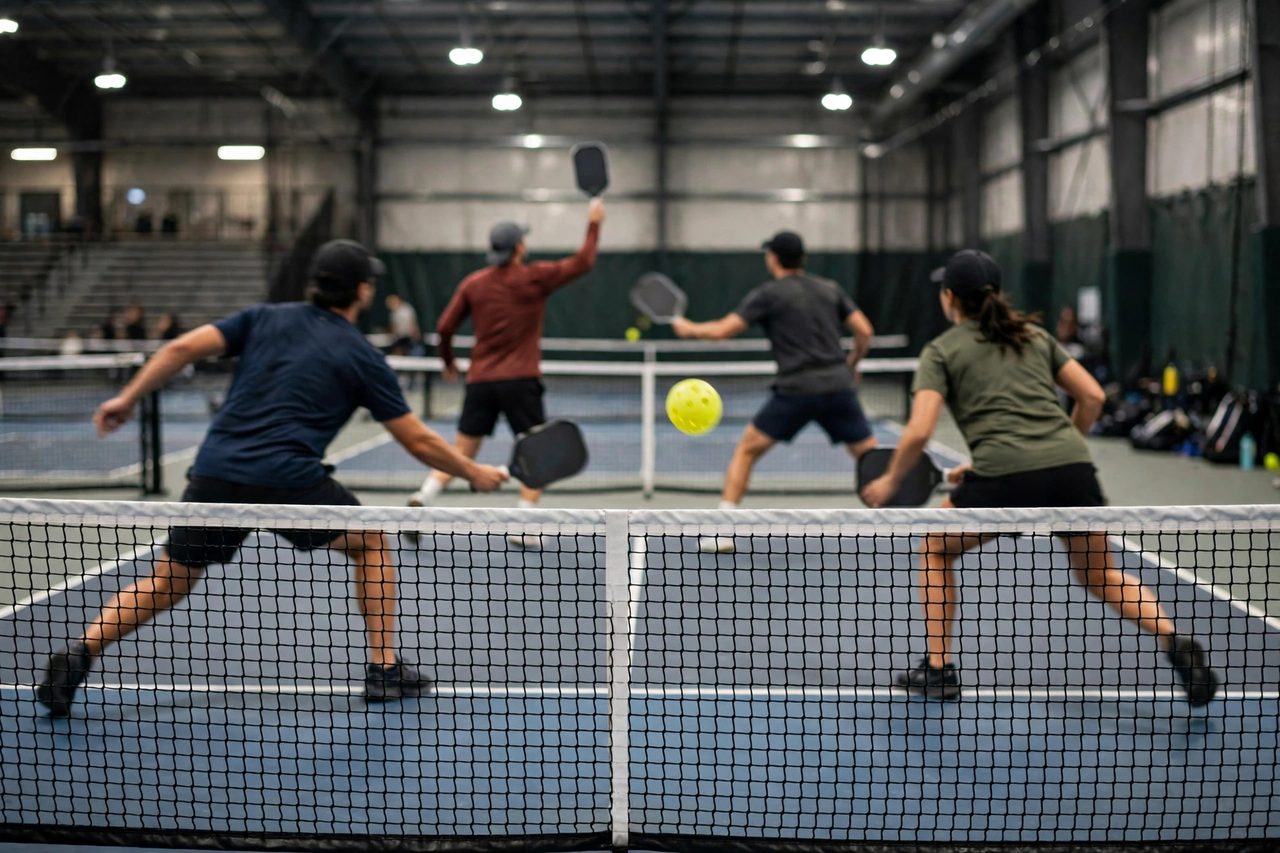
Major League Pickleball is the sport’s team competition, and it looks nothing like a normal tournament. There are no individual brackets. Instead, franchises draft squads, play head-to-head team matches, and settle ties with one of the most dramatic formats in racquet sports: the DreamBreaker. Here is how it all works.
The team match: four games, always
Every MLP match consists of four games, played in this order:
- Women’s doubles
- Men’s doubles
- Mixed doubles
- Mixed doubles
All four games are always played, even if a team clinches the match 3-0 early. That rule exists because point differential and game results feed into the standings, so every game on every day carries real stakes.
The doubles games use traditional side-out scoring: only the serving team can score. Games are played to 11 points, win by 2, and teams switch ends when the first team reaches 6 points.
The DreamBreaker
When a match finishes 2-2 after the four regulation games, it goes to the DreamBreaker, MLP’s signature tiebreaker and the reason many fans watch the league.
The DreamBreaker is a singles shootout played with rally scoring, meaning every rally scores a point regardless of who serves. It is a race to 21, win by 2, with one twist that makes it brutally tense: the match must be won on your own serve.
Each team’s players rotate through in four-rally cycles in a set order announced before the tiebreaker begins. Every player on the roster takes part, which means the order in which a captain lines up the rotation is a genuine tactical decision. Teams switch ends at 11 points, and each team gets one timeout.
The DreamBreaker has decided championships and produced some of the most-watched moments in pickleball, including playoff heroics that landed on SportsCenter’s Top 10 in the 2026 season.
Rosters and the draft
MLP builds its teams through a draft: franchises select players from the pool of available professionals rather than players entering as fixed pairs. In 2026 the league scrapped its old two-tier system, Premier and Challenger levels were folded into a single tier, and every team rosters six players, three men and three women. The 2026 rules also require teams to use their full roster during events rather than leaning on a starting four.
Before the season, three 2025 franchises did not return, with players from those teams entering the free agency pool, while the Palm Beach Royals joined as an expansion franchise at a league-record $16 million valuation.
The season structure
The MLP season runs from May through August, presented by DoorDash. Regular-season events run Thursday through Sunday in team markets across the United States. The 2026 season opened in Dallas in late May, home of the 2024 champion Dallas Flash, closed its regular season at Disney’s ESPN Wide World of Sports complex in Orlando, and included a mid-season tournament in Grand Rapids.
Playoff qualification is based on cumulative standings points earned across the season, with points awarded for each team’s Super Sunday result at every event. The 2026 playoffs were expanded to a three-week format, with rounds in Dallas and Newport Beach before the finals in New York City. Amateur play runs alongside the pros: MiLP and junior MLP activations are staged at select events.
Why the format matters
MLP’s design choices are deliberate. The team structure gives fans someone to root for week after week, the draft creates storylines around player movement, and the DreamBreaker guarantees that no match night ends quietly. With the 2026 season setting league records for attendance and television ratings, including 773,000 viewers for the finals on CBS, the format appears to be doing exactly what it was built to do.
Related articles
Dubai P1: The Upset-Filled Week That Ended With Two New Champions
The Dubai P1 served up the wildest quarter-finals of the padel season, with the world No. 1s out and three first-time semi-finalists — then two new champions lifted the trophies.

How the FIP Tournament Ladder Works
Bronze, Silver, Gold and Platinum: a simple guide to padel's ladder below Premier Padel, and how players climb it.
Spain vs Argentina: The World Cup Final Padel Has Been Waiting For
Two finals, one rivalry, and a farewell: Spain and Argentina meet for both world titles in Doha, in a team event that turns padel's individual stars into national teammates.