
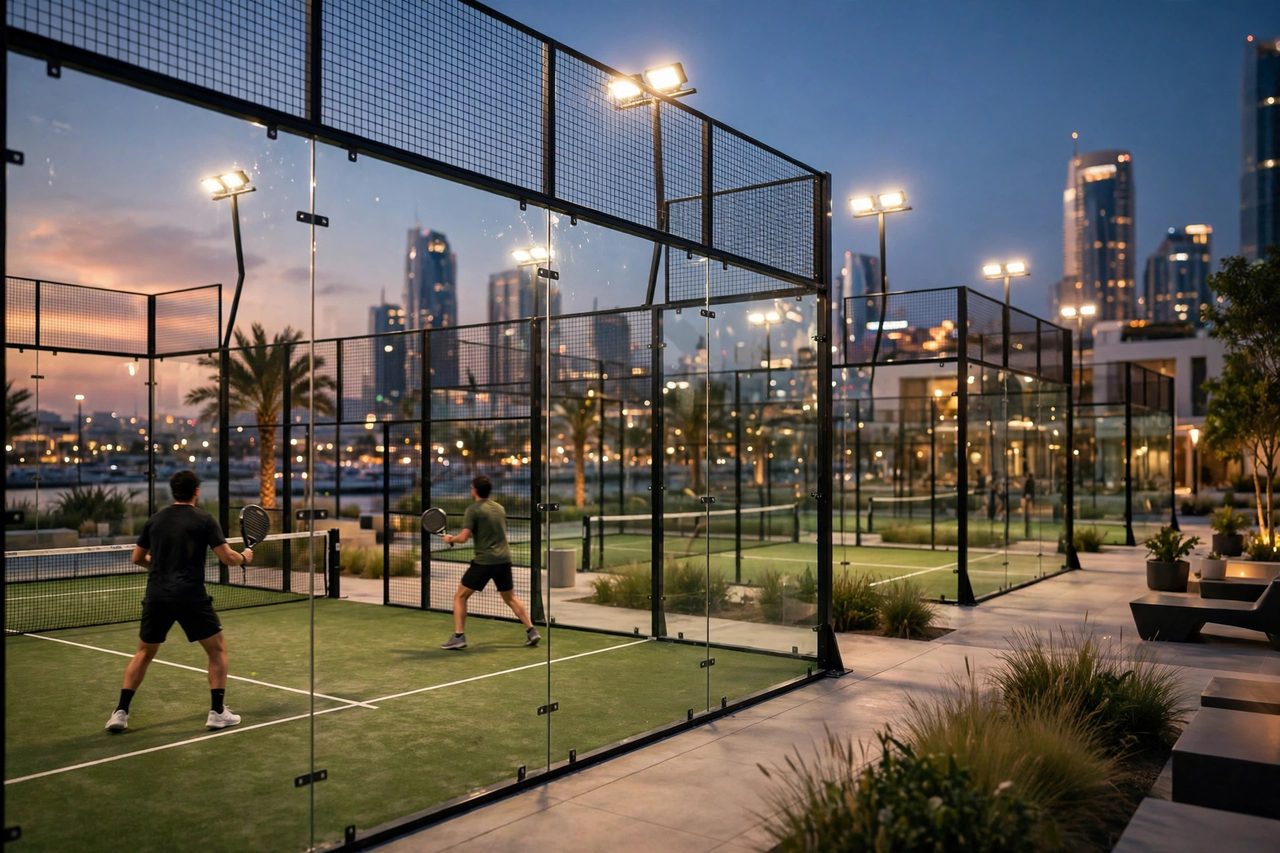
Stand on a rooftop in Dubai at 8 p.m. and you will hear it: the hollow pop of a padel ball off a glass wall, floating up from floodlit courts below. Ten years ago that sound barely existed in the Gulf. Today padel is everywhere in the region — in hotels, on rooftops, in malls, and in housing developments that now advertise courts the way they used to advertise swimming pools.
The numbers tell the story. Saudi Arabia has more than 1,100 courts, according to the International Padel Federation’s 2025 world report, across more than 430 facilities. The United Arab Emirates has around 1,000 courts. Kuwait has about 600. Qatar has more than 150. Add them up and the Gulf states hold close to 3,000 courts — in a region where, a few years ago, most people had never heard of the sport.
Why the Gulf fell for padel
Padel is an easy sell in the Gulf. It is played in pairs on a small court enclosed by glass walls, and it is simple to learn: most beginners can enjoy a rally in their first session. It is social — four people, one small court, constant conversation — and it fits the region’s lifestyle. In a climate where summer temperatures pass 40 degrees, air-conditioned indoor courts let people play all year round. Hotels and housing developers noticed quickly, and courts became a standard feature of new luxury projects, alongside gyms and pools.
The sport also arrived with money behind it. In 2023, Qatar Sports Investments, the owner of Paris Saint-Germain football club, bought the World Padel Tour and folded it into a single world circuit, Premier Padel. That put Gulf money at the centre of the professional game — and it put Gulf cities on the tour map.
The tour follows the money
This week is a good example. The Kuwait Major, one of only four Majors on the Premier Padel calendar, is being played at The Arena Kuwait — the same venue that hosted the first FIP World Cup Pairs last year. Next comes the FIP World Cup in Doha, padel’s world team championship. Then a P1 event in Dubai, the next tier down from a Major. Three huge weeks, three Gulf cities, one after another.
The 2026 Premier Padel season opened in Riyadh, Saudi Arabia, in February, and the season includes 26 tournaments in 18 countries. The Gulf is no longer a stop on the tour. It is the spine of the calendar’s biggest stretch.
That matters for the region’s players too. Local players get to watch the world’s best up close, and Gulf federations are investing in coaching and junior programmes to build their own talent. The region’s courts are not just for tourists and expats anymore.
What it costs to play
Padel in the Gulf is not cheap. Court hire at premium Dubai clubs can run to hundreds of dirhams per hour at peak times, among the highest prices anywhere in the sport. That is the other side of the boom: padel here grew as a premium product, tied to hotels, private clubs and luxury housing, rather than as a cheap neighbourhood sport.
That is starting to change at the edges. More public and mid-priced clubs are opening, and the sheer number of courts means prices face downward pressure in some areas. But for now, padel in the Gulf remains a sport you pay properly for — and the waiting lists at popular clubs suggest most players think it is worth it.
The lesson for the rest of the world
The Gulf boom is a preview of what padel’s next decade could look like elsewhere. The formula is simple: small courts that fit into existing buildings, a game that beginners enjoy immediately, a social format that suits groups of friends, and professional events that give the sport a shop window.
Spain and Italy got there first, with tens of thousands of courts between them. Sweden boomed and then crashed, building too many courts too fast. The Gulf, so far, has avoided that mistake by growing with money and events behind it, not just concrete.
The question now is whether the Gulf can turn players into champions. Courts and tournaments are the easy part. The harder part — the one that takes a generation — is producing local players who can compete with the Spanish and Argentine stars who currently fill the tour’s top ranks. The courts are built. The crowds are there. The next chapter is the players.
Related articles
Pickleball's Billion-Dollar Paddle Boom: How a Backyard Game Became Big Business
Sixty years ago, the first pickleball paddles were plywood boards cut in a basement. Today they are $200 carbon-fibre pro gear, and the paddle business is worth about a billion dollars a year.
Padel Is a Social Club First, a Sport Second
After-work games, club bars, mixed doubles nights and team outings: padel grew so fast because the game is built around people, not just points.
Pickleball's Noise Problem: The Sport the Neighbours Love to Hate
Pickleball is the fastest-growing sport in America, but its sharp pop is driving neighbours to court, closing courts and forcing the sport to get quieter.