
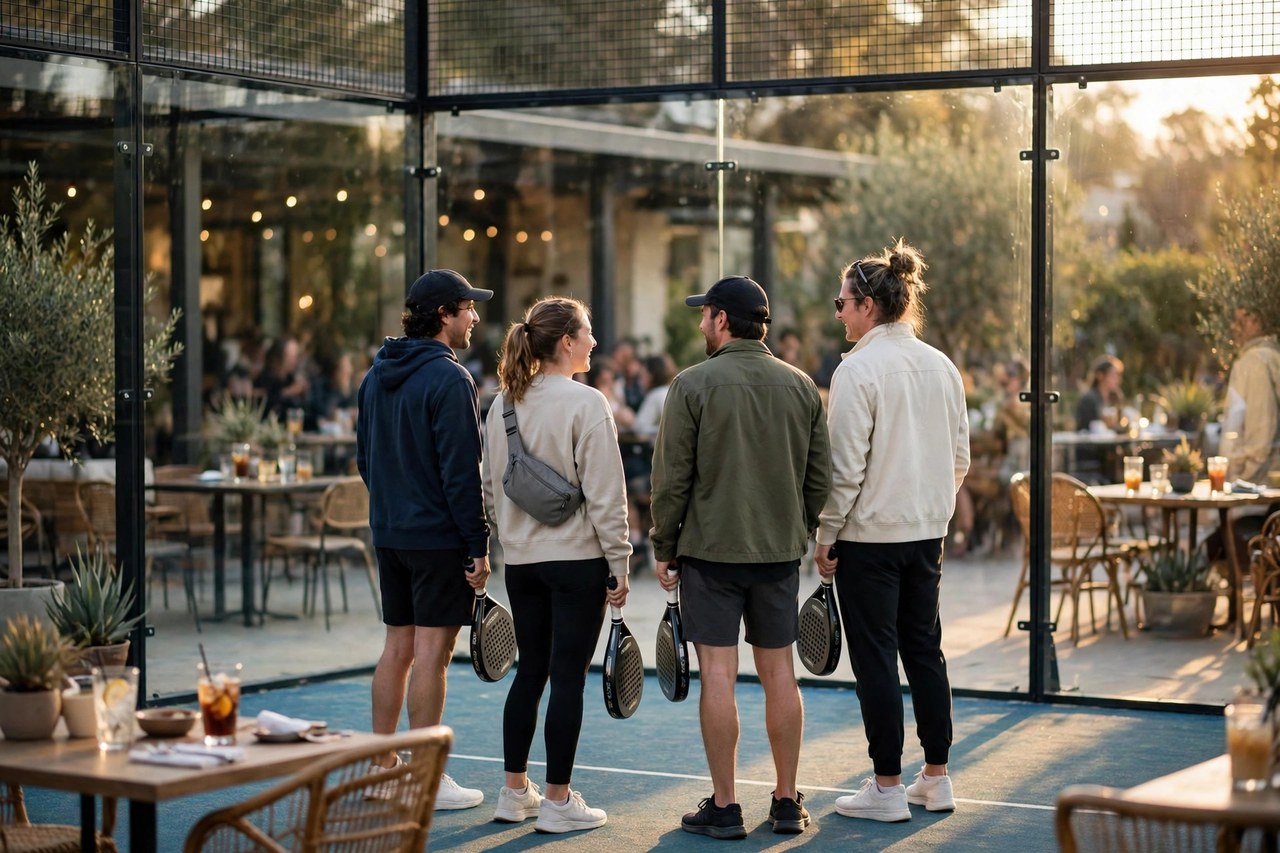
The best part of padel often starts after the last point. The game ends, the four players walk off the court, and nobody goes home. They sit down at the club bar, order food and drinks, and stay for another hour. The match was just the warm-up for the evening.
That is the secret behind padel’s rise. It is a fun sport, yes. But it is also a place to meet people. For a lot of players, the club matters as much as the court.
A game built for talking
Padel is a racquet sport played in pairs on a small court surrounded by glass walls. The walls keep the ball in play, so points last longer than in most racquet sports. You play with a partner, against two other players, on a court about a third the size of a tennis court.
That setup makes padel social by design. You are never alone on court. You always have a partner next to you, and two opponents close by. A rally is a back-and-forth exchange of shots between the two sides. In padel, rallies last a long time, because the glass walls bounce the ball back into play. There is time to laugh, to joke, and to cheer each other on between points.
Compare that to running or going to the gym. You can do those things with friends, but the exercise itself is mostly silent. In padel, talking is part of the game. You plan points with your partner. You celebrate together. You blame the glass wall together when a shot goes wrong.
The after-work game
In Spain, where padel grew up, the after-work game is a habit. Friends book a court for 7 or 8 in the evening, play for an hour, and then eat together at the club. It is the same slot a lot of people once gave to after-work drinks — only now the drinks come after the sport.
The same pattern is spreading everywhere padel grows. In Sweden, in the Gulf, in Britain, in the United States, clubs fill up on weekday evenings with groups of work friends. Many of them are people who never played a racquet sport before. Padel is easy to start, so a group of four colleagues can have a real game on their first night. Nobody needs months of lessons first.
Some clubs now run their evenings like a bar with courts attached. There are quiz nights, live music, and food menus that go well past a snack bar. The court booking brings people in. The bar keeps them there.
Mixed doubles nights
One of the most popular ideas at padel clubs is the mixed doubles night. Mixed doubles means teams of one man and one woman playing together in pairs. Clubs set up an evening where players sign up alone and get matched with new partners every round.
It works because padel is forgiving. The court is small, the ball is soft, and a clever shot beats a hard shot most of the time. A beginner and a strong player can share a court and both enjoy it. That is rare in sport, and it is why mixed nights pull in people who would never join a league or a team.
For many players, these nights are how they meet their padel group. They arrive alone and leave with three new friends and a regular Thursday game.
The new golf
People keep calling padel the new golf. The comparison makes sense. Golf was never only about the game. It was where business deals happened, where friendships formed, and where people spent four unhurried hours together. Padel does the same thing in one hour, at a much lower cost, and with far less skill needed to start.
Companies have noticed. Team nights are now a normal work event: a firm books four courts, splits its staff into teams, and finishes the evening with dinner at the club. It is cheaper than a golf day, it gets everyone moving, and it mixes people who would never sit together at the office.
It works for dating, too. A padel date is low-pressure in a way a dinner date is not. You have something to do, something to laugh about, and a ready-made excuse to meet again next week — “same time Thursday?”
Why the club is the point
The numbers show how big this has become. The International Padel Federation’s World Padel Report 2026 counts more than 91,000 courts and nearly 28,500 clubs worldwide, in 191 countries and territories, with more than 40 million people playing the game. Almost every one of those clubs has the same business model: the courts bring people in, and the social life keeps them coming back.
That is why new padel clubs look less like sports centres and more like members’ clubs. The bar is not an afterthought. It is the heart of the building. Some clubs have restaurants, co-working space, and kids’ areas, so the whole evening — or the whole Saturday — happens in one place.
The sport itself helps, of course. Padel is fast, fun, and easy to learn. But plenty of fun sports never built a scene like this. Padel did because the game gives people a reason to gather, and the club gives them a reason to stay.
So if someone invites you to padel, say yes — even if you have never held a racquet. You might lose the match. You will probably gain a regular evening, a few new friends, and a table at the club bar with your name on it.
Related articles
Pickleball's Billion-Dollar Paddle Boom: How a Backyard Game Became Big Business
Sixty years ago, the first pickleball paddles were plywood boards cut in a basement. Today they are $200 carbon-fibre pro gear, and the paddle business is worth about a billion dollars a year.
Pickleball's Noise Problem: The Sport the Neighbours Love to Hate
Pickleball is the fastest-growing sport in America, but its sharp pop is driving neighbours to court, closing courts and forcing the sport to get quieter.
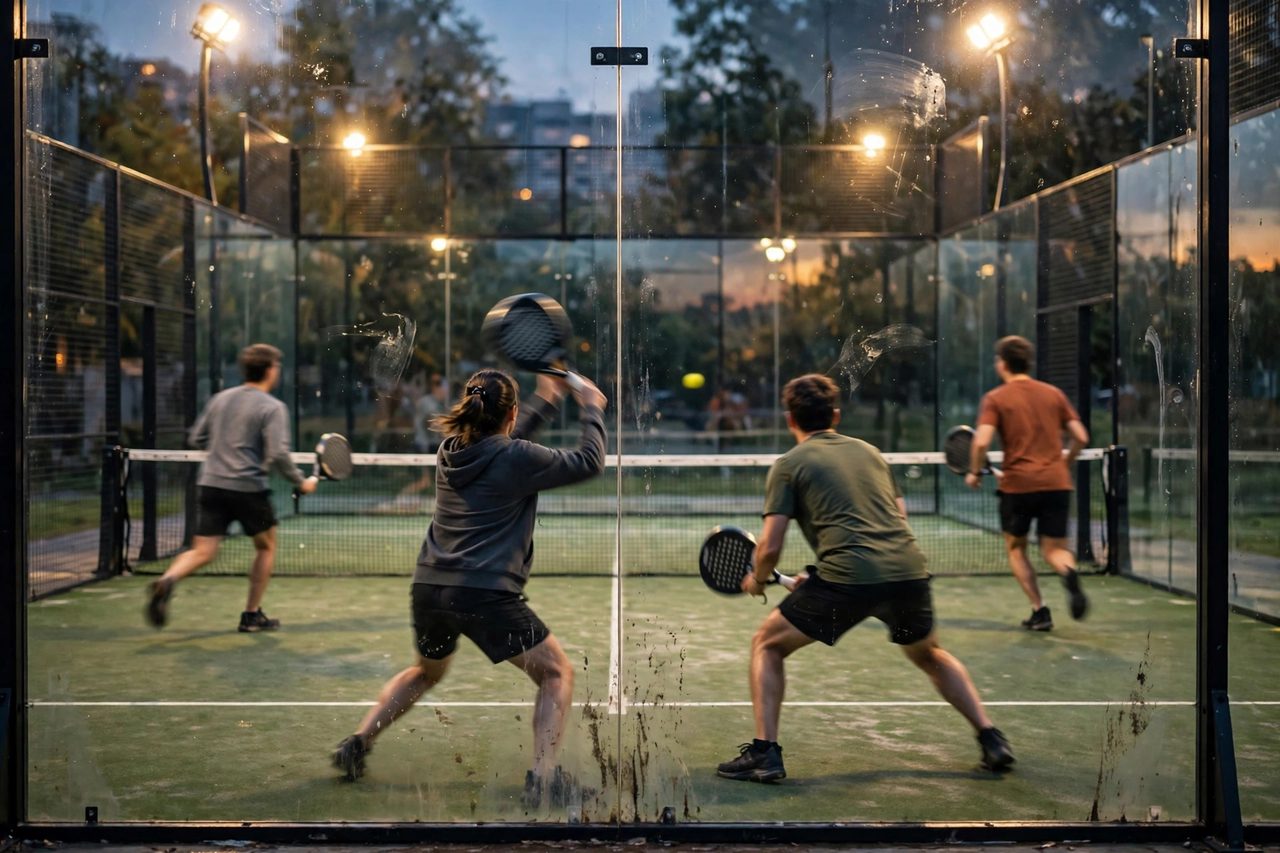
How Footballers and Celebrities Made Padel the Sport of the Stars
From footballers opening clubs to actors owning teams, famous faces turned padel into the sport everyone wants to try.