
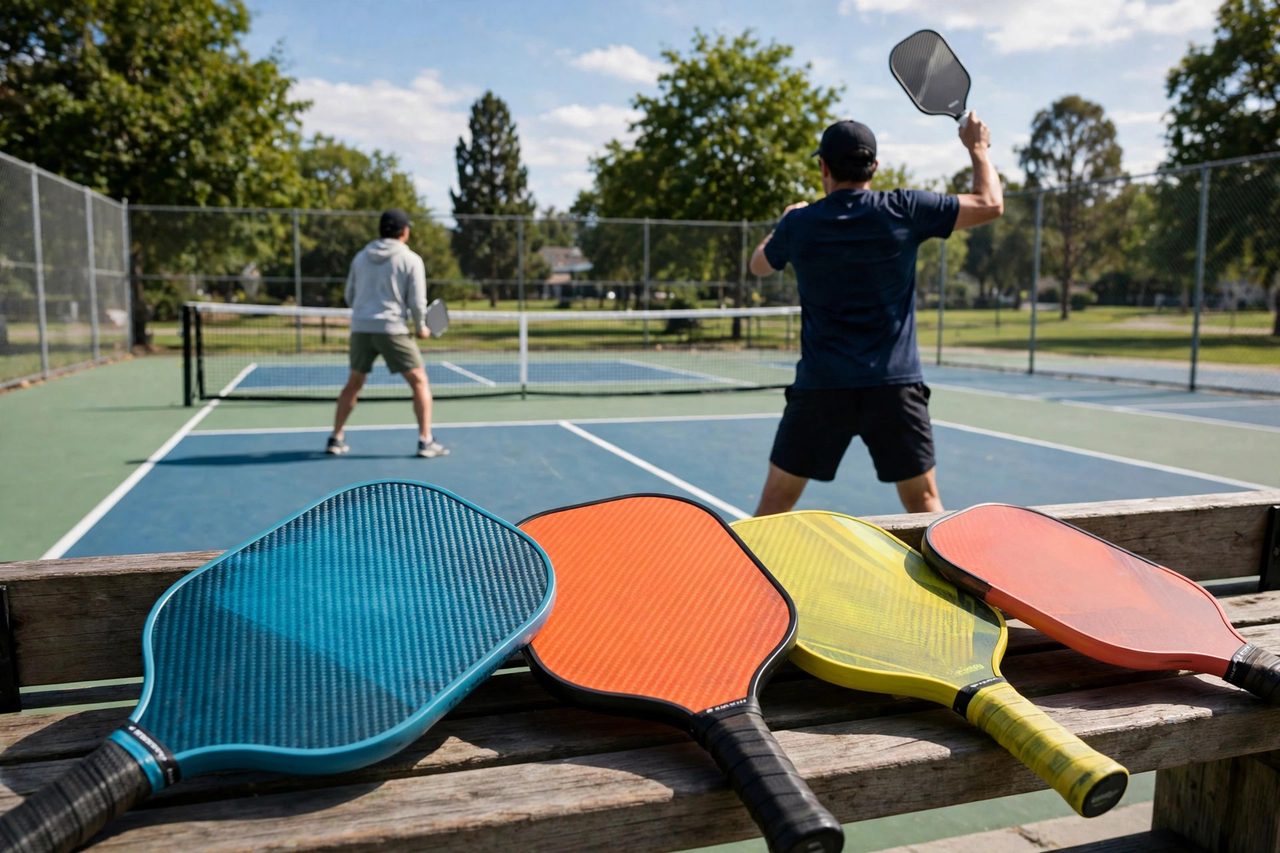
Walk into any sports shop in America today and you will find a wall of pickleball paddles. Some cost less than a pizza. Others cost more than a pair of good trainers. Sixty years ago, there was no wall at all. There was a basement, a bandsaw, and a sheet of plywood.
Pickleball was invented in the summer of 1965, on Bainbridge Island in Washington state. A paddle is the flat bat you use to hit the ball — pickleball has no strings, unlike a tennis racquet. The first players started with table tennis paddles, then realised they were too small. One of the game’s inventors, Barney McCallum, went down to his basement and cut bigger paddles out of plywood. In 1968, the inventors set up a small company to sell wooden paddles and starter kits. That was the whole industry.
For decades, that was roughly how it stayed. Pickleball was a friendly backyard game, mostly played by older Americans, and a wooden paddle did the job fine. Then the game exploded.
Millions of new players
The numbers are hard to believe. In 2020, about 4.2 million Americans played pickleball, according to the Sports & Fitness Industry Association, known as SFIA. By 2025, that number had reached 24.3 million. That is growth of nearly 480 percent in five years, and SFIA calls pickleball America’s fastest-growing sport for the fifth year in a row. Around 7.5 million of those players are regulars who play at least eight times a year.
Every one of those players needs a paddle. Many of them buy more than one. And that is where the money comes in.
Market researchers put the global pickleball paddle market at roughly $1 billion in 2025. Different firms give slightly different numbers, but they agree on the shape of the story: the market is big, it is still growing, and it could roughly double over the next decade.
From plywood to carbon fibre
The paddle itself has changed beyond recognition. Carbon fibre is a light, stiff material made from woven carbon threads — the same stuff used in racing bikes and aircraft parts. A modern pro paddle has a carbon-fibre face and a honeycomb plastic core inside. The core is a layer of tiny hexagonal cells, like a beehive, that keeps the paddle light but strong.
That change matters on court. A wooden paddle is heavy and dead: the ball comes off it slowly and with little spin. A carbon-fibre paddle is lighter, so you can swing it faster, and its rough, textured face grips the ball. Grip the ball and you can add spin — spin is when the ball rotates in the air, which makes it dip, curve or kick off the bounce. The sweet spot is the part of the paddle face where hits feel best and go where you want them to.
The result is a ladder of prices. At the bottom, a simple wooden paddle still costs under $10. A decent beginner set with two paddles and balls can be had for around $15 to $50. In the middle, solid carbon-fibre paddles from the big brands sell for $50 to $100. At the top, the pro models pass $200 — and some go well beyond that.
The brands fighting for your bag
A handful of brands now dominate the paddle wall. JOOLA, Selkirk and Franklin are the names most players know, alongside HEAD, Paddletek, Diadem and a growing crowd of smaller makers. USA Pickleball, the sport’s governing body in the US, approved 718 new paddles in 2025 alone, and 193 new manufacturers registered with it that year. The wall keeps getting longer.
The brands compete the way sports brands always have: by signing stars. A signature paddle is a paddle designed with a pro player and sold under their name. JOOLA’s best-known line carries the name of Ben Johns, the sport’s biggest star — his Hyperion range sells for around $160, and the newer Pro V models list at about $200. JOOLA also makes signature paddles for Tyson McGuffin and Anna Bright. Selkirk’s premium line, the LABS Boomstik, lists at $333. Franklin, one of the oldest names in the game, built signature paddles with Johns, Aspen Kern and Christine McGrath.
This is the tennis and golf playbook, applied to a sport that barely existed on television ten years ago. Fans buy the paddle their favourite player uses. Amateurs argue about paddle weight and core thickness the way golfers argue about clubs. The paddle has become a piece of identity, not just a piece of kit.
What the boom changed
The money changed the game itself. Big brands now sponsor pro tournaments, which means bigger prize money and better broadcasts. They fund junior programmes and college teams. They pay the top players enough that pickleball can be a full-time job, which was unthinkable when the sport was a retirement hobby.
It also changed who plays. The old image of pickleball was a game for retirees in Florida. SFIA’s figures show the fastest-growing group of players is now teenagers and young adults aged 13 to 24. Women make up about 43 percent of players, up from under 39 percent in 2020. A sport that sells $200 carbon-fibre paddles to twenty-somethings looks very different from the one that sold wooden boards by mail order in 1968.
But the direction is clear. A game invented because some bored kids could not find a shuttlecock now has a billion-dollar equipment industry, pro stars with signature gear, and millions of new players a year. The paddle went from a basement bandsaw to carbon fibre. The backyard game became a business — and the business is still growing.
Related articles
Padel Is a Social Club First, a Sport Second
After-work games, club bars, mixed doubles nights and team outings: padel grew so fast because the game is built around people, not just points.
Pickleball's Noise Problem: The Sport the Neighbours Love to Hate
Pickleball is the fastest-growing sport in America, but its sharp pop is driving neighbours to court, closing courts and forcing the sport to get quieter.
How Footballers and Celebrities Made Padel the Sport of the Stars
From footballers opening clubs to actors owning teams, famous faces turned padel into the sport everyone wants to try.