
Not long ago, watching professional pickleball on television felt like finding a local access channel by accident. The camera angles were flat, the sound was thin, and nobody explained what was happening. If you did not already play the game, you had no reason to stay. That has changed fast, and the numbers now tell a story no one in sports television can ignore.
The headline number came in January 2026. The Carvana PPA Masters, shown on CBS, averaged 791,000 viewers and peaked at 1,047,000. A peak is the highest audience reached at any moment during the broadcast. In the same time slot, that broadcast outdrew an NBA game on Amazon Prime, college basketball on FOX, NBC and ESPN, the Premier League on USA Network, and Liga MX on Univision. A sport that barely existed on national television a few years ago was beating some of the biggest properties in American sports, head to head, on a Sunday.
Then came August. The Major League Pickleball Finals, also on CBS, averaged 773,000 viewers between noon and 1 p.m. Eastern on the Sunday the New Jersey 5s sealed their first full-season title over the St. Louis Shock in New York’s Central Park. That was the highest audience in MLP history, a 55% jump on the previous year’s final, and just 18,000 viewers short of the all-time pickleball record set in January. Two record audiences in one year is not a fluke. It is a trend.
What changed on screen
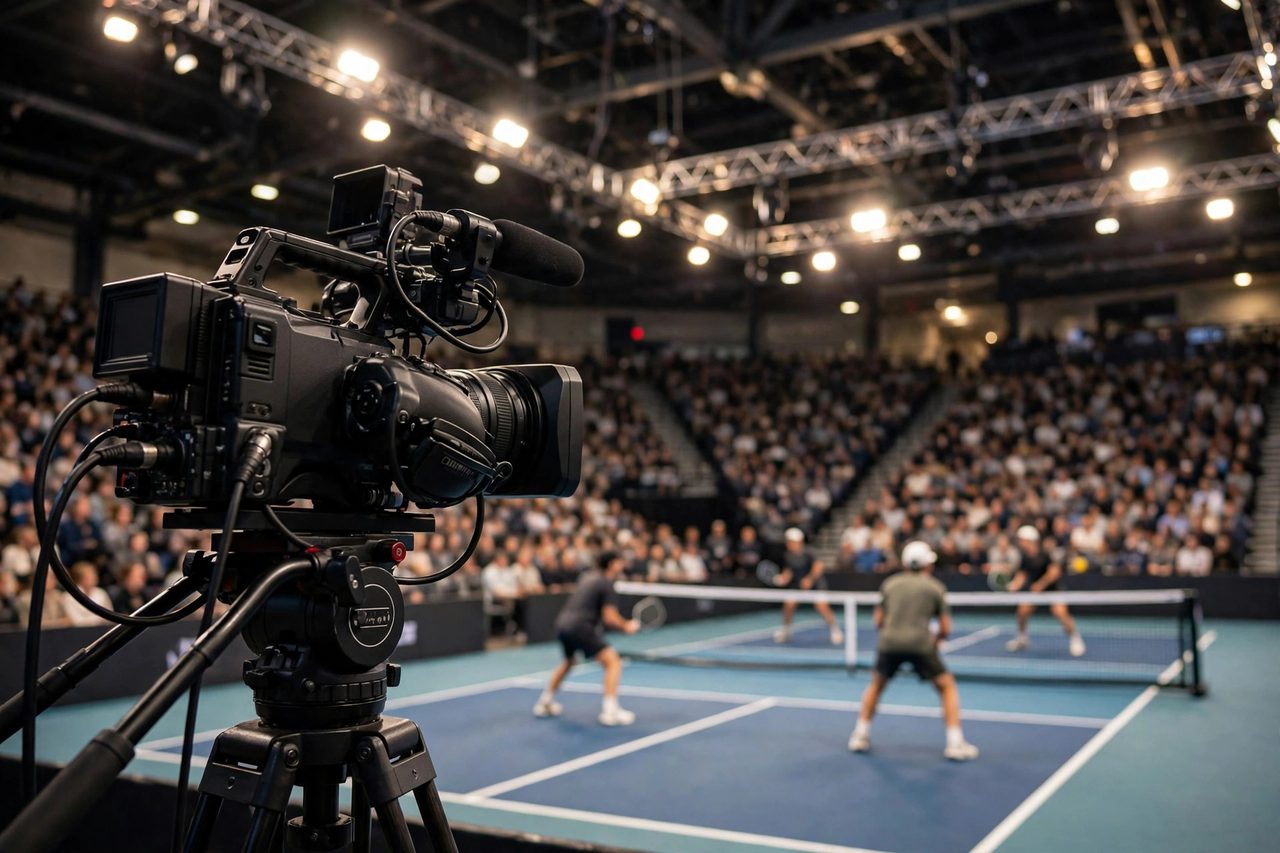
The first change was the simplest: pickleball started to look like television, not like a livestream. Broadcasters moved cameras lower and closer, so viewers could feel the speed of the hands battles at the net. A hands battle is the rapid-fire exchange of volleys — volleys are shots hit before the ball bounces — that breaks out when both teams are at the kitchen line. The kitchen line is the line marking the no-volley zone near the net. Shot from the side at net height, those exchanges look electric. Shot from high in the stands, they look like nothing at all.
Sound changed too. The pop of the paddle — the sharp crack a plastic pickleball makes off a paddle face — became part of the broadcast’s identity, the way the thwack of a tennis ball or the swish of a basketball net is part of theirs. Microphones near the court now catch players talking, laughing and arguing, which makes strangers on screen feel like people you know. Pickleball’s players are unusually open on court, and television finally let that show.
The third change was explanation. Pickleball has rules that confuse first-time viewers: the kitchen, the double-bounce rule, the scoring that only lets the serving side add points. The double-bounce rule says each side must let the ball bounce once on the first two shots of a rally, before anyone is allowed to volley. Broadcasts now explain these ideas in plain language during matches instead of assuming viewers already know them. That matters, because most of the new audience does not play the sport yet. They are discovering it through the screen, and the screen has to teach as well as entertain.
What the boom changed off screen
Television money changed the sport’s shape. In 2024, more than 350 hours of MLP and PPA Tour coverage aired across FOX, CBS, ESPN, ESPN2, Amazon Prime, Tennis Channel and others, and Pickleballtv — the sport’s own 24/7 streaming platform — passed 1 billion minutes watched in a season. In 2025, the PPA Tour reported a 95% rise in minutes viewed per event on Pickleballtv, ticket revenue up 33% per domestic event, and attendance up 16% per event. MLP reported sponsor revenue more than doubling, ticket revenue up 94%, and YouTube views up 230%. Television did not just show the sport to more people. It gave sponsors a reason to pay more, which gave tournaments bigger stages, which gave television a better product to show. The circle feeds itself.
It also changed who plays. When the PPA and MLP reported their 2024 season, they noted that roughly 130 contracted professional players earned more than $30 million collectively, with women on equal pay averaging $260,000 — more than the highest-paid WNBA player at the time. That sentence travelled further than any rally ever could. Parents, agents and young athletes noticed. A sport where you can make a living, be on CBS on a Sunday, and still be early in its story is a tempting place to build a career.
And it changed the calendar. The PPA Tour now produces original streaming content too, including Prime Video’s Partners, a six-episode docuseries following the 2025-26 season. A docuseries is a documentary told across several episodes, following real people over time. Sports fans know this trick from Formula 1’s Drive to Survive: a behind-the-scenes show turns players into characters, and characters bring in viewers who never watched a match. Pickleball is betting the same trick works for it.
What comes next
There are still problems to solve. Pickleball’s TV audience is big for pickleball, but small next to the NFL or the NBA finals. Matches can run long, and the sport still has to explain itself to every new viewer. The next step is probably not more hours, but better hours: prime-time slots, bigger finals, and broadcasts that trust the sport to be fast, loud and funny as it is.
But the direction is clear. A decade ago, pickleball was a curiosity you played at a community centre. Today it is a television product that beats the NBA in its time slot, pays its stars properly, and has its own streaming channel running around the clock. The sport did not change to fit television. Television changed to fit the sport — closer cameras, louder sound, simpler explanations — and the audience came with it. That is a lesson every young sport dreams of learning, and pickleball just learned it in public.
Related articles
Pickleball's Billion-Dollar Paddle Boom: How a Backyard Game Became Big Business
Sixty years ago, the first pickleball paddles were plywood boards cut in a basement. Today they are $200 carbon-fibre pro gear, and the paddle business is worth about a billion dollars a year.
Padel Is a Social Club First, a Sport Second
After-work games, club bars, mixed doubles nights and team outings: padel grew so fast because the game is built around people, not just points.
Pickleball's Noise Problem: The Sport the Neighbours Love to Hate
Pickleball is the fastest-growing sport in America, but its sharp pop is driving neighbours to court, closing courts and forcing the sport to get quieter.