
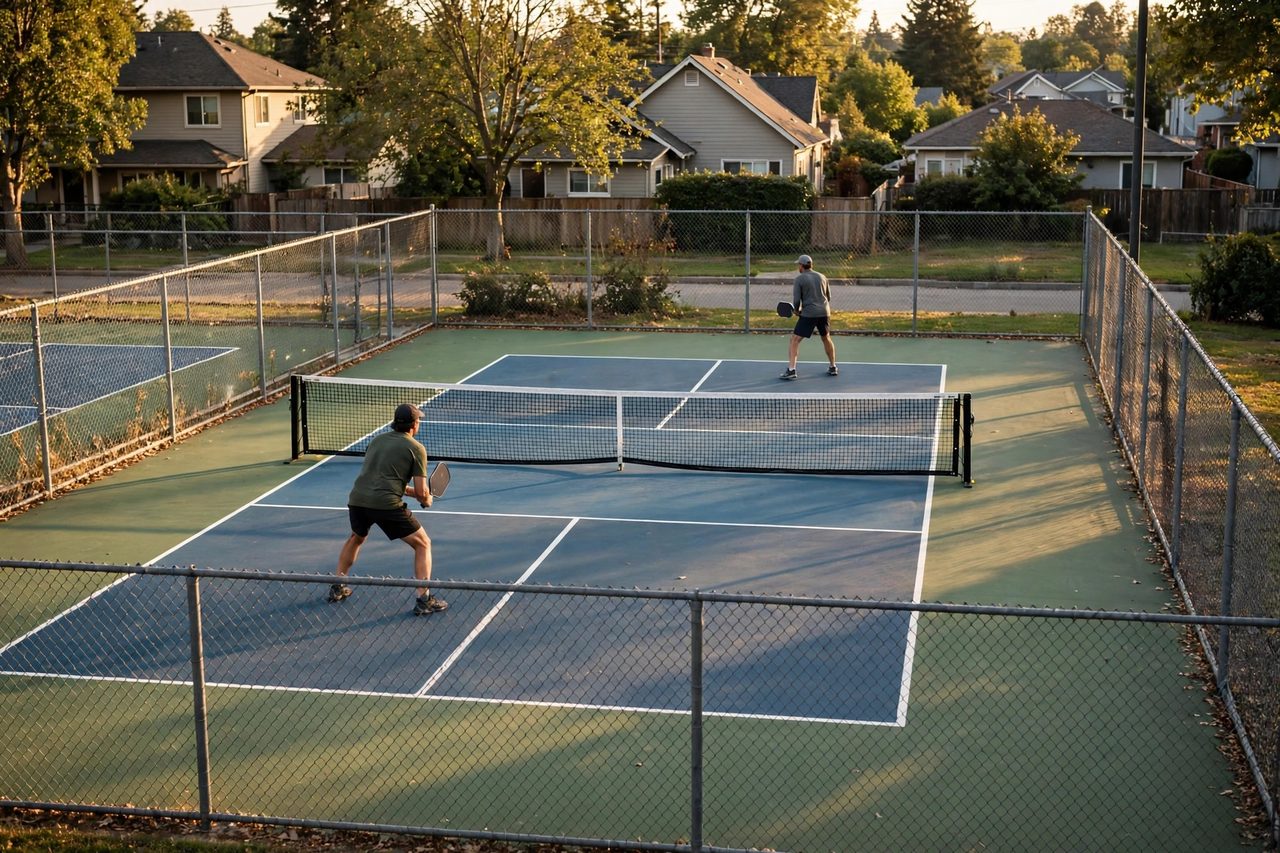
Pickleball has a problem, and it is not a rival sport. It is the sound it makes.
Walk past a busy court on a sunny afternoon and you will hear it before you see it. Pop. Pop. Pop. A sharp crack, over and over, sometimes for hours at a time. Players love it. It is the sound of a good rally, a long exchange of shots over the net. The neighbours next door hear something else entirely: the sound of a sport that moved in without asking.
Pickleball is the fastest-growing sport in the United States. More than 82,000 courts now exist across the country, according to USA Pickleball, the sport’s governing body. Underused tennis courts in public parks have been repainted as pickleball courts, often with little warning to the people who live nearby. And in city halls and courtrooms across America, the backlash has reached a fever pitch. By one count, more than 200 lawsuits have been filed by homeowners seeking relief from the noise.
Why pickleball is so loud
The answer is simple physics. A pickleball racquet is hard, and a pickleball is a hard plastic ball with holes in it. When the two meet, the sound is a sharp, high-pitched pop. A tennis ball, by contrast, is a soft ball covered in felt, and it makes a dull thud. That difference matters more than the volume alone.
A decibel is the unit used to measure how loud a sound is. At a distance of about 100 feet, a tennis hit measures roughly 40 decibels. A pickleball hit at the same distance measures between 70 and 80 decibels, according to the American Ceramic Society. That is roughly the difference between a quiet library and a vacuum cleaner running in the next room.
But the number is only half the story. The other half is the pitch. A standard pickleball paddle produces a tone of 1,100 to 1,200 hertz, USA Pickleball says — a frequency is simply how high or low a sound is, and this one sits right in the range the human ear finds hardest to ignore. Worse, it never stops. A single doubles game, with four players on court, produces a pop roughly every second, or 700 to 1,000 pops per hour on an active court. Complaints are common when courts sit within 100 to 200 feet of homes, and on quiet sites the sound can carry much farther.
The towns that fought back
The fight has a pattern now. Courts open, neighbours complain, the town tries to fix it, and nobody is fully happy.
In Walnut Creek, California, two tennis courts at Rudgear Park were turned into eight pickleball courts a few years ago. The nearest homes sit 50 to 90 feet away. Neighbours say the noise can reach 88 decibels, and that it can run for 14 hours a day on a summer weekend. The city cut playing hours, closed the courts some afternoons and started locking them outside posted hours. It was not enough. Forty-two neighbours signed a petition, and the dispute is now a lawsuit against the city.
In Martinez, also in California, the story ended more abruptly. The city council voted in March 2025 to permanently stop pickleball at the eight-court Hidden Valley Sports Park, a month after the courts opened. The courts were built, paid for and then shut down.
Other towns have tried a different answer: distance. Some now require new courts to sit at least 250 feet from the nearest home. Others have gone as far as 600 feet, according to planner Charles Leahy, writing for the American Planning Association in November 2025.
The sport answers back
Pickleball is not ignoring the complaints. In fact, the sport’s own governing body has made quiet its biggest project.
In September 2023, USA Pickleball launched a Quiet Category, a certification for equipment that makes far less noise. To qualify, a paddle must test below 80 decibels and below 600 hertz — roughly half the noise of a standard paddle. The first certified paddle, the OWL, was announced in November 2023. By September 2026, the approved list had grown to 17 paddles, from brands including Diadem, Gearbox, ProXR and Stafford.
The second answer is the courts themselves. Builders now install tall acoustic barriers, walls that block the high pitch of the pop. One country club in Old Lyme, Connecticut, put up a 15-foot barrier after residents complained. Some new courts are being built indoors, where the sound stays inside.
The third answer is the simplest: hours. Many courts now open later in the morning and close earlier in the evening, so the early risers and the late games disappear. It is the most common fix, and the one players dislike most.
A sport learning to be a neighbour
None of this will make pickleball silent. A dink, the soft shot dropped just over the net into the kitchen — the zone near the net where you cannot hit the ball out of the air — still makes a pop. The sound is part of the game. But the sport has learned something important: growing fast is not the same as growing well.
For years, the pitch was simple. Pickleball is fun, easy to learn and good for all ages. Towns painted lines on old tennis courts and waited for the crowds. They came. What nobody planned for was the noise those crowds would make, or the people living 50 feet away who never got a say.
The next chapter of the pickleball boom will be quieter, almost literally. Quieter paddles, taller walls, better sites and shorter hours. The sport that conquered America one tennis court at a time now has to prove it can live next door to the people it woke up. If it can, the pop becomes part of the neighbourhood. If it cannot, more courts will follow Martinez — built, opened, and then closed for good.
Sources: USA Pickleball; American Ceramic Society; Racquet Sports Industry, May 2026; City of Walnut Creek reporting.
Related articles
Pickleball's Billion-Dollar Paddle Boom: How a Backyard Game Became Big Business
Sixty years ago, the first pickleball paddles were plywood boards cut in a basement. Today they are $200 carbon-fibre pro gear, and the paddle business is worth about a billion dollars a year.
Padel Is a Social Club First, a Sport Second
After-work games, club bars, mixed doubles nights and team outings: padel grew so fast because the game is built around people, not just points.
How Footballers and Celebrities Made Padel the Sport of the Stars
From footballers opening clubs to actors owning teams, famous faces turned padel into the sport everyone wants to try.