
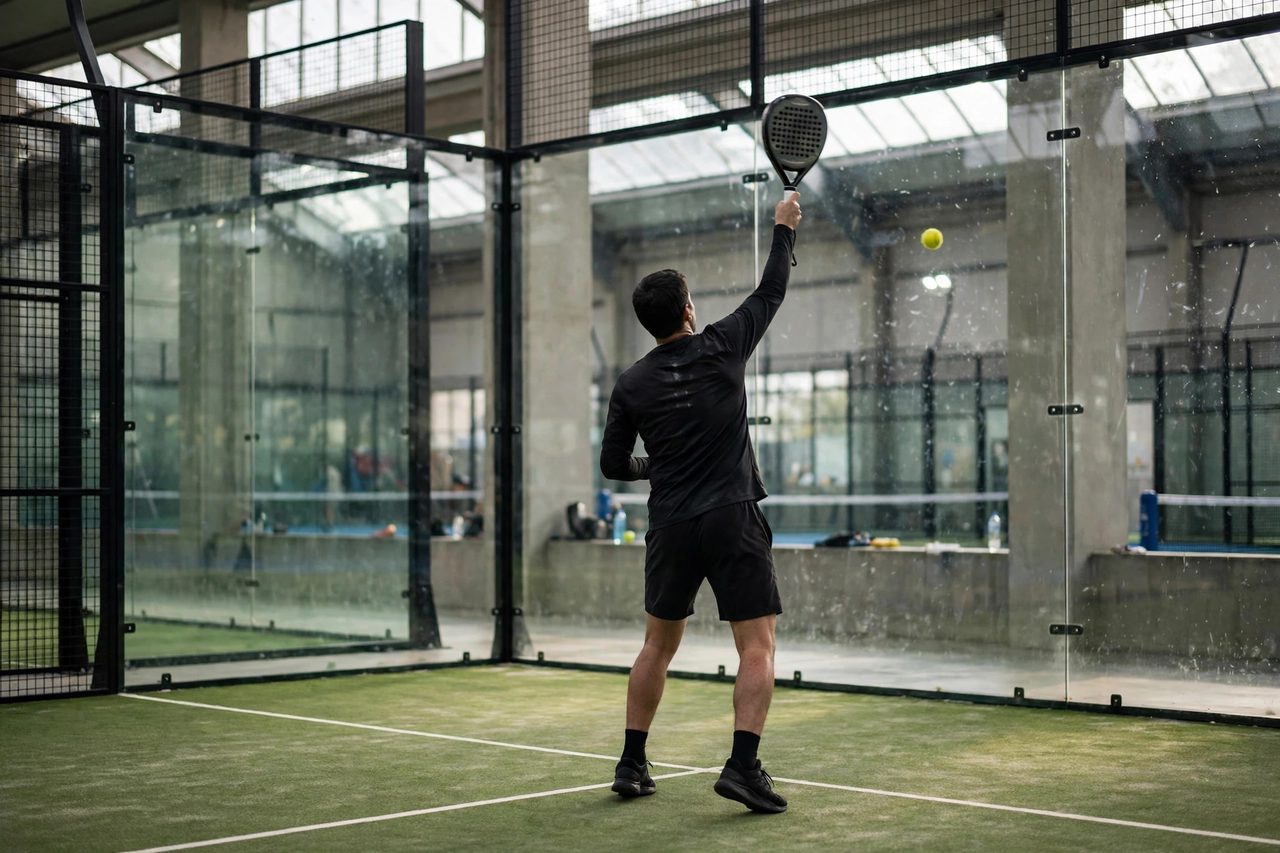
You know the feeling. Your opponent lobs you, the ball hits the back glass, and suddenly it is bouncing back toward you at an awkward height. Most players panic here and swing wildly, or let the ball drop and lose the net. There is a better option, and it has a name: the bajada.
The bajada is padel’s overhead shot played after the ball has bounced off the back glass. You let the lob hit the glass, read the rebound, and hit down on the ball as it comes back toward you. It is a controlled overhead finish, not a smash, and once you learn it, those awkward lobs become chances to attack.
How the bajada is different
Padel has three main overhead shots. The bandeja is a flat, controlled overhead hit before the ball reaches the glass, used to keep the net and stay in control. The vibora is its attacking cousin, a sliced overhead with sidespin that skids low off the glass. The bajada differs from both: you wait for the ball to hit the back glass first, then hit it on the way back.
Why wait? A lob that reaches the glass is usually too deep to attack in the air. If you try to smash it, you will be off balance and reaching behind you. The glass gives you a second chance: it slows the ball and sends it back to a hittable height.
Step 1: read the lob early
The bajada starts before the ball touches the glass. As soon as you see a lob going over your head, turn and move back — do not wait to see where it lands. Get between the ball and the glass, with room to swing.
Watch the lob’s shape. A high, slow lob will come off the glass softly and drop. A flatter, faster lob will rebound harder and stay higher. Either way, get behind the rebound, not under the ball.
One warning: if the lob is short and sits up nicely in front of you, do not play a bajada — hit a bandeja or a smash instead. The bajada is for lobs too deep to hit in the air.
Step 2: position yourself off the glass
Stand about a racquet’s length from the back glass, facing the net, body turned slightly sideways. You want the ball to come back at around shoulder height. Too close and you will be cramped; too far and the ball will drop below your hitting zone before you reach it.
Keep your knees bent, weight on the balls of your feet. The rebound can be unpredictable, especially if the lob had spin, so stay light and ready to adjust, racquet up at roughly head height.
Use a continental grip: the base knuckle of your index finger sits on the top bevel of the handle, like holding a hammer. It gives you a firm wrist and a slightly open racquet face, which is exactly what the bajada needs.
Step 3: let the ball come to you
This is the hardest part for beginners, because it feels wrong. Do not chase the ball. Let it hit the glass and come back to you. The glass does half the work: it kills the lob’s pace and sends the ball back on a path you can read.
As the ball rebounds, take a small step so it is slightly in front of your hitting shoulder. Contact must be in front of your body, never behind you. If the ball gets past your shoulder, let it drop and play a defensive lob back.
Step 4: hit down and through
The swing is short and compact, not a big wind-up. Bring the racquet back just past your shoulder, then drive forward and slightly down through the ball — a firm push with pace, not a wild swing.
Contact should be at around shoulder height, with the racquet face slightly closed, meaning tilted a touch downward. Aim cross-court and low, toward the middle of your opponents’ court or at their feet — the goal is a ball that is hard to lift, not a winner every time. If they have to dig the ball up from low, you keep the net and the next ball is yours to finish. Follow through toward your target, letting the racquet finish across your body, then move forward again right away to reclaim the net.
Common mistakes
The first is standing too close to the glass. Give yourself room — the ball needs space to rebound, and so do you.
The second is swinging too hard. The bajada is not a smash: a controlled shot at 70 percent pace, placed well, beats a wild swing that finds the net or the fence.
The third is hitting the ball late, behind your body. If you are late, do not force it. Let the ball drop and play a lob of your own. A good decision beats a forced shot every time.
The fourth is forgetting to move forward after contact. Hit the bajada, then hunt the net again — that is where padel points are won.
Three drills to learn it
Start with a partner feeding soft lobs that hit the glass. Forget power; just practice reading the rebound and making clean contact in front of your body.
Next, add a target: place a cone or a bag mid-court and try to land your bajada near it. This teaches the low cross-court finish that wins matches.
Finally, play it live: have your partner lob you during a rally, and commit to the bajada whenever the lob reaches the glass. You will miss some at first, but every miss teaches you something about reading the rebound.
The bandeja keeps you in control, the vibora attacks, and the bajada turns your opponent’s best escape — the deep lob — into your next chance to finish. Learn to read the glass, and the back of the court stops being a place you fear.
Related articles
The Padel Serve: How to Start Every Point Underarm, Step by Step
In padel, the serve starts the rally — it doesn't end it. The rules, the technique step by step, and three easy drills to make your serve steady and smart.
The reset: how to turn a hard ball into a soft one, step by step
When your opponent fires a hard ball at you at the net, the reset is your answer. A simple step-by-step guide to soft hands, paddle angle, and where to aim.
Playing Off the Glass: How to Use Padel's Walls, Step by Step
The glass walls are not the enemy. Learn how the ball comes off the back and side walls, when to let it bounce, and simple drills to build your confidence.