
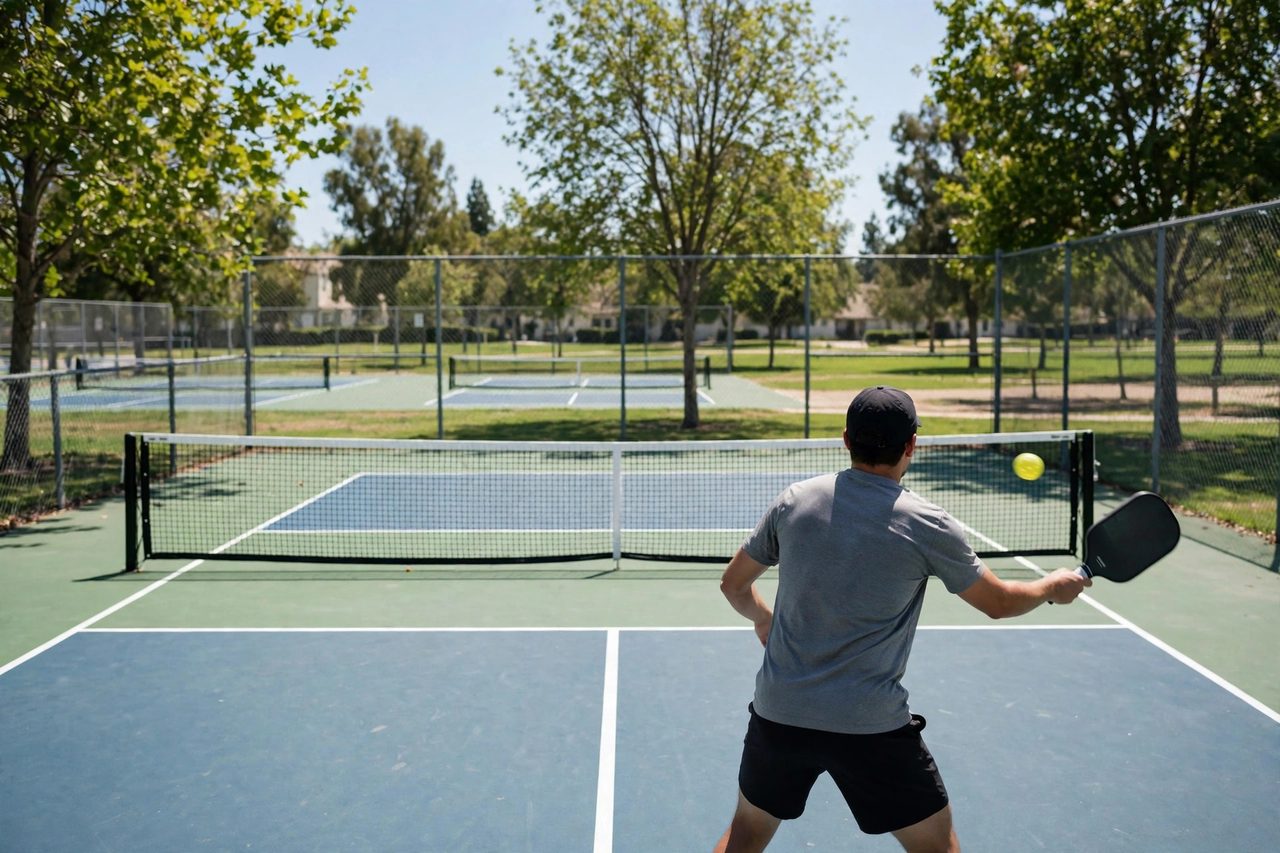
Most pickleball advice tells you to play soft. Dink, dink, dink, wait for the mistake. A dink is a soft shot that lands just over the net in the kitchen, the area near the net where you cannot volley. The kitchen line is the line that marks the edge of that area, seven feet from the net.
That advice is mostly right. But it is not the whole game. Sometimes the right move is to hit the ball hard. That shot is called a drive: a firm, flat or slightly topspin shot hit with pace, usually from the back of the court or from mid-court, aimed at your opponents’ feet or at the open space between them.
Learning when to drive is what separates a decent player from a dangerous one. Here is how to think about it.
First, what the drive is for
A drive has three jobs. It can win the point outright, if your opponents are out of position. It can push them back, so you can move forward to the kitchen line yourself. And it can force a weak reply, a ball that pops up high enough for you or your partner to smash.
It is not a wild swing. A good drive is controlled power. You are hitting firmly, but you are still aiming. The target is usually low: at your opponents’ feet, or into the gap between them, or down the middle where they have to decide who takes it. Shots aimed low are harder to attack, because your opponents have to hit up on the ball.
When to drive
Drive when you get a ball you can attack. That means a ball that sits up a little high, around waist height or above, and comes to your forehand or backhand with time to set up. If the ball is bouncing nicely and you are balanced, that is your green light.
Drive when your opponents are both back. If they are standing near the baseline and you are at the kitchen line, a firm shot at their feet puts them under real pressure. They have to defend from deep, and they cannot attack you back easily.
Drive when you see a gap. If your opponents are both covering the same side, or if one of them has drifted too far wide, hit the open space. You do not need to hit the ball as hard as you can. You need to hit it where they are not.
Do not drive when the ball is low and skidding at your feet. Do not drive when you are off balance or stretched wide. And do not drive just because you are frustrated. A drive hit from a bad position usually becomes a free point for the other side.
How to hit it, step by step
Start with your feet. Turn sideways to the net, with your paddle-side foot back. This is called the ready position for a groundstroke, and it lets your body rotate into the shot instead of just arming it.
Take the paddle back early, but not too far. Your paddle should go back to about hip height, with the face slightly closed, meaning tilted a little toward the ground. A short, compact backswing is better than a huge one. Pickleball is a fast game, and a long swing leaves you late.
Swing forward and slightly upward, brushing up the back of the ball. This gives you topspin, which is spin that makes the ball dip down after it crosses the net. Topspin is your friend on a drive, because it lets you hit firmly while keeping the ball inside the court. Contact the ball in front of your body, around waist height, and follow through toward your target.
Then recover. After you hit the drive, move forward if you can. The drive is often a setup shot: it pushes your opponents back, and your job after hitting it is to take the space they gave up. Get to the kitchen line, paddle up, ready for the next ball.
The most common mistake
Beginners drive too often, and from the wrong balls. They see a ball they could dink, and they swing hard instead. The ball flies long, or into the net, and the point is over.
Here is a simple rule that helps. If the ball is above the net and you are balanced, you may drive. If the ball is below the net or you are stretched, dink it instead. A dink is a soft shot that buys you time and keeps the rally going. A drive from a bad ball gives the point away.
Practice this way. Have a partner feed you balls at different heights. Dink the low ones. Drive the high ones. After a few sessions, the choice starts to feel automatic, and you will stop guessing.
Putting it together
The best pickleball players are not the ones who hit hardest. They are the ones who know when hard is right and when soft is smarter. The dink sets the trap. The drive springs it. Learn both, and learn when to use each, and your game will jump a level without you having to hit a single shot harder than you already do.
Related articles
The Padel Serve: How to Start Every Point Underarm, Step by Step
In padel, the serve starts the rally — it doesn't end it. The rules, the technique step by step, and three easy drills to make your serve steady and smart.
The reset: how to turn a hard ball into a soft one, step by step
When your opponent fires a hard ball at you at the net, the reset is your answer. A simple step-by-step guide to soft hands, paddle angle, and where to aim.
Playing Off the Glass: How to Use Padel's Walls, Step by Step
The glass walls are not the enemy. Learn how the ball comes off the back and side walls, when to let it bounce, and simple drills to build your confidence.