
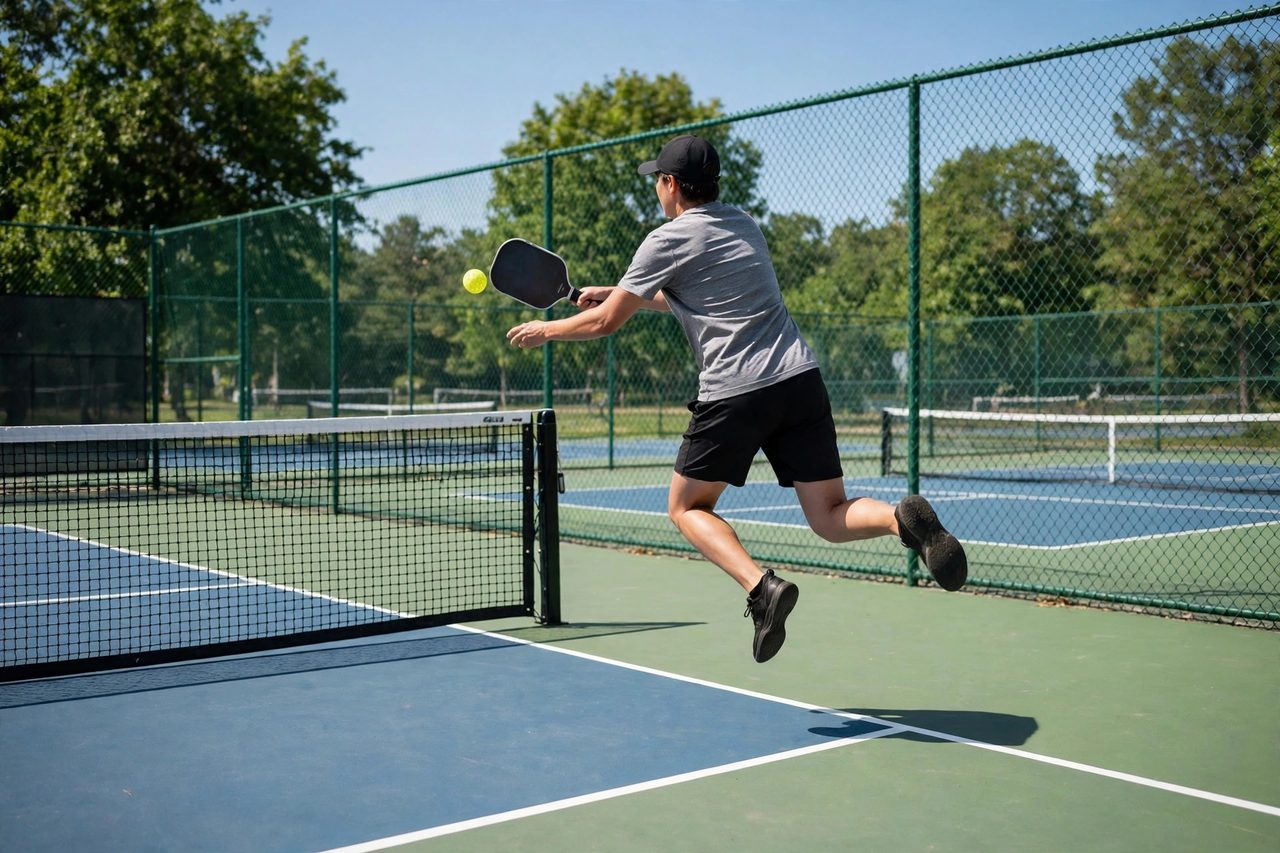
There is a shot in pickleball that looks like cheating. Your opponent hits a soft ball down the sideline. You suddenly appear beside the net, outside the court, and smash it away before it bounces.
That shot is called the Erne. It is completely legal. And once you understand it, you will start seeing chances for it everywhere.
First, the kitchen line
To understand the Erne, you first need the kitchen line. The kitchen is the no-volley zone, the rectangle of court on each side of the net, 7 feet deep. You are not allowed to volley — hit the ball out of the air, before it bounces — while standing in the kitchen, or while your momentum carries you into it after a volley.
That rule shapes the whole game. It stops players from standing at the net and smashing everything. Instead, players stand just behind the kitchen line and trade soft shots called dinks, waiting for a ball that pops up high enough to attack.
The Erne is a way around that rule — legally. The trick is simple: you do not volley from inside the kitchen. You jump over the corner of the kitchen, land outside the court, and volley from there.
Where the name comes from
The shot is named after Erne Perry, an American player who made it famous in the early days of competitive pickleball. He figured out that the kitchen rule only covers the kitchen itself. The ground beside the kitchen, outside the sidelines, is fair game. If you can get your body there in time, you can hit a volley that your opponent never expects.
Today every top professional uses it. It is one of the most exciting shots in the sport, and it is easier to learn than it looks.
When to use it
The Erne works when your opponent hits a soft ball down your sideline, close to the net. Usually this happens during a dinking rally, when both teams are at the kitchen line trading soft shots. Your opponent tries to push you wide with a dink near the sideline. Instead of reaching for it from behind the line, you go around.
Look for these signs:
- The ball is heading toward your sideline, not the middle.
- It is soft and low, not a hard drive.
- Your opponent is leaning toward that side, expecting you to struggle.
- You have a split second to move. If the ball is fast, stay put.
Do not try an Erne on a hard, fast ball. You will not get there in time, and you will leave your side of the court wide open. The Erne is a surprise attack, not a desperate lunge.
The Erne, step by step
1. Read it early. Watch your opponent’s paddle, not just the ball. When they shape to hit a soft ball toward your sideline, start moving. The Erne is won or lost in this first half-second.
2. Move around, not through. Step to the side and then forward, running around the corner of the kitchen. Never step into the kitchen on your way. If any part of your body touches the kitchen while you volley, or your momentum carries you in afterwards, it is a fault and you lose the point.
3. Jump the corner. As you approach the sideline, take a small jump over the corner of the kitchen. You want both feet to land outside the court, beyond the sideline. Think of it as hopping around a puddle, not leaping over a fence. A small, controlled jump is enough.
4. Hit it at the top. Meet the ball in front of you, at about net height or a little above. You are close to the net now, so a short, firm punch is all you need. Aim down into your opponent’s court, or at their feet. Do not swing big — you are so close that a big swing will send the ball long.
5. Land safely, then recover. Land outside the court with your balance under control. If your momentum is carrying you toward the net post, be careful: touching the net with your body or paddle is also a fault. Once the shot is away, step back behind the kitchen line and get ready for the next ball.
The risks
The Erne is a gamble, and honest teachers say so. When you leave your position to go around the kitchen, you leave a gap. If your opponent reads your move and hits the ball behind you, into the open court, you will look silly.
That is why the best Erne players disguise it. They stay in their normal position until the last moment, then explode sideways. They also pick their moments: they Erne when the ball is slow and their opponent is off balance, not on every single dink.
In doubles, warn your partner first: when you Erne, they must slide across to cover the middle, or you will leave two gaps instead of one.
How to practise it
Start without a ball. Stand at the kitchen line and practise the footwork: step sideways, jump the corner, land outside the court, then step back. Do it ten times on each side until the movement feels natural.
Next, have a partner feed you soft balls toward your sideline. Just practise getting around the kitchen and making contact in front of you. When you can do that ten times in a row without touching the kitchen, try it in a friendly match, once or twice per game at most. Pick slow balls. Every player who hits great Ernes today once jumped the wrong way and lost the point.
Why it matters
The Erne is more than a trick shot. It teaches you the most important lesson in pickleball: the rules create the game, and understanding the rules creates chances.
The kitchen rule exists to keep the game soft and fair at the net. The Erne respects that rule and still finds a way through it. That is smart pickleball.
So next time you are stuck in a dinking rally and your opponent pushes a soft ball wide, do not just reach for it. Go around. Jump the corner. And enjoy the look on their face.
Related articles
The Padel Serve: How to Start Every Point Underarm, Step by Step
In padel, the serve starts the rally — it doesn't end it. The rules, the technique step by step, and three easy drills to make your serve steady and smart.
The reset: how to turn a hard ball into a soft one, step by step
When your opponent fires a hard ball at you at the net, the reset is your answer. A simple step-by-step guide to soft hands, paddle angle, and where to aim.
Playing Off the Glass: How to Use Padel's Walls, Step by Step
The glass walls are not the enemy. Learn how the ball comes off the back and side walls, when to let it bounce, and simple drills to build your confidence.