
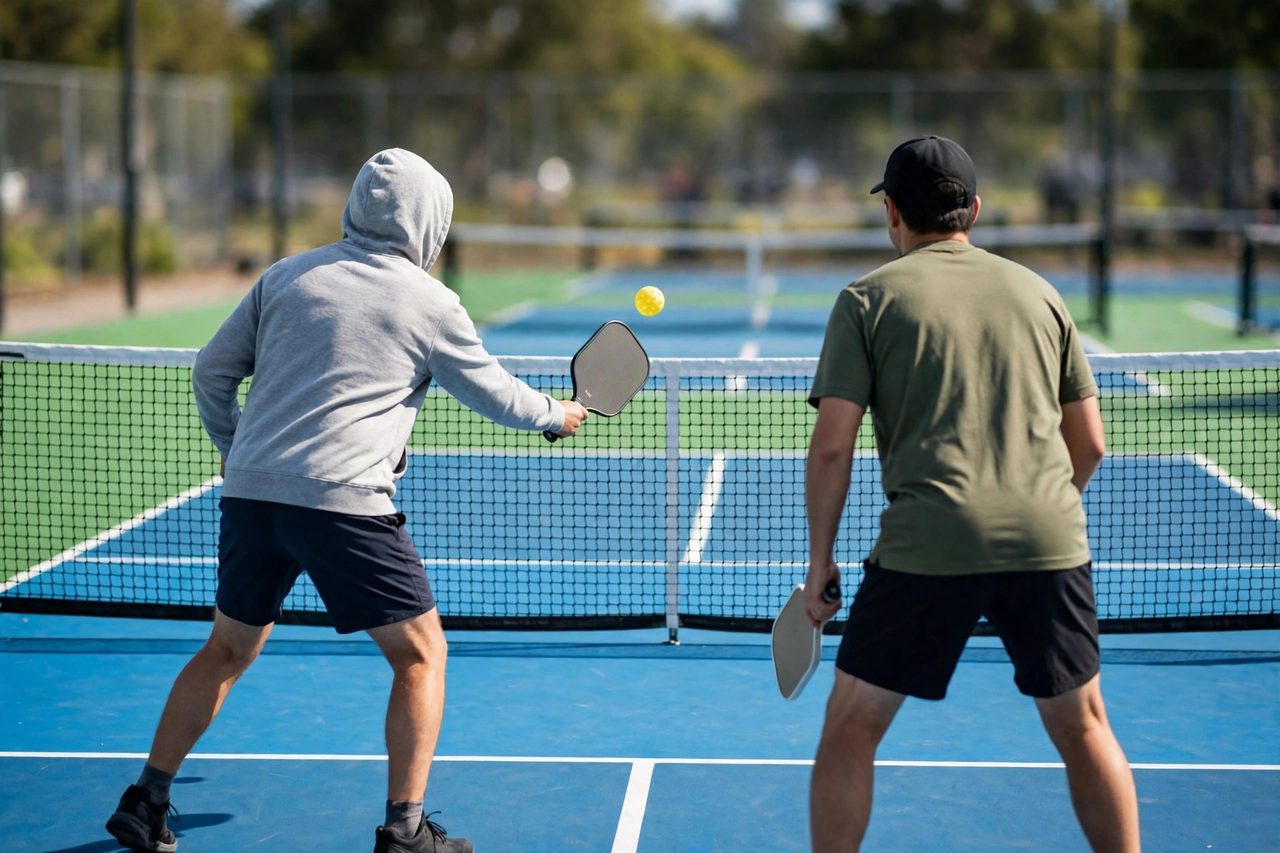
Pickleball will not be part of the Brisbane 2032 Olympic Games.
The Brisbane 2032 organising committee has confirmed the sport will not even be considered for the programme. The news was reported by the ABC on Monday, November 16.
It ends years of hope that a home Games would be pickleball’s Olympic debut. Brisbane is the city where Pickleball Australia is based, and it hosts some of the country’s biggest pickleball events. For a long time, 2032 looked like the sport’s best chance to reach the Olympics. That chance is now gone.
The problem is who runs the sport
To get into the Olympics, a sport needs one international federation recognised by the IOC. The IOC is the International Olympic Committee, the body that runs the Olympic Games. A federation is the one organisation that governs a sport around the world. Pickleball does not have one.
Instead, it has two rival bodies, and each one claims to be the sport’s world governing body.
The first is the World Pickleball Federation, known as the WPF. It was formed in June 2025, when the International Pickleball Federation and the old WPF merged. It is registered in Lausanne, Switzerland, the same city where the IOC is based.
The second is the Global Pickleball Federation, known as the GPF. It has long named Brisbane 2032 as its Olympic target, and it says it has 55 member countries across five continents.
Talks to bring the two sides together have been going on for more than a year, and they have not produced a single body. In November 2025, the GPF and another group, the Unified World Pickleball Federation, announced a joint task force to build one governing body. They said finishing the job by July 2026 was a realistic goal. That date has come and gone, and no completed unification has been announced.
So the IOC still has nobody it can recognise as pickleball’s one world body. And without that, Brisbane’s organisers say the sport does not meet the criteria.
A tougher door than before
The timing worked against pickleball too. IOC President Kirsty Coventry said in May that the era of expanding the Olympic programme is over. Brisbane will not match the record 36 sports on the Los Angeles 2028 programme.
Brisbane 2032 is also the first Games run under the IOC’s new “Fit for the Future” model. Under that model, new sports are judged one discipline at a time, not as whole sports. Every new discipline has to pass checks on governance, anti-doping, financial integrity and safeguarding before anyone even looks at how popular it is or how many people watch it.
There is a hard cap of 10,500 athletes at the Games. That means anything added has to push something else out.
The host committee can propose up to four extra disciplines that suit Queensland’s existing venues. Surf lifesaving, netball, lawn bowls, cricket, rugby league and Australian rules football have all held early talks. Pickleball is not among them.
What happens next
The decision is not quite final in form, but the direction is clear. In December 2026, the IOC Executive Board will sort the proposed disciplines into three groups: automatic recommendation, further comparison, or eliminated. The final Brisbane 2032 programme will be confirmed in April 2027, at the 147th IOC Session in Punta Cana, in the Dominican Republic.
For pickleball, the realistic Olympic window now moves to 2036 at the earliest. And even that depends on the sport doing the one thing it has not managed yet: settling on a single federation the IOC can recognise.
Squash got in. Pickleball did not.
The contrast hurts. Squash, a fellow racquet sport, is on the Los Angeles 2028 programme. It was one of five sports added for those Games, alongside baseball and softball, cricket, flag football and lacrosse.
Squash had what pickleball still lacks: one recognised world body, speaking for the sport with a single voice.
Pickleball has the players. Tens of millions of people play it in the United States alone, and it keeps growing fast in Australia, Asia and Europe. But the Olympics do not work on popularity alone. They work on structure. A sport needs one federation, clean anti-doping rules, solid finances and proper safeguarding before it gets a vote.
None of that is impossible. But it takes time, and time is what pickleball has just run out of for Brisbane. The sport’s leaders now have a simple job and a hard one: stop arguing about who is in charge, and agree. Until they do, the five rings will stay out of reach.
Related articles
Mexico Major preview: Coello and Tapia chase history in Acapulco
The last Major of the season starts Monday in Acapulco, with Coello and Tapia chasing a clean sweep and the final Barcelona spots on the line.
Lebrón and Augsburger End the Long Wait in Dubai as Fernández and Calvo Win Again
Juan Lebrón and Leo Augsburger beat Tino Libaak and Gonza Alfonso 7-6, 5-7, 6-3 to win the Dubai P1, while Claudia Fernández and Martina Calvo beat Paula Josemaría and Bea González 7-5, 6-1 for their third title together.
Dubai P1 Draw: With Galán and Chingotto Out, the Men's Race Opens Up
The Dubai P1 draw is out, and the men's field is wide open: world No. 2 pair Alejandro Galán and Federico Chingotto are absent, Juan Lebrón and Leo Augsburger move up to No. 2 seeds, and the race for the Barcelona Finals gets its last-but-one shake-up.