
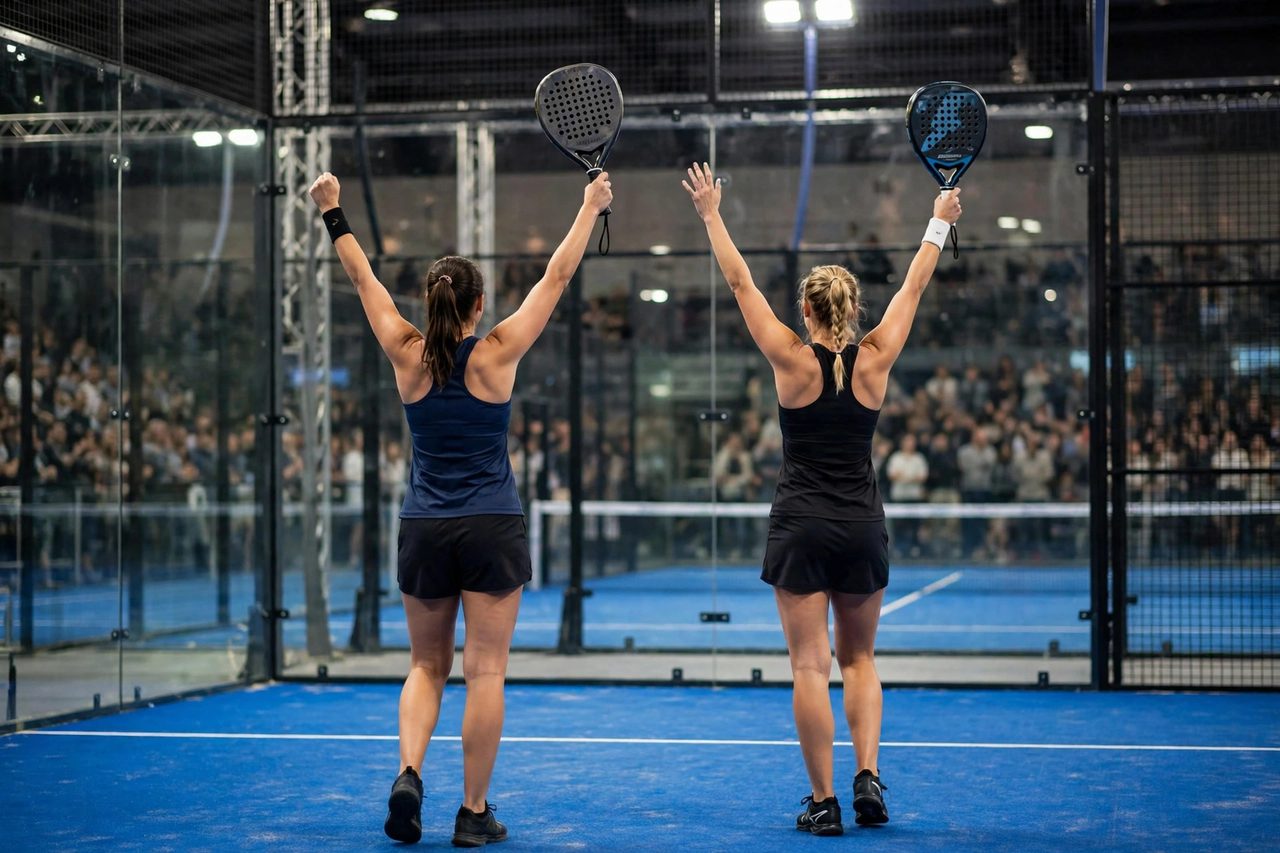
Spain’s women are world champions again. On Saturday in Doha, they beat Argentina 2-0 in the final of the FIP World Cup, padel’s team world championship. It is their seventh world title in a row, and their tenth in total.
Padel is a racquet sport played in pairs on a small court surrounded by glass walls. The World Cup is its biggest team event: countries play each other in ties of three doubles matches, and the first team to win two matches takes the tie. Only two countries have ever won the women’s title. Spain and Argentina. Every final is a rematch of the same rivalry.
This one was no different. It was the same final as two years ago, in the same city, with the same score. In 2024, Spain also beat Argentina 2-0 in Doha. On Saturday, they did it again.
A fast start
Ari Sánchez and Andrea Ustero set the tone in the first match. They beat Aranzazu Osoro and Martina Fassio 6-3, 6-3, and they never looked troubled. The two Spaniards played clean, fast padel from the first ball, and the Argentine pair never found a way in.
It was a strong start, and Spain needed it. Argentina had arrived in the final without dropping a set all week, just like Spain. Nobody had taken a set off either team. Something had to give.
The champions’ turn
The second match gave the final its drama. Paula Josemaría and Gemma Triay faced Claudia Jensen and Delfi Brea, and for the first time all week, Spain lost a set.
Josemaría and Triay took the first set 6-2, playing the kind of padel that has made them two of the best players in the world. Then Jensen and Brea hit back. They won the second set in a tiebreak — a short extra game played when a set reaches 6-6 — 7-6, and suddenly the final was wide open.
The third set decided the title. Josemaría and Triay found their level again, took control, and closed it out 6-3. With that, the tie was won, the trophy was Spain’s, and the third match was never played.
A pair that had never played together
There was something unusual about the winning pair. Josemaría and Triay are both stars, but they had never played together as a pair before this final. On the professional tour, Triay’s partner is Brea — the same Brea standing on the other side of the net on Saturday.
Triay and Brea are the world No. 1 pair on tour. In Doha, they were rivals. Triay wore Spain’s colours. Brea wore Argentina’s. And it was Triay who came out on top, winning the point that sealed her country’s seventh straight title.
That is what makes the World Cup different from every other event in padel. All year, these players are partners and friends on tour. For one week, they split up and play for their countries. The best pair in the world was broken in two, and the final was decided by which half held its nerve.
Seven in a row
Seven straight world titles is a run with no equal in padel. Spain’s women have now won every World Cup since 2014, and their tenth title overall moves them further clear of Argentina, who have eight women’s titles.
The gap is not just in trophies. Eight of Spain’s squad are ranked in the world’s top ten. Argentina’s best player, Brea, is world No. 1 alongside Triay, but Spain’s depth is what wins team events. When a tie needs two wins out of three matches, having the stronger second and third pairs matters as much as having the best first pair.
Argentina will feel this one. They reached the final without losing a set, and they had two of the best players in the world in their line-up. But they ran into a team that has not lost a World Cup final in more than a decade.
One final still to play
The men’s final follows later on Saturday, and it is the same match-up: Argentina against Spain. Argentina are the defending men’s champions, having beaten Spain 2-1 in the 2024 final in Doha. Spain are chasing revenge, and a clean sweep of both titles would cap a perfect week for Spanish padel.
Whatever happens in the men’s final, the women’s story is already written. Spain’s dynasty rolls on. Seven in a row, ten in total, and no sign of anyone stopping them.
Related articles
Mexico Major preview: Coello and Tapia chase history in Acapulco
The last Major of the season starts Monday in Acapulco, with Coello and Tapia chasing a clean sweep and the final Barcelona spots on the line.
Pickleball Ruled Out of the Brisbane 2032 Olympics
Brisbane 2032 has confirmed pickleball will not be considered for the Olympic programme. The sport has no single international federation the IOC can recognise — and its two rival bodies still cannot agree on one.
Lebrón and Augsburger End the Long Wait in Dubai as Fernández and Calvo Win Again
Juan Lebrón and Leo Augsburger beat Tino Libaak and Gonza Alfonso 7-6, 5-7, 6-3 to win the Dubai P1, while Claudia Fernández and Martina Calvo beat Paula Josemaría and Bea González 7-5, 6-1 for their third title together.