
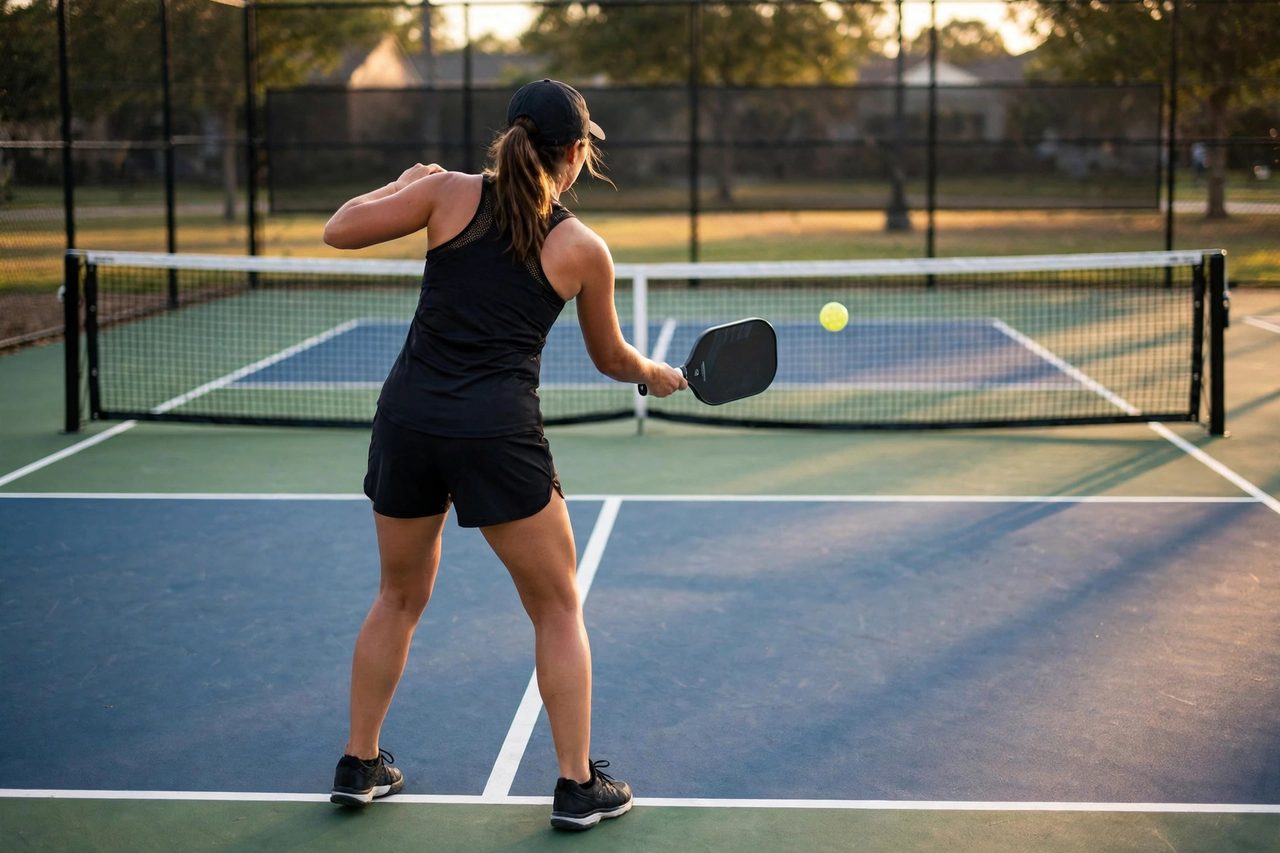
Every sport has a player the others secretly wish they could be. In pickleball, for much of the last decade, that player has been Catherine Parenteau — not the loudest, not the flashiest, but the one who simply does not miss when it matters. A 53-time PPA Tour gold medalist with two career triple crowns, she is the second most decorated woman in the sport’s history, and she built that record on a quality no highlight reel can capture: reliability.
From Montreal to Michigan State
Parenteau grew up in Montreal and picked up a tennis racquet at four years old. She was good enough to be ranked among the top five juniors in Canada, and she crossed the border to play NCAA Division I tennis — first at the University of Arkansas, then at Michigan State, where she spent three years on the Spartans’ team.
It was at Michigan State that her career changed direction. Her coach there was Simone Jardim, herself a pickleball great, who introduced Parenteau to the smaller court. Parenteau started playing in October 2016. Six months later she was competing at the US Open — one of pickleball’s biggest stages — and winning the 5.0 mixed bracket. Most players take years to make that jump. Parenteau took half a season.
The record
The numbers since then are staggering in their consistency. Three US Open titles. Two national championships. Two triple crowns — gold in singles, doubles and mixed at the same event, a feat only a handful of players have ever managed. Fifty-three PPA Tour gold medals, a total that trails only Anna Leigh Waters among women.
Her most famous partnership was with Waters herself. The two won around 31 titles together at roughly a 96 percent win rate, one of the most dominant doubles pairings the sport has seen, before the partnership ended in April 2025. In the 2026 season Parenteau has played women’s doubles with Rachel Rohrabacher and mixed with Christian Alshon — and she remains ranked among the top three in both women’s doubles and mixed doubles on the PPA Tour.
She is also the captain of the LA Mad Drops in Major League Pickleball, and she helped lead the team to an MLP championship. That leadership role suits her: teammates describe her as the player who steadies a team, not the one who needs steadying.
Why she wins: the third-shot drop
Ask coaches what makes Parenteau special and they will not start with power. They will start with the third-shot drop — the soft, arcing shot that lets the serving team reach the kitchen line instead of getting pinned at the baseline. Parenteau’s drop is the best in the women’s game: heavy enough to buy time, soft enough to land short, and — crucially — repeatable under pressure.
That shot is a metaphor for her whole game. Parenteau plays aggressive control: finesse, spin and high-percentage choices, punctuated by sudden acceleration when the opening appears. She does not beat herself. In a sport where unforced errors decide most matches at the top level, that is a superpower.
The person behind the consistency
Off court, Parenteau is one of pickleball’s most popular figures — upbeat, generous with fans, and deeply involved in growing the game through clinics and her teaching academy. She is based in Miami now, but her Montreal roots still show in the way she talks about the sport: as something to share, not just something to win.
She is also, quietly, a bridge between pickleball’s generations. She played with Waters’ mother before she played with Waters. She learned from Jardim, a pioneer, and now teaches the next wave. When the sport’s history gets written, Parenteau will be in it twice: once as a champion, and once as the player who showed everyone else what a professional pickleball career could look like — built not on one hot season, but on never going away.
Related articles
Tyson McGuffin: the showman who made pickleball loud
From tennis pro in Yakima to world No. 1 and a triple crown: how Tyson McGuffin's power, noise and big-match nerve helped turn pickleball into a pro sport.
Delfina Brea: The Quiet Brain of the World's Best Padel Pair
World No. 1 Delfina Brea went from her father's small padel club in Buenos Aires to the top of the women's game. The story of the calm, clever right-side player who makes the best pair in padel work.
Ariana Sánchez: The Quiet Genius of Women's Padel
They call her Magic Ari. No shouting, no drama — just the smartest game in women's padel, a former world No. 1, and a trophy cabinet that now holds 58 major titles.