
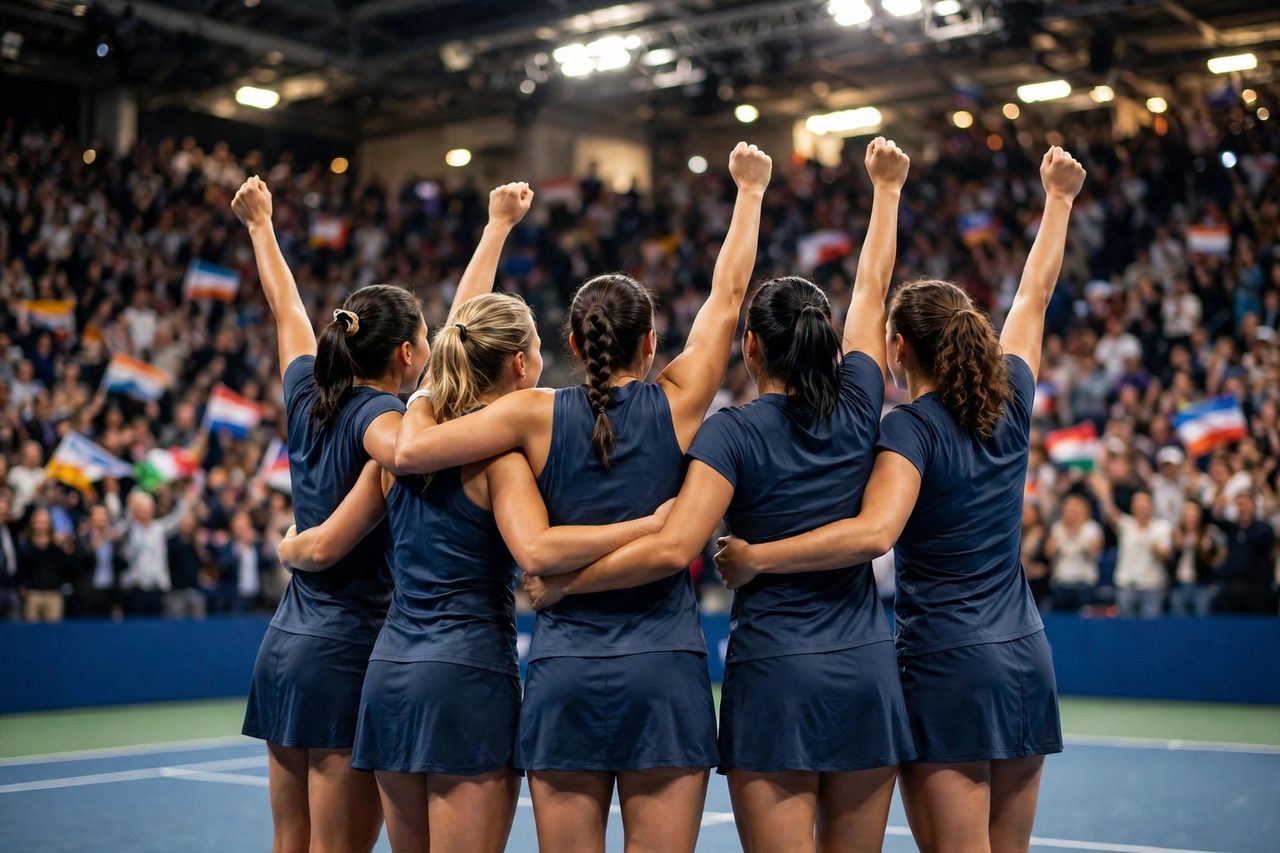
Every autumn, the best women players in tennis set aside their rankings, their sponsors and their rivalries, and play for the flag on their chest. The Billie Jean King Cup is the World Cup of tennis — the largest annual international team competition in women’s sport, with more than 100 nations involved. Here is how it works.
A quick history
The competition began in 1963 as the Federation Cup, created to give women’s tennis the team event the men’s game had enjoyed through the Davis Cup since 1900. It was renamed the Fed Cup, and then, in September 2020, took the name of the woman who won it ten times — seven as a player and four as a captain, including once as player-captain: Billie Jean King, 39-time Grand Slam champion and the sport’s most consequential activist. The current title sponsor is Gainbridge.
The season structure
The Cup runs in four stages across the year.
The Qualifiers (April). Fourteen nations play seven home-or-away ties, with the host nation choosing the surface — clay in South America, indoor hard in northern Europe, whatever suits the home team. Each tie is a two-day event: two singles matches on day one, then a doubles match followed by two reverse singles on day two. The first nation to three matches wins the tie and qualifies for the Finals; the seven losers drop into November’s Play-offs.
The Finals (September). The showpiece. Eight teams — the seven Qualifiers winners plus the host nation, which qualifies automatically — gather at a single venue for a six-day knockout event. In 2026 it was the Shenzhen Bay Sports Centre Arena in Shenzhen, China, from 22 to 27 September. Each tie is played in a single day: two singles matches, and a deciding doubles if the nations split them. The first team to two matches takes the tie. Every match is best-of-three tiebreak sets with regular ad scoring — no Fast4, no match tiebreaks, no gimmicks.
The Play-offs (November). The Qualifiers’ losers meet the best teams from the three Regional Group I events, fighting for places in the following year’s Qualifiers.
The Regional Groups. Below all of this sit the zone groups — the sprawling entry level where most of the 100-plus nations begin their campaigns.
Teams, captains and prize money
Each nation fields a team of four or five players, and the captain — often a former great, like Czechia’s Barbora Strycova or Spain’s Carla Suárez Navarro — decides the singles and doubles line-ups. Captains can, and do, spring surprises: doubles specialists get the nod in live deciding rubbers, and young players get their first taste of senior team tennis.
The money is serious. The 2026 Finals carried $4.9 million in total player prize money, equal to the Davis Cup Final 8. The champions took $1.5 million per team, the runners-up $1 million, semi-finalists $500,000 and quarter-finalists $350,000.
What makes it different
Tour tennis is an individual sport played in a team sport’s clothing — everyone travels with an entourage, but the wins and losses are yours alone. The Billie Jean King Cup flips that. Players sit on the bench together, cheer between points, and feel the particular pressure of losing for a country rather than for themselves. Form counts for less than it should: lower-ranked players routinely produce the best tennis of their lives with a flag behind them, and top players sometimes freeze under a weight they never feel on tour.
The 2026 edition showed why the format works. Czechia — led by Karolina Muchova, Linda Noskova and Marie Bouzkova — swept through the Finals without dropping a tie, beating Great Britain and Spain 2-0 before defeating Ukraine 2-0 in the final to become world champions. Italy, the defending champions, fell to China in the quarter-finals. The host nation’s automatic place always adds spice; in 2026, China used it to reach the last eight on home soil.
How to follow it
The Finals stream on the competition’s official platforms, and the Qualifiers’ home-or-away ties are among the best atmospheres in the sport — a sold-out 5,000-seat arena in Prague or Seville, with everything on the line across two days, is tennis at its most alive. The 2026 Play-offs take place in the week of 16 November, when the likes of Australia, Canada, Japan and the USA fight to stay in the 2027 Qualifiers. The World Cup of tennis never really stops; it just changes venue.
Related articles

The ATP Finals Semi-Final Race: Who's In, Who's Out, and What Happens Next
Two semi-final spots are settled in Turin and two are still up for grabs. Here is the maths, the remaining matches, and what each player needs.
How the Australian Open Works
A simple guide to the first Grand Slam of the year: the draws, the format, the courts and the heat.

How the Hopman Cup Works
A simple guide to tennis's mixed-team event, where one man and one woman play for their country.