
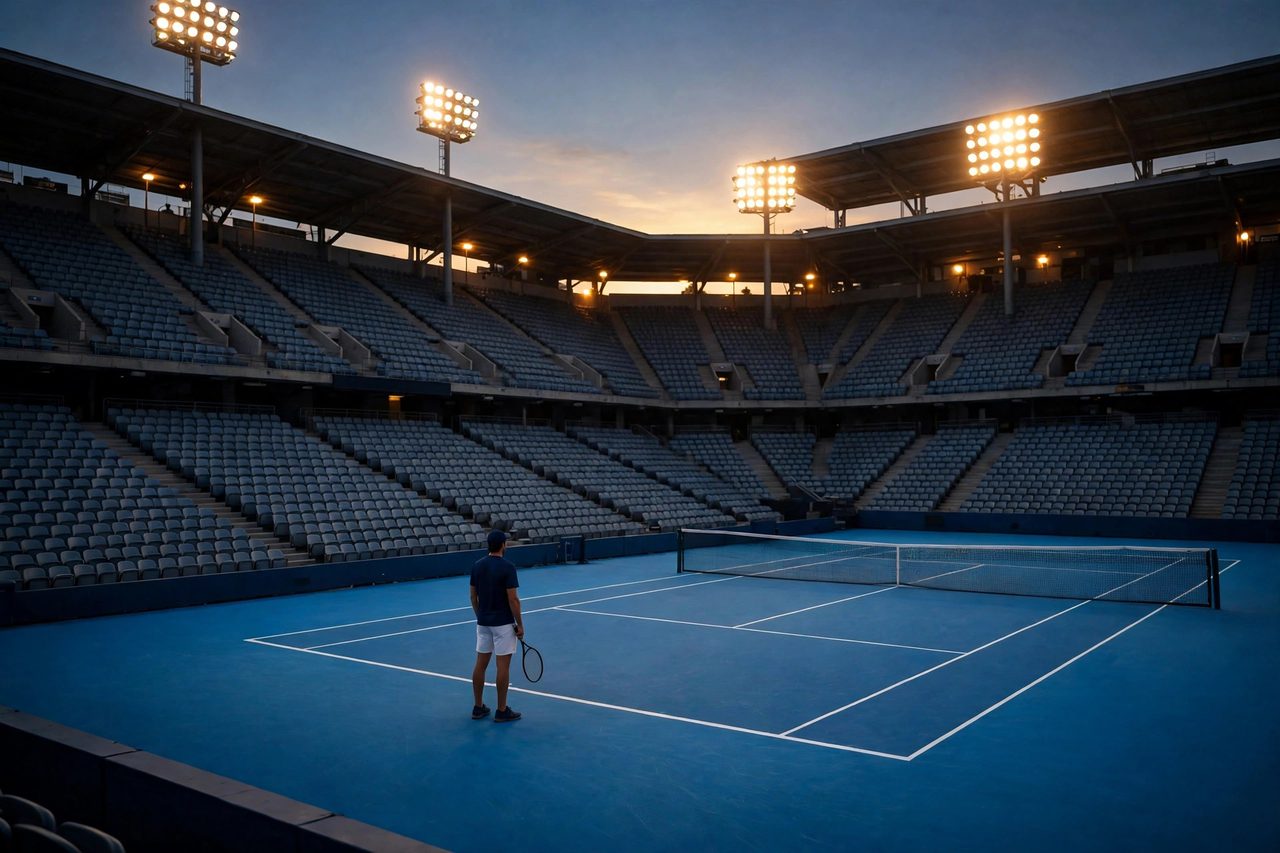
Every January, while most of the tennis world is still shaking off the off-season, Melbourne throws a party. The Australian Open is the first Grand Slam of the year. A Grand Slam is one of the four biggest tournaments in tennis — the others are the French Open, Wimbledon and the US Open — and winning one is the biggest prize in the sport. Here is how it all works.
The basics: where and when
The Australian Open is played at Melbourne Park, in Melbourne, Australia. It takes place in the middle of the Australian summer, in January. The main draw — the main part of the tournament, with the world’s best players — ran from January 18 to February 1 in 2026, and the whole event lasts about two weeks. Whoever wins in Melbourne sets the tone for the rest of the year.
January in Melbourne can be brutal. Temperatures often climb past 35°C, and the court surface can feel even hotter. That is why the Australian Open was the first Grand Slam to put roofs on its main courts, and why it has a heat rule (more on that below).
The draws: 128 players, one winner
Both the men’s and women’s singles events have a draw of 128 players. A draw is the bracket that decides who plays whom: win and you move on, lose and you go home. Seven wins in a row take you from the first round to the trophy.
The 32 best-ranked players in each draw are seeds. A seed is a top player who is placed in the bracket so the biggest names cannot meet each other in the early rounds. The top seeds are spread through the bracket so they cannot meet early.
Not everyone in the draw is there on ranking alone. Sixteen places in each singles draw are kept for qualifiers, and a few more go to wildcards. A wildcard is a free pass into the main draw, usually given to a young local player or a popular name coming back from injury.
Qualifying: three wins or nothing
Qualifying is the tournament before the tournament: a separate 128-player draw, played in the days before the main event, for players ranked just below the main-draw cut-off. To earn one of the 16 places, a player must win three matches in a row. Lose once and you are out.
It is one of the toughest weeks in tennis. The players in qualifying are fighting for the same prize money and ranking points as everyone else, but they have to win three extra matches just to get in. A qualifier who then wins a round or two in the main draw can change their whole season in a fortnight.
The format: how matches are won
Men play best of five sets. A set is a race to six games, and the first man to win three sets takes the match. Women play best of three sets, so the first to two sets wins.
If the final set reaches six games each, the match is decided by a 10-point tiebreak. A tiebreak is a short shootout that decides a set instead of playing on forever: the first player to 10 points, leading by at least two, wins the match. The Australian Open has used this rule since 2019, and all four Grand Slams now follow it.
The other three Grand Slams are played on clay or grass. Melbourne is different: since 1988 the Australian Open has been played on hard court — a firm, blue surface that is fast and true. The current surface is called GreenSet, in use since 2020.
The courts: three roofs, one big stage
Melbourne Park has three show courts with retractable roofs, so play can continue in rain or extreme heat. Rod Laver Arena is the main stadium, named after the Australian legend. Margaret Court Arena is the second court, and John Cain Arena is the third — famous for having the loudest, most rowdy crowd in tennis.
On the outside courts, fans can watch up close for free with a ground pass.
The heat rule
Melbourne’s summer is the tournament’s biggest challenge. In 2019 the Australian Open brought in a new Extreme Heat Policy, built around a Heat Stress Scale that measures air temperature, sun, humidity and wind. When the scale hits 4, play can be suspended on the outside courts, the roofs close on the main courts, and players get extra breaks to cool down — women get extra time before the final set, men get a 10-minute break after the third set.
The money and the points
The 2026 tournament paid out a record A$111.5 million in total prize money. The men’s and women’s singles champions each took home A$4.15 million, the runners-up A$2.15 million, and even a player who lost in the first round earned A$150,000. Men and women have earned equal prize money at the Australian Open since 2001.
The ranking points are just as big. A Grand Slam win is worth 2,000 points — more than any other tournament offers — the runner-up gets 1,300, and even a first-round loss is worth 10. For a player ranked outside the top 100, a good run in Melbourne can lift them dozens of places overnight.
The exact prize money and dates for the 2027 edition had not been announced yet at the time of writing.
A short history
The first edition was played in 1905, at a cricket ground in Melbourne, as the Australasian Championships. For decades the tournament moved between cities — even to New Zealand twice — and was always played on grass. It became the Australian Championships in 1927 and took its current name in 1969.
In 1972 it settled in Melbourne for good, at the small Kooyong club — and by the 1980s it had outgrown it. In 1988 it moved to a brand-new home, Melbourne Park, and switched from grass to hard court at the same time. The surface has changed twice since, but the blue hard courts are now the tournament’s signature look.
Why it matters
The Australian Open is the Happy Slam, as the players call it — sunny, relaxed and fun. But it is also one of the hardest tests of the year: players arrive after a short off-season and are thrown straight into best-of-five-set matches in fierce heat. In 2026, Carlos Alcaraz beat Novak Djokovic in the men’s final, and Madison Keys won the women’s title.
It is the first Grand Slam of the year, the only one in the southern hemisphere, and the one where the season’s story starts.
Related articles

The ATP Finals Semi-Final Race: Who's In, Who's Out, and What Happens Next
Two semi-final spots are settled in Turin and two are still up for grabs. Here is the maths, the remaining matches, and what each player needs.

How the Hopman Cup Works
A simple guide to tennis's mixed-team event, where one man and one woman play for their country.
How the United Cup Works: Tennis's Mixed-Team Season Opener, Explained
The United Cup opens the tennis season in Australia, with 18 countries, men and women on the same team, and a trophy decided in Sydney. Here is how the whole thing works.