
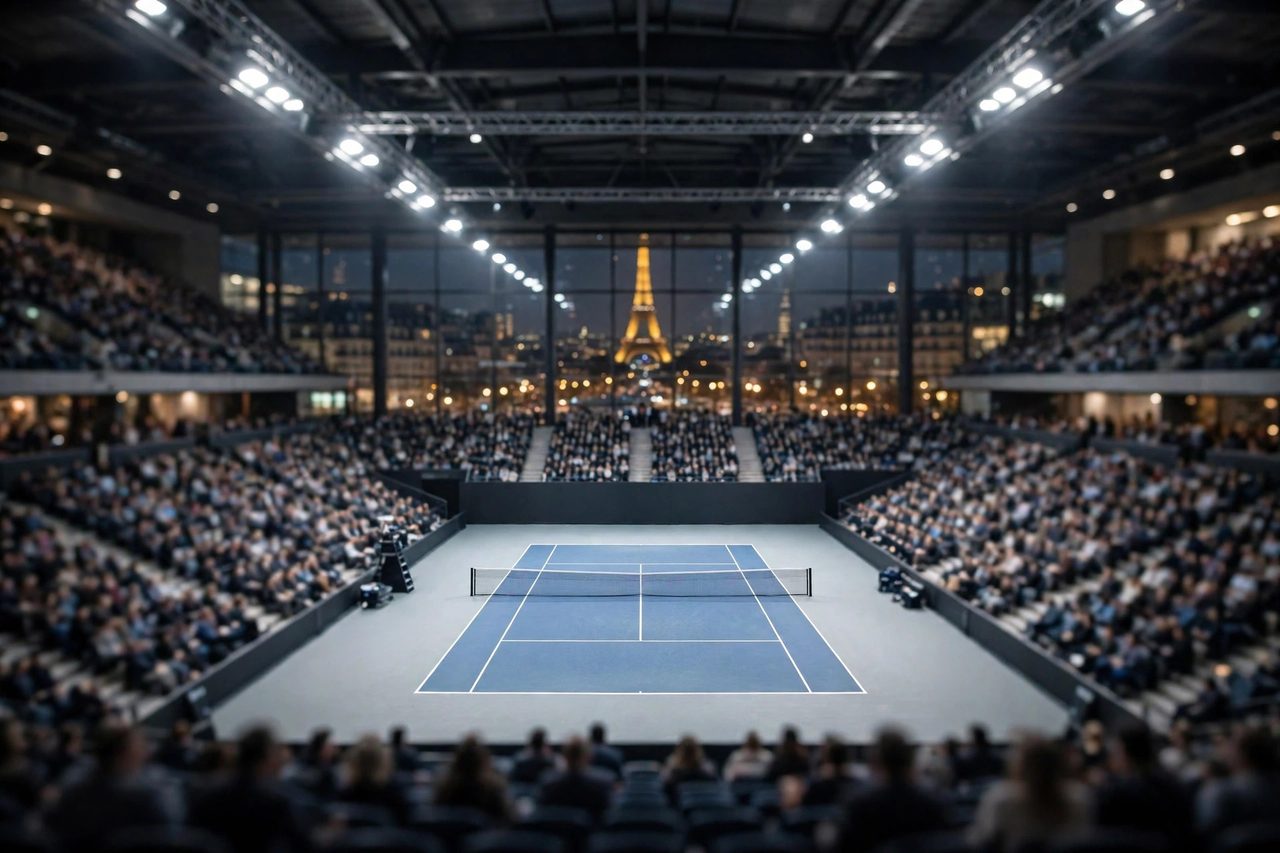
The tennis season has one last big swing left. The Paris Masters, the final Masters 1000 event of the year, runs from November 2 to 8 at La Défense Arena in Nanterre, just outside Paris. Qualifying takes place on October 31 and November 1, and the main draw starts on November 2.
A Masters 1000 is the highest level of regular men’s tournament below the four Grand Slams. There are nine of them each year, and Paris is the last one. That timing is what makes it so tense. After Paris, only the season-ending finals remain. For players still chasing a place there, Paris is the final chance to change their fate.
What is at stake
The ATP Finals bring together the eight best players of the season, in Turin, Italy. Qualification is decided by the Race to Turin, the season-long points table. Most of the eight spots are settled by the time Paris arrives. The last one or two are usually not.
That is why Paris matters so much. A deep run here, a quarter-final or a semi-final, can be worth hundreds of points. A semi-final is the last four of the tournament, and a quarter-final is the last eight. For a player sitting ninth, tenth, or eleventh in the Race, those points can be the difference between going to Turin and watching from home.
Take Alex de Minaur as an example. The Australian is 10th in the live Race after his fighting win in Vienna on Monday. If he keeps winning this week and then goes deep in Paris, his Turin dream stays alive. If he loses early in both, it probably ends. He is not the only one in that position. Every player on the edge of the top eight faces the same maths in Paris.
There is also seeding to think about. A seed is a top player given a protected spot in the draw. A strong Paris run can lift a player into a better seed for Turin, which means an easier group. A weak run can do the opposite.
The setting
Paris is played indoors, on hard courts. Indoor hard courts are fast. The ball skids through quickly, serves are hard to break, and matches often come down to a few key points. Big servers love these conditions. So do aggressive players who take the ball early and attack.
The venue, La Défense Arena, is huge for tennis. It can hold around 15,000 fans for the Masters, which makes it one of the biggest indoor tennis arenas in the world. A full house in Paris is loud, and French crowds are famously passionate. Players who feed off noise will love it. Players who need quiet will have to cope.
The draw has 56 players in singles, plus doubles. That means the top seeds get a bye in the first round. A bye is a free pass to the next round, given to the highest-ranked players. The rest have to win from day one, which makes the early rounds dangerous. A tired or nervous seed meeting a fresh, confident qualifier can be a recipe for an upset.
The full draw had not been released at the time of writing, so this preview does not name a final field. What is certain is that the event will be stacked. Masters 1000 events bring together almost all of the world’s best, because the points and prize money are so big, and because no one wants to end the season with regrets.
Why Paris produces drama
Paris has a habit of producing surprise winners and late-season twists. Because it is the last Masters, players arrive in very different states. Some are fresh and hungry. Some are tired after a long year. Some are carrying small injuries. Some are desperate for points. That mix creates upsets.
It is also a tournament where young players often announce themselves. A lower-ranked player who catches fire indoors, serves well for a week, and rides the crowd can beat anyone on a given day. And for veterans, Paris can be a last stand: one more big week before the season ends, or, in some cases, before a career ends.
The defending champion from 2025 is Jannik Sinner, who beat Felix Auger-Aliassime in that final. Whether he defends his title depends on fitness and the final entry list, which had not been confirmed when this preview was written. Either way, the trophy will be won by someone who handles pressure, fast courts, and a loud arena for a full week.
What to watch
Watch the Race. That is the simplest way to follow Paris. Before the first ball is hit, check who sits seventh, eighth, ninth, and tenth in the Race. Then watch their matches. Every win moves them closer. Every loss ends the dream.
Watch the early rounds, too. The first two days are full of danger for seeds, because qualifiers and wild cards arrive match-sharp and fearless. A wild card is a free pass into the main draw, given by the tournament. A qualifier has already won matches just to get in. Both are dangerous.
And watch the second week of the story. The Paris champion will arrive in Turin full of confidence, while the players who missed out will start planning for next year. That is the cruelty and the beauty of the last Masters. It does not just end a tournament. It decides who gets one more week, and who has to wait until January.
Paris starts on November 2. By November 8, we will know the final eight. Between now and then, every match counts.
Related articles
The ATP Finals Semi-Final Race: Who's In, Who's Out, and What Happens Next
Two semi-final spots are settled in Turin and two are still up for grabs. Here is the maths, the remaining matches, and what each player needs.
How the Australian Open Works
A simple guide to the first Grand Slam of the year: the draws, the format, the courts and the heat.

How the Hopman Cup Works
A simple guide to tennis's mixed-team event, where one man and one woman play for their country.