
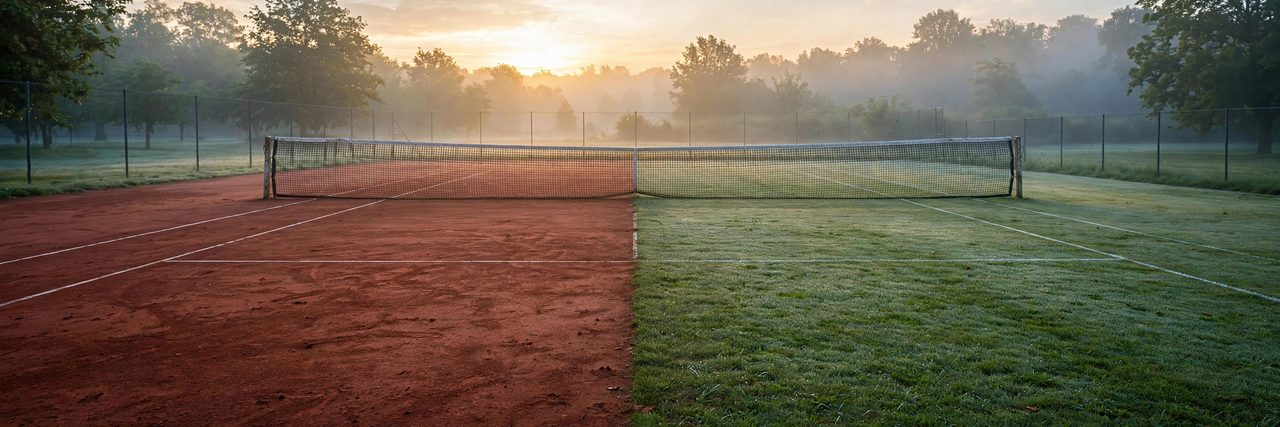
It is called the Channel Slam, and the name is the joke and the explanation at once. Win Roland-Garros on the red clay of Paris, then cross the English Channel and win Wimbledon on the grass of London — in the same calendar year, with about three weeks to remake your entire game. In the Open Era, only six men have ever done it. Only a handful of women. It is arguably the rarest great achievement in tennis.
The list
Rod Laver did it first, in 1969, on the way to his second calendar-year Grand Slam. Then came the master: Björn Borg, who didn’t just do it but did it three years running, 1978 to 1980 — and nearly made it four, losing the 1981 Wimbledon final to John McEnroe after winning Paris again. For almost three decades, nobody followed. Then Rafael Nadal broke the drought in 2008, beating Roger Federer in the Wimbledon final that many still call the greatest match ever played, and repeated it in 2010. Federer did it in 2009, his only Channel Slam, and Novak Djokovic in 2021. The most recent name on the list: Carlos Alcaraz, who in 2024 beat Alexander Zverev at Roland-Garros and Djokovic at Wimbledon to become, at 21, the youngest man in the Open Era to complete the double.
On the women’s side the list is shorter still in the modern game. The Open Era doubles belong to Margaret Court (1970), Billie Jean King (1972), Chris Evert (1974) — and then Serena Williams, twice, in 2002 and 2015. Serena’s 2015 run, which also included the Australian Open, was one match from a calendar Grand Slam; nobody talks about it that way, but the Channel Slam was the hard part.
Why it’s so hard
The two tournaments are played on different planets wearing different surfaces. Clay rewards patience: high bounces, long rallies, sliding into shots, constructing points with heavy topspin. Grass punishes it: low, skidding bounces, points that end in three shots, reflexes at the net. The champions who manage both aren’t just versatile — they’re bilingual in the sport’s two great languages.
And the calendar is cruel. Paris ends in early June; Wimbledon begins in early July. Three weeks to retool everything: the footwork (slide vs. sprint), the serve (kick vs. slice), the return position, the mindset. Alcaraz called it “a great feeling even thinking about being French Open winner and Wimbledon champion the same year, that few players have done before” — the understatement of a 21-year-old who had just done the hardest thing in the sport.
The near misses
The Channel Slam is also a museum of almosts. Swiatek’s 2024 attempt ended in the Wimbledon third round. Nadal’s knees cost him 2009’s defense. And 2026’s Roland-Garros champion, Alexander Zverev, arrived in London with the double alive — a reminder that the first half is merely the admission ticket. The second half is the exam.
What makes the Channel Slam special is that it resists the era. Power baseliners dominate everything else, but the double has been achieved by serve-and-volley-era Borg, clay-court Nadal, all-court Federer and Djokovic, teenage Alcaraz — and, across the net, by Court, King, Evert and Serena. No single style owns it. That’s why it endures as tennis’s true test: it asks the one question every champion must answer, in two different languages, three weeks apart. Can you be two players at once?
Channel Slam records via Tennis Majors and Tennis365’s double-crown archive
Related articles
The Tiebreak: How Tennis's Greatest Invention Saved the Sport
Before the tiebreak, a tennis set could go on forever. One match lasted three days. This is the story of the man who fixed it — and why the rule is still changing today.
The Ball Kids: Tennis's Smallest, Fastest Stars
They sprint, roll, crouch and vanish — all without a word. Ball kids are the quiet engine of every big tennis match, and getting the job is harder than most people think.
The Sound of Tennis: Grunts, Crowds and the Quiet Rule
Tennis asks its crowds to stay quiet, its players to grunt or not, and every tournament to find its own sound. Here is why the quiet rule exists — and why it keeps being broken.