
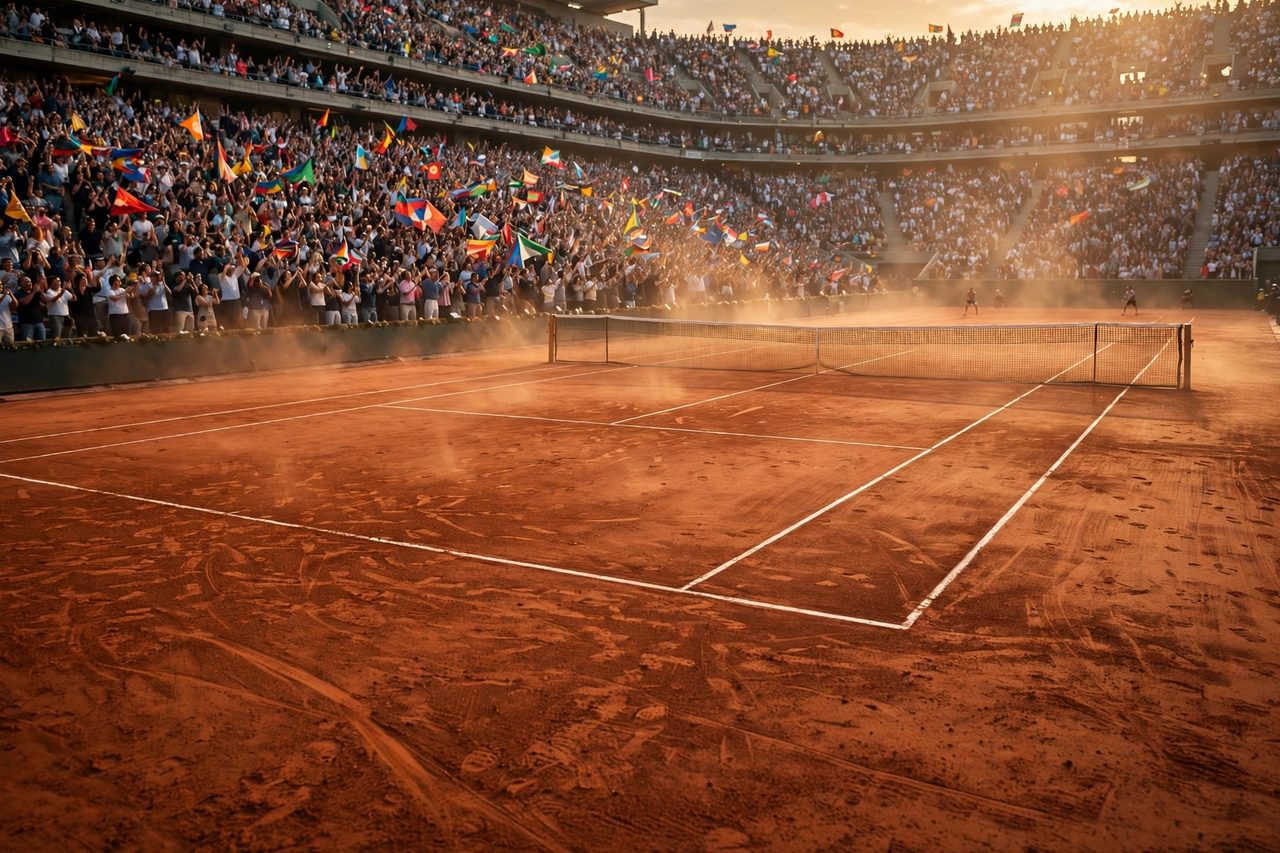
Ask players to name the toughest crowd in tennis and one answer comes back more than any other: Paris. Not the polite applause of Wimbledon or the celebrity hum of New York, but the full-throated, flag-waving, whistle-blowing theatre of Roland-Garros — an audience that loves tennis fiercely, knows it deeply, and makes absolutely no secret of whose side it is on.
The home team always
The defining feature of the French crowd is its partisanship. France has not produced a men’s Roland-Garros champion since Yannick Noah in 1983, and the hunger for a successor has curdled, over the decades, into something close to desperation. When a French player takes the court against a foreigner, the stands become a twelfth man in a way no other Slam allows: chants between points, rhythmic clapping on second serves, and — famously — full renditions of La Marseillaise when the moment demands it.
Visitors are not just beaten; they are serenaded out of the building. In the second round of the 2023 French Open, Taylor Fritz beat Arthur Rinderknech 2-6, 6-4, 6-3, 6-4 — eliminating the last French man in the draw — and the night-session crowd on Court Suzanne Lenglen let him know exactly how they felt. The booing continued for over a minute after match point. Fritz answered with a finger to his lips, the now-famous shush, which only made things louder. His on-court interview with Marion Bartoli could barely proceed; the jeers drowned out the questions. Fritz, to his credit, took it in good humour afterwards — but few players volunteer for that treatment twice.
When passion crosses the line
Sometimes the theatre turns ugly. In 1999, Martina Hingis arrived at the Roland-Garros final as the world No. 1 and overwhelming favourite against Steffi Graf. The crowd adopted Graf — playing the last French Open of her career — as its cause, and turned on Hingis as the match slipped away. Hingis, 18 and furious, disputed calls, served underarm, and left the court in tears before returning to finish. She lost, and the final is remembered as much for the crowd’s cruelty as for Graf’s triumph.
A quarter of a century later, the problem persists in different forms. In 2024, David Goffin claimed a spectator spat chewing gum in his direction after his first-round win over Frenchman Giovanni Mpetshi Perricard, describing the atmosphere as the most hostile he had known. The tournament’s response was telling: Roland-Garros banned alcohol in the stands, an admission that the line between passion and menace had been crossed.
The other side of the coin
It would be unfair — and inaccurate — to call the French crowd merely hostile. It is also the most knowledgeable in tennis. Parisian crowds applaud great shots from anyone, sustain five-set epics with an attention no other Slam crowd matches, and have a genuine romance with the sport’s artistry: the one-handed backhand, the drop shot, the clay-court craftsman will always find friends in Paris. Rafael Nadal, a Spaniard, was adopted as an honorary Frenchman over fourteen titles. The crowd does not hate foreigners; it loves its own more.
And the players who win it over are rewarded with an atmosphere nothing else in tennis can replicate. The 2024 Olympic tennis tournament, staged at Roland-Garros, showed the crowd at its best — fervent, loud, but celebratory. Novak Djokovic’s gold-medal run was cheered to the rafters by the same stands that had booed him for years.
Why it matters
Tennis likes to present itself as a genteel sport, all hushed tones and polite applause. The French crowd is the rebuttal: proof that tennis, at its best, is a live event with a pulse, where 15,000 people can genuinely change a match. It can be unfair. It can be magnificent. Often it is both in the same afternoon.
Every player who walks onto Court Philippe Chatrier knows the deal. Win the crowd and you will never feel more loved. Lose it, and you will hear about it — loudly, at length, and in French.
Related articles
The Tiebreak: How Tennis's Greatest Invention Saved the Sport
Before the tiebreak, a tennis set could go on forever. One match lasted three days. This is the story of the man who fixed it — and why the rule is still changing today.
The Ball Kids: Tennis's Smallest, Fastest Stars
They sprint, roll, crouch and vanish — all without a word. Ball kids are the quiet engine of every big tennis match, and getting the job is harder than most people think.
The Sound of Tennis: Grunts, Crowds and the Quiet Rule
Tennis asks its crowds to stay quiet, its players to grunt or not, and every tournament to find its own sound. Here is why the quiet rule exists — and why it keeps being broken.