
Watch a big tennis match and your eyes follow the players. But look at the edges of the court and you will see the other athletes in the picture.
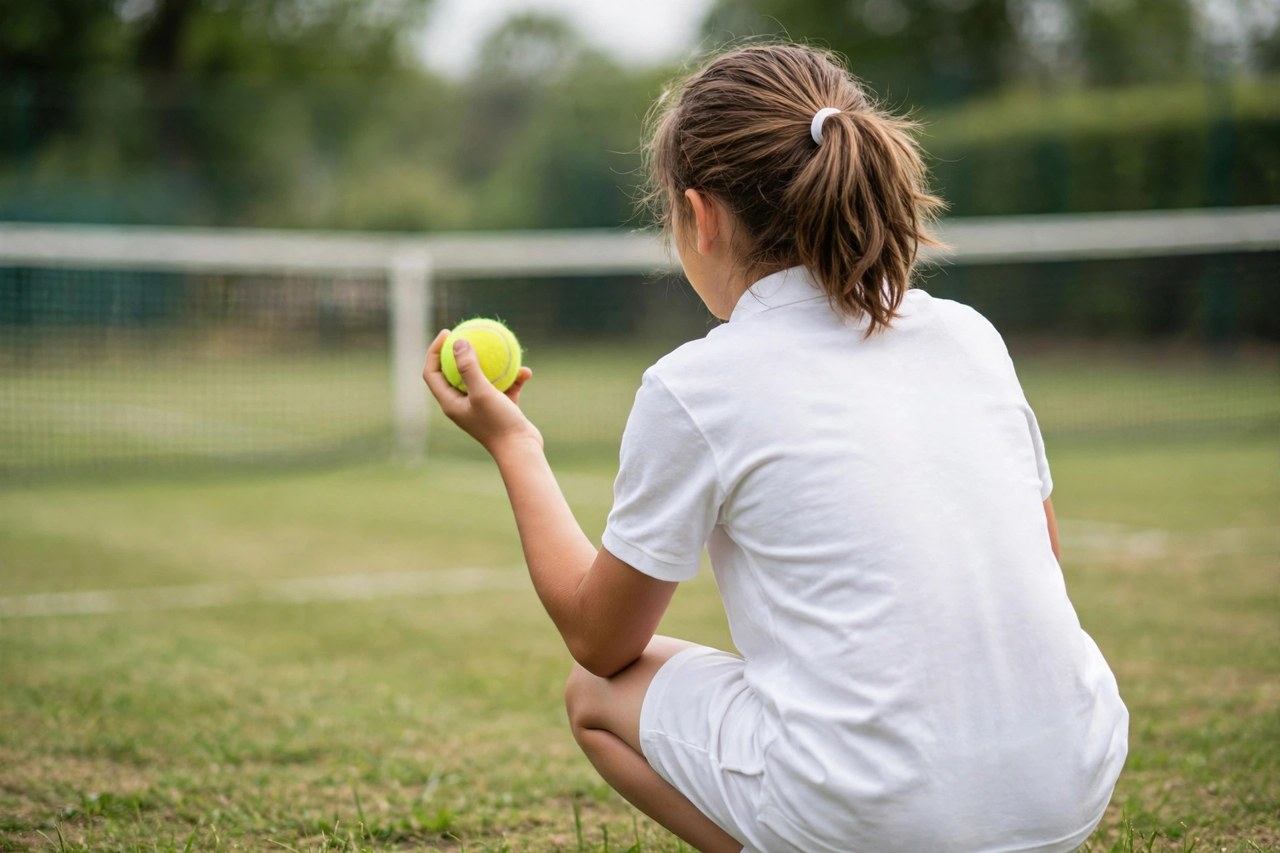
They are the ball kids. They crouch by the net post. They sprint across the court between points. They roll a ball along the ground, straight, into a player’s outstretched hand. Then they freeze, still, until the next point ends.
They are easy to miss. That is the whole point. A good ball kid is almost invisible — until you start watching for them. Then you realise the match would fall apart without them.
What they actually do
A ball kid’s job sounds simple: keep the balls moving. In practice, it is a small, precise routine that repeats hundreds of times per match.
Between points, ball kids collect the loose balls and get them to the server. A rally is one back-and-forth exchange of shots between the players, and once it ends, the balls can land anywhere. The ball kids gather them fast, so the next point can start without a wait.
During a point, they stay perfectly still. A player about to serve needs total quiet and a clear view of the court, and a moving ball kid in the corner of their eye can break their focus.
The most famous skill is the ball roll. When a player needs a ball, a ball kid rolls it along the ground so it arrives at exactly the right speed, right at the player’s hand, without a single bounce. It looks easy. Try it: the ball wobbles, bounces, or stops short. Doing it cleanly, at full speed, in front of thousands of people, takes months of practice.
Getting the job is hard
At the biggest tournaments, becoming a ball kid is a competition of its own.
Take Wimbledon. Each year around 1,400 school students apply, and only about 280 are picked. Most are around 15 years old, in their ninth or tenth year of school, from local schools near the tournament. About 180 are new each year, and around 100 are returning ball kids from the year before.
The selection starts months ahead. Candidates take a written test on court rules and procedures, plus skills tests: running, throwing, catching, and standing still for long stretches. They have to show they can stay calm and focused while everything moves fast around them.
Training starts in February, months before the tournament. The young hopefuls train for about two and a half hours a week at first, and the sessions get longer and more intense as the tournament gets closer. The best teams earn the biggest courts: Centre Court and No. 1 Court.
The other Grand Slam tournaments — the four biggest events in tennis: the Australian Open, the French Open, Wimbledon, and the US Open — run their own versions of the same process. The ages shift a little from place to place: at the Australian Open, ball kids are usually 12 to 15, and at the French Open, roughly 12 to 16. Everywhere, the idea is the same: young, quick, disciplined, and calm under pressure.
The rules of the job
Once they are on court, ball kids follow strict rules.
Stay still during play. Move only when the point is over. Never talk to the players, and never celebrate a great shot. Always know which ball the server wants — players are picky, and many have a favourite ball they like to keep.
Ball kids work in teams of six on a court. They usually spend about an hour on court and then an hour off, rotating through the day. They move in a pattern so practised that it looks like a dance. One runs left, another runs right, and the balls are back in play in seconds.
A long match can run for hours, and the ball kids are sprinting and crouching the whole time. One lazy moment — a ball left on the court, a slow handover, a noise at the wrong time — and everyone notices.
A short history
Ball kids have been part of tennis for over a century. In the early days, they were often local boys hired for the day, and for decades the job was boys only.
That changed in 1977, when girls were first included at Wimbledon. Mixed teams of boys and girls followed in 1980. Today, boys and girls work side by side on every court, in the same uniform, doing the same job.
Why they matter
So why do ball kids matter so much? Because tennis is a game of rhythm.
A tennis match is a chain of small moments: serve, rally, point, pause, serve again. When that chain runs smoothly, the players stay in their flow and the crowd stays locked in. When it breaks — when a player has to wait for a ball — the energy drops.
Ball kids keep the chain unbroken. They are the reason a player can serve ten seconds after the last point ended, and the reason a five-hour match never stalls between points. They set the pace of the whole match, and they do it without anyone noticing.
For the kids themselves, it is often the best week of their lives. They stand metres away from the best players in the world and learn what it takes to be part of a big event: discipline, teamwork, and doing a small job perfectly, over and over.
And for the rest of us, they are a reminder of something tennis does well. The biggest stars get the headlines. But the match only works because a team of teenagers in white is sprinting, crouching, rolling, and standing still in exactly the right places at exactly the right times.
Next time you watch a match, spend one game watching them instead of the players. You will never unsee it. The smallest people on the court might be the fastest stars in the stadium.
Related articles
The Tiebreak: How Tennis's Greatest Invention Saved the Sport
Before the tiebreak, a tennis set could go on forever. One match lasted three days. This is the story of the man who fixed it — and why the rule is still changing today.
The Sound of Tennis: Grunts, Crowds and the Quiet Rule
Tennis asks its crowds to stay quiet, its players to grunt or not, and every tournament to find its own sound. Here is why the quiet rule exists — and why it keeps being broken.
Tennis's On-Court Rituals: Why Players Bounce the Ball, Fix Their Strings and Talk to Themselves
From Nadal's water bottles to Djokovic's endless ball bounces, tennis players repeat the same small habits before almost every point — and there is a good reason for it.