
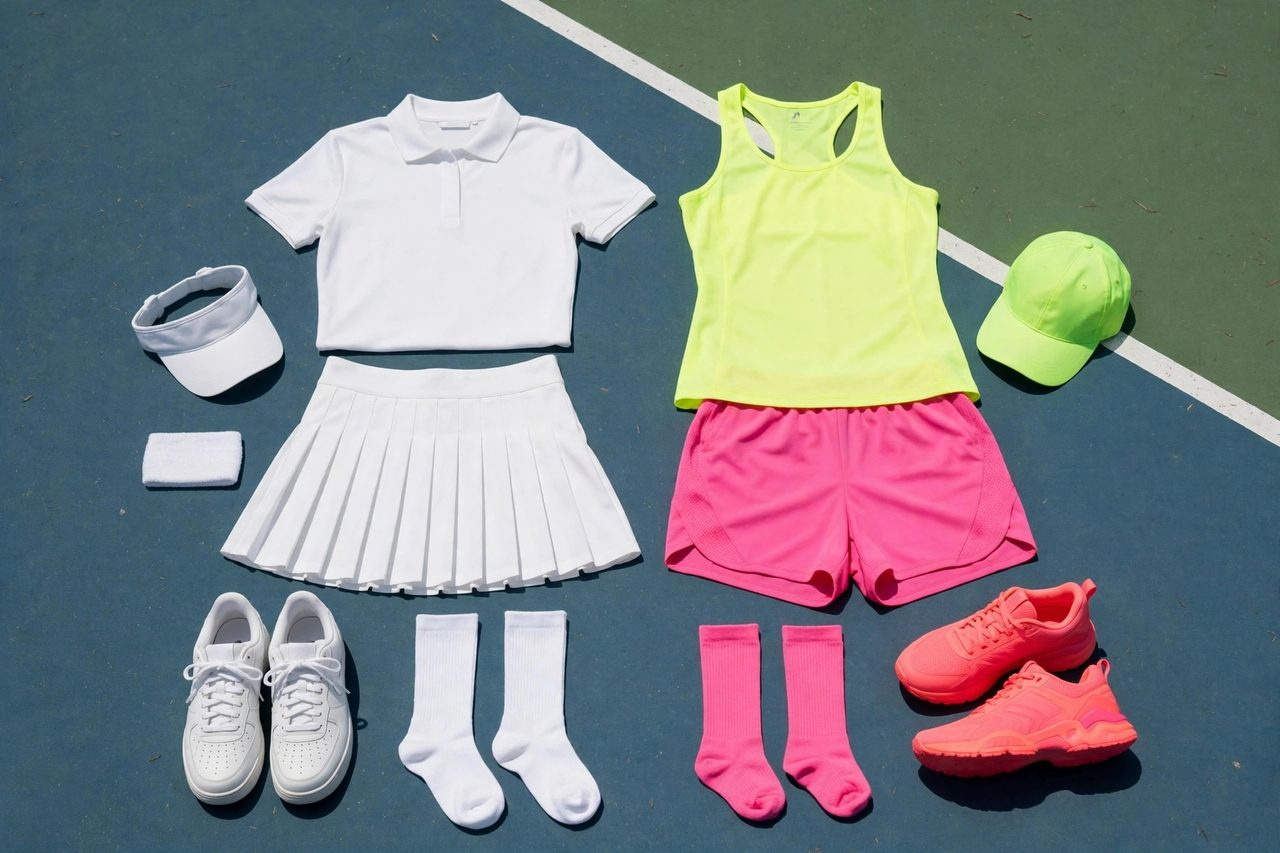
Tennis fashion has come a long way. A hundred years ago, players wore long trousers, long sleeves and stiff collars, all in white. Today, players walk onto court in neon pink, electric blue and black, in outfits designed by fashion houses. The journey from whites to neon is really the story of how tennis grew up.
Why white in the first place?
The white rule started in Victorian England, where tennis was a sport for wealthy people playing at private clubs. White was the colour of the upper class: it showed you did not do manual work, and it hid nothing. Sweat marks, grass stains and dirt were all part of the game, and white clothing showed you could afford to keep it clean.
Wimbledon, the oldest and most famous tennis tournament, still keeps the all-white rule today. Players at Wimbledon must wear almost entirely white clothing, including their shoes and underwear. It is one of the last places in sport where the dress code has barely changed in a century, and it is part of what makes the tournament feel special.
For women, the early dress code was even stricter. Female players in the 1800s and early 1900s played in long skirts, long sleeves and corsets. A corset is a stiff undergarment that squeezes the waist, and it made running and swinging a racquet extremely difficult. Tennis fashion, in those days, was about looking respectable, not about playing well.
The rebels who loosened things up
Change came slowly, and it came from brave players. In the 1920s, French star Suzanne Lenglen shocked crowds by playing in a knee-length skirt with bare arms. At the time, that was scandalous. Today it looks modest, but Lenglen’s outfit was a revolution: it let her actually move.
In the 1930s and 1940s, shorts replaced long trousers for men, and skirts got shorter for women. Fabrics improved too. Cotton gave way to lighter, stretchier materials that let players sweat without feeling heavy. By the 1970s, tennis had a new look: headbands, short shorts and bright colours, worn by stars like Bjorn Borg and John McEnroe. Tennis was no longer just a country-club sport. It was on television, and television loves colour.
The 1980s went further. Andre Agassi arrived with long hair, denim shorts and neon shirts, looking more like a rock star than a tennis player. Traditionalists were horrified. Young fans loved it. Agassi proved that a tennis player could be a style icon, and brands noticed. Sportswear companies started designing tennis clothes as fashion, not just as kit.
Colour takes over
By the 2000s, colour had won almost everywhere except Wimbledon. Rafael Nadal played in sleeveless tops and long shorts, inspired by basketball. Serena Williams wore outfits that made headlines on their own, including a black catsuit at the French Open in 2018. A catsuit is a tight one-piece outfit, and Serena said she wore it partly for health reasons, to help her circulation after giving birth. The French Open later banned it, which started a big debate about who gets to decide what athletes wear.
Today’s tennis fashion is a mix of everything. Some players go classic and clean, like Roger Federer in his tailored whites and pastels. Others go bold: neon, patterns, and outfits designed in collaboration with fashion labels. Naomi Osaka has worked with Japanese designers. Carlos Alcaraz wears bright, modern Nike kits. Coco Gauff has her own signature shoe line, which is rare for a tennis player and shows how far the sport has come as a fashion platform.
Technology changed the clothes too. Modern tennis outfits are made from moisture-wicking fabrics. Moisture-wicking means the fabric pulls sweat away from your skin so you stay dry and cool. Players also wear compression gear, tight layers that support muscles, and shoes designed for the hard stops and starts of tennis footwork.
What it all means
Tennis fashion matters because it shows who the sport is for. The all-white era said tennis was for a small, wealthy group. The neon era says tennis is for everyone: every age, every background, every style. When a young player sees someone who looks like them, dressed in a way they like, they are more likely to pick up a racquet.
Wimbledon keeps its white rule, and that is fine. Tradition has its place. But the rest of tennis has moved on, and the sport is more fun for it. From long skirts and corsets to neon nights under the lights, tennis fashion has finally caught up with the athletes who wear it.
Related articles
The Tiebreak: How Tennis's Greatest Invention Saved the Sport
Before the tiebreak, a tennis set could go on forever. One match lasted three days. This is the story of the man who fixed it — and why the rule is still changing today.

The Ball Kids: Tennis's Smallest, Fastest Stars
They sprint, roll, crouch and vanish — all without a word. Ball kids are the quiet engine of every big tennis match, and getting the job is harder than most people think.
The Sound of Tennis: Grunts, Crowds and the Quiet Rule
Tennis asks its crowds to stay quiet, its players to grunt or not, and every tournament to find its own sound. Here is why the quiet rule exists — and why it keeps being broken.