
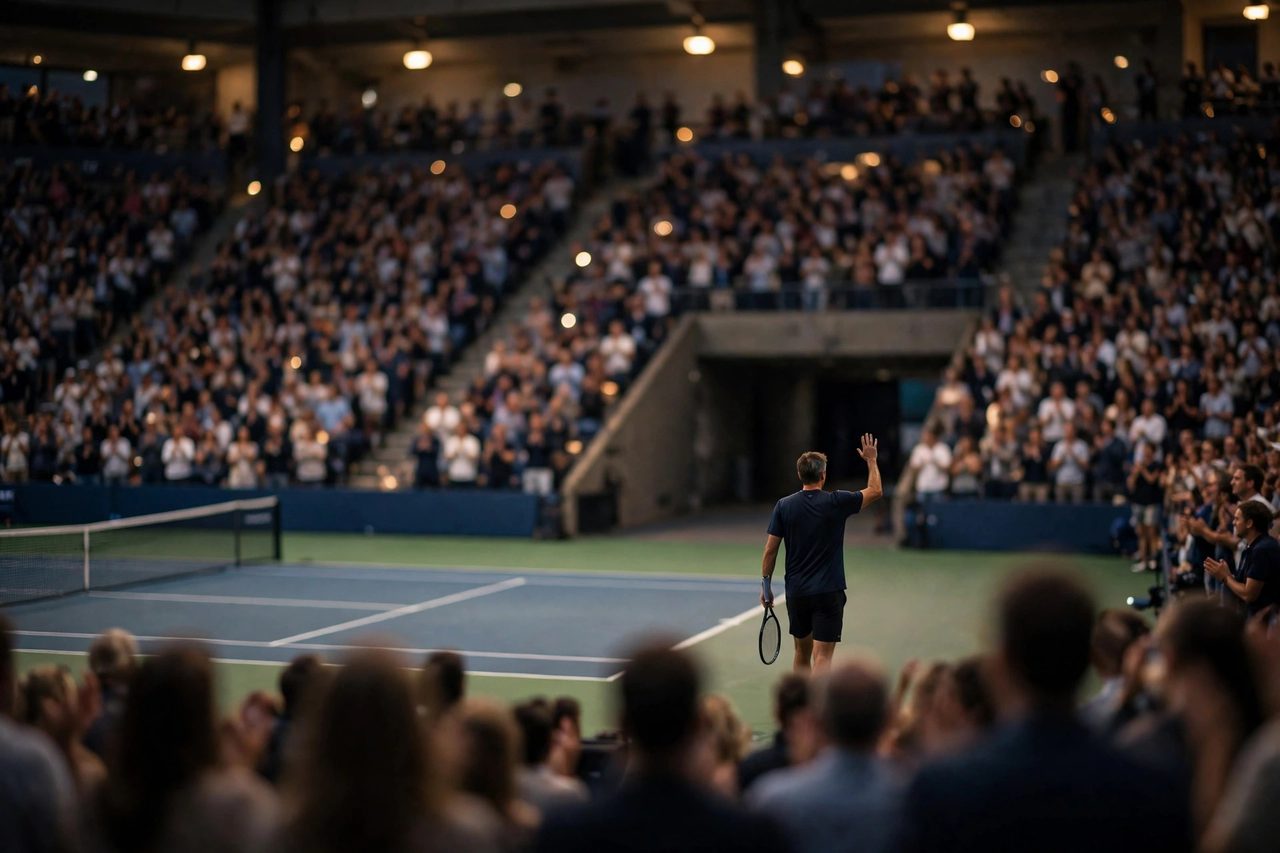
There is a moment at the end of every great career that has nothing to do with winning. The player looks around the stadium, takes it all in one last time, and walks off knowing they will never return as a competitor. This week, tennis watched Stan Wawrinka do exactly that in Basel, in his home country of Switzerland. He was 41 years old. He had played professional tennis for more than two decades. And with his exit, something bigger than one career came to an end.
This is not a match report. The match itself is already history. This is about what leaves the sport when a whole generation walks out the door at once, and about what arrives to take its place.
The man who would not quit
To understand why Wawrinka’s farewell hit so hard, you have to understand what he was up against. A Grand Slam is one of the four biggest tournaments in tennis: the Australian Open, the French Open, Wimbledon and the US Open. Winning even one of them puts a player in the history books. For most of Wawrinka’s career, those four trophies were shared out among a tiny group of all-time greats, and the rest of the tour was left fighting for scraps.
Wawrinka refused to accept that. He won three Grand Slams, and he won them the hard way. His first came at the Australian Open in 2014, when he beat Rafael Nadal in the final. His second came at the French Open in 2015, when he beat Novak Djokovic in the final. His third came at the US Open in 2016. Three finals, three wins, all against players who are among the best ever to hold a racquet. Nobody else in his generation can say that.
The numbers tell the rest of the story. Sixteen tour-level titles. A career-high ranking of world No. 3. A ranking is the sport’s official pecking order, worked out from results over the past year, and reaching No. 3 in that era meant climbing past almost everyone alive. He also won 590 tour matches, and an Olympic gold medal in doubles at Beijing in 2008, playing alongside Roger Federer.
But the numbers are not really why fans loved him. Fans loved him because he never looked like the easy choice. He was not the most graceful player, and he was not the most hyped young star. He was the grinder with the huge one-handed backhand. A backhand is the shot played with the racquet on the opposite side of the body from your dominant hand, and a one-handed version is rarer, harder to time and, when it lands, one of the most beautiful shots in the sport. Wawrinka’s version was a weapon. When it was on, it felt like nobody on earth could stop him.
Then came the long goodbye. Wawrinka announced before the season that 2026 would be his last year. He spent it saying farewell at the tournaments that shaped his career, still fighting hard in every match. His last win came earlier in October in Lyon, against Martin Landaluce. His final match came in Basel on Tuesday 27 October, against Jiri Lehecka, and he lost it in two close sets. A day earlier, the tournament had honoured him with a farewell ceremony on centre court. One more goodbye is still to come: an exhibition event in Geneva on 19 December. An exhibition is a friendly match played for show rather than ranking points, and it is a fitting last bow.
Wawrinka left on his own terms, still competitive, still himself. That is rarer than it sounds.
He was not the only one leaving
Here is the part that makes this week feel like the end of an era rather than the end of one career: Wawrinka was not alone. In 2026, a whole group of players born in the 1980s walked away from professional tennis, many of them within weeks of each other.
Gaël Monfils said goodbye at the US Open, the last Grand Slam of the season. A Grand Slam tournament runs for two weeks and draws the biggest crowds in the sport, and the US Open gave Monfils a stage to match his personality. He turned 40 during his first-round match and won it, turning what could have been a sad send-off into a birthday party. A round later, he lost to Learner Tien, a 20-year-old American. There is a kind of poetry in that: the showman handing the stage to a player half his age. Monfils won 13 tour titles and reached a career-high ranking of No. 6, but his real legacy was joy. He played tennis like an entertainer, diving for balls other players would let go, and crowds loved him for it.
Sorana Cirstea’s farewell took a different shape. The Romanian announced that 2026 would be her final year, and then went out and played the best tennis of her life. She reached a career-high ranking of No. 15, beat world No. 1 Aryna Sabalenka in Rome, reached the quarter-finals at the French Open, and won a title on home soil in Transylvania. At the US Open she won three matches in straight sets before losing in the fourth round, her best result ever at that tournament. Most players fade in their final season. Cirstea got better. That is a strange and wonderful way to say goodbye.
Kei Nishikori closed his career in Tokyo, at home in Japan. He won 12 tour titles and reached No. 4 in the world, but his place in history is bigger than those numbers. In 2014 he became the first Asian man to reach a Grand Slam singles final, at the US Open, and he opened a door that younger Japanese and Asian players have walked through since. He played 684 tour matches. When he stopped, Japan lost its trailblazer.
David Goffin, the Belgian, played his last match at home in Brussels. He won six tour titles and reached No. 7 in the world, building a career on clean, clever tennis rather than raw power. Mikhail Kukushkin, who reached No. 39, said farewell at the Almaty Open in Kazakhstan after two decades on tour. Roberto Bautista Agut, another veteran of the same generation, also stepped away in 2026.
Even doubles said goodbye. A doubles team is two players on each side of the net, instead of one against one, and it has its own stars. Joe Salisbury and Rajeev Ram, one of the great doubles partnerships of recent years, retired together after the US Open. Salisbury won four Grand Slam doubles titles, and Ram won three US Open doubles titles in a row with Salisbury. They left as a pair, which feels right.
Add it all up and 2026 starts to look like a changing of the guard. A changing of the guard is the moment when one generation hands over to the next. Tennis has had them before, but rarely this many farewells in a single season.
What made this generation different
Every generation thinks its players were special, so it is worth asking what was actually different about this one. The honest answer is the company they kept.
These players grew up and spent their best years in the shadow of the greatest trio the men’s game has ever known. That shaped them in two ways. First, it limited what they could win. Wawrinka’s three Grand Slams are extraordinary precisely because of who he had to beat to get them. Monfils never won a Grand Slam at all, despite his talent, because the path was blocked by players who barely ever lost. Second, it taught them patience. When the biggest prizes are out of reach for years, you learn to love the smaller ones: a home title, a great week, a crowd on its feet.
That patience is also why so many of them lasted so long. A seed is a top-ranked player given a protected place in a tournament draw, so that the best players do not meet in the first round. Seeds get the easier early matches. These veterans spent years outside the seeds, fighting through the early rounds, taking wild cards just to keep playing. A wild card is a free invitation into a tournament for a player who did not qualify by ranking.
They also played the game in a different style. Watch a highlight reel of this generation and you will see variety: one-handed backhands, drop shots, players charging the net, long rallies built on patience rather than pure power. A drop shot is a soft shot that just clears the net and dies, forcing your opponent to sprint forward. Modern tennis is faster and heavier, and some of that variety is already fading. When Wawrinka leaves, the tour loses one of its last great one-handed backhands. When Monfils leaves, it loses its greatest showman.
What arrives next
So what replaces them? The short answer is: players who grew up watching them.
The new generation is younger, faster and more powerful, and it is already here. Learner Tien, the 20-year-old who beat Monfils at the US Open, is part of it. So are the teenagers and twenty-somethings now filling the draws at every tournament, players who hit the ball harder at a younger age than any generation before them. They train with data, video analysis and sports science from childhood. A tie-break is the short deciding game played when a set reaches 6-6, and the younger players seem to treat every tie-break like a formality rather than a test of nerve. They grew up on big stages, posting highlights online, comfortable in a spotlight that the old guard had to grow into.
That is not a criticism. Every generation looks different, and the new players are thrilling to watch. But notice what changes with them. The old guard played for crowds they could hear and see, in stadiums where the noise built slowly over three hours. The new guard plays for crowds and cameras at the same time, with every great shot clipped and shared within minutes.
There is also a simple human change. For more than twenty years, fans could turn on a tournament and see familiar faces: Wawrinka, Monfils, Nishikori, Goffin. You knew their stories, their injuries, their comebacks. You had watched them lose finals, win titles, disappear and return. New stars will earn that kind of bond, but it takes time. Familiarity is not instant. It is built over seasons, and this week, a big chunk of it walked out the door.
What tennis keeps
Here is the good news, and it matters: tennis does not lose these players completely. Retired players rarely vanish. They coach, they commentate, they run academies, they play exhibitions like Wawrinka’s Geneva farewell in December. Their knowledge stays in the sport, passed to the next players in line. Monfils will still be Monfils. Nishikori will still be a hero in Japan. Wawrinka’s backhand will live on in every highlight video a young player watches at midnight, trying to copy it in their bedroom mirror.
The sport also keeps the standard they set. Wawrinka proved that a player does not need to be the favourite to win the biggest prizes. He proved it three times. Cirstea proved that a final season can be a best season. Goffin proved that a smaller player with a smarter game can reach the top ten. Those are not just memories. They are lessons, and young players will use them.
And tennis keeps its calendar of goodbyes. Farewell tours used to be rare. Now they are part of the sport: a season-long thank you, a ceremony on centre court, a last match at home. They give everyone a chance to say goodbye properly, instead of waking up one morning to find a favourite player simply gone. Wawrinka’s farewell season did that well. He played his last matches in front of the people who mattered, in the places that mattered, and he left with his head high.
The last of the old guard
It is tempting to call Wawrinka the last of the old guard, but that is not quite right. He is one of the last, and the guard was never a formal group: just players born in the same decade, shaped by the same era, who happened to leave in the same year. Some are still playing. The door is not fully closed, but it is closing.
If you are young and just getting into tennis, here is the honest advice: go and watch these players while you still can, in old matches online, before the memories fade. Watch Wawrinka’s backhand in the 2015 French Open final. Watch Monfils dive for a ball he had no right to reach. Watch Nishikori move around the court like he had solved a puzzle nobody else could see. You will understand, in about ten minutes, why this week felt so sad for so many people.
And then watch the new players. Watch Tien and the rest of his generation, and the ones coming behind them. They are not replacements. Nobody replaces Wawrinka, or Monfils, or Nishikori. They are the next chapter, and they will write it their own way, with their own shots, their own style, their own farewells, twenty years from now.
That is how tennis works. The old guard leaves. The new guard arrives. The game goes on, a little different and a little the same, and the crowd keeps coming back, because it always wants to see what happens next.
The veterans of 2026 gave the sport two decades of fight, flair and stubborn belief. The least we can do is remember them properly, and then get excited about whatever comes next.
Related articles
The Tiebreak: How Tennis's Greatest Invention Saved the Sport
Before the tiebreak, a tennis set could go on forever. One match lasted three days. This is the story of the man who fixed it — and why the rule is still changing today.
The Ball Kids: Tennis's Smallest, Fastest Stars
They sprint, roll, crouch and vanish — all without a word. Ball kids are the quiet engine of every big tennis match, and getting the job is harder than most people think.
The Sound of Tennis: Grunts, Crowds and the Quiet Rule
Tennis asks its crowds to stay quiet, its players to grunt or not, and every tournament to find its own sound. Here is why the quiet rule exists — and why it keeps being broken.