
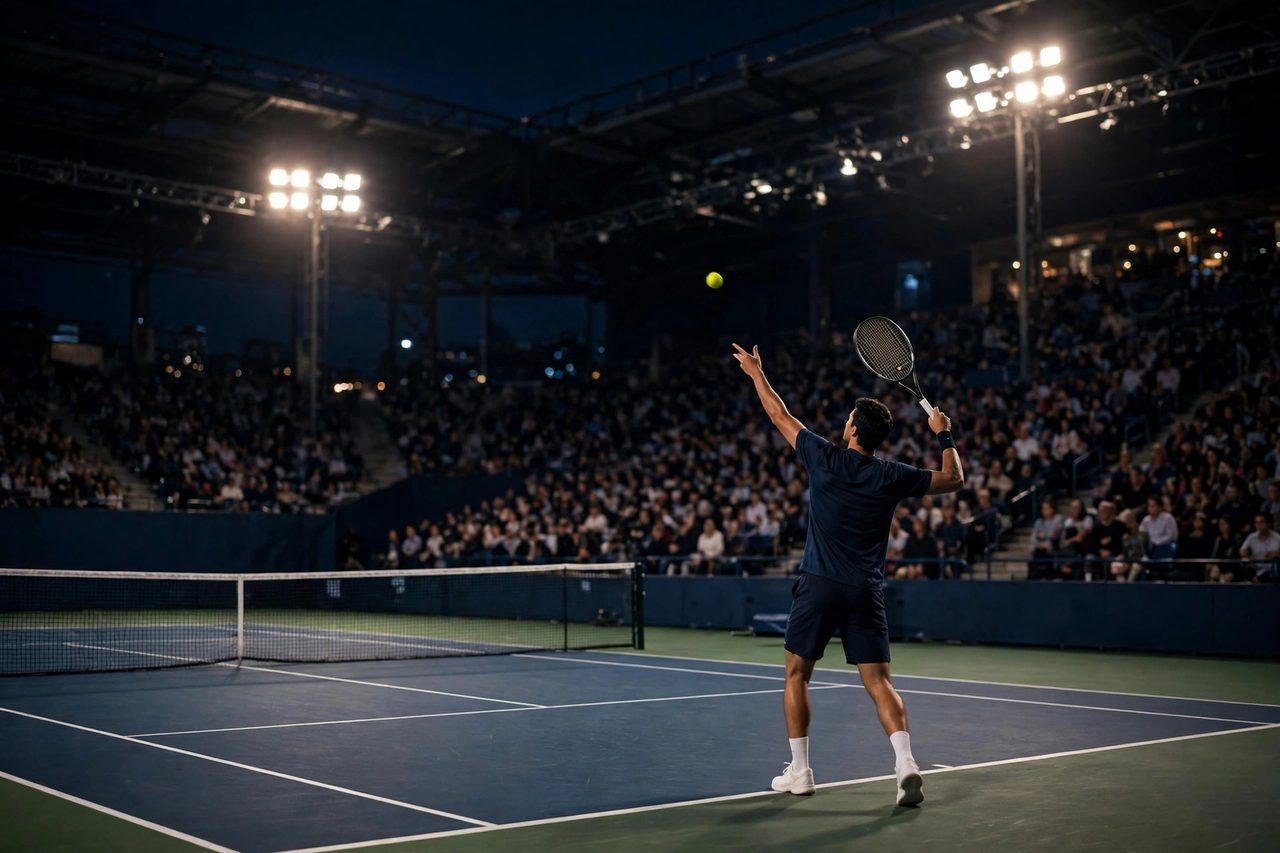
Tennis used to end when the sun went down. Now, some of its biggest moments happen after dark. The night session, the evening set of matches played under floodlights, has become the main event at the biggest tournaments. It is where the stars play, the crowds roar loudest, and television audiences peak.
How did a daytime sport become a prime-time show? Prime time is the evening period when most people are home and watching television. Tennis did not get there by accident. It got there because night matches feel different, and fans love that feeling.
Tennis was a daytime sport
For most of its history, tennis was played in daylight. The early tournaments had no floodlights, and matches stopped when it got dark. Even when lights arrived, they were used to finish matches, not to start a whole evening show.
The change began in the United States. The US Open, one of the four Grand Slams, started playing matches at night, under lights, in front of big crowds at Arthur Ashe Stadium in New York. The idea was simple. People work during the day. In the evening, they are free to watch, either in the stadium or on television. A night match could reach far more people than a daytime match.
Other tournaments followed. The Australian Open built its own night-session tradition at Rod Laver Arena in Melbourne. The French Open, long the holdout, added a night session on its main court, Court Philippe-Chatrier, in Paris. Wimbledon, with its strict traditions and London neighbours, was slower, but even there, the roof and lights on Centre Court mean matches can now run into the evening.
Why night feels different
A night match is not just a day match played later. It feels different, and that is the point.
First, the atmosphere is louder. Evening crowds have had all day to build up excitement. They arrive after work, often in bigger groups, and they stay for one big match, not a full day of tennis. That focus makes the noise sharper. Every great shot gets a bigger roar. Every tense moment feels bigger.
Second, the conditions change. At night, the air is cooler and often heavier. The ball travels a little slower through the air, and the court can play a touch slower too. That tends to help players who rely on long rallies and heavy spin, and hurt players who rely on pure serve power. It is not a huge difference, but at the top level, small differences matter.
Third, the lights change how the match looks. Under floodlights, the court glows, the ball stands out against the dark background, and the players look larger than life on television. It is made for cameras. A night match looks like an event, even before a ball is hit.
The star slot
Today, the night session is where tournaments put their biggest match of the day. If there is one match everyone wants to see, it goes on at night. That gives the night session a simple promise: come in the evening, and you will see the stars.
This has changed how players plan their days. A player in the night session sleeps later, practises later, and eats later. Their whole day shifts around one evening match. Some players love it. They feed off the crowd and the occasion. Others prefer the calm of a daytime match, with less noise and less pressure. Both are valid, but there is no doubt which slot gets more attention.
The night session has also changed who watches tennis. A daytime match is for people who can watch during the day: fans at the tournament, or viewers with flexible schedules. A night match is for everyone. It fits around work, school, and family life. It turns tennis into an evening out, or an evening in front of the television, in a way daytime tennis never quite could.
The debate
Not everyone loves the night session. Players and fans have raised fair concerns.
Night matches can finish very late, sometimes after midnight. That is hard on players, who then have little time to recover before their next match. It is also hard on fans getting home late, and on ball kids, officials, and staff who work long days.
There is also a fairness question. If one player always gets the night slot, and another always plays in the daytime heat, is that fair? Tournaments say they rotate the slots, but star players do get more night matches, because that is what broadcasters and ticket buyers want. It is a tension that has not gone away.
And there is a simple sporting point. Tennis is an outdoor sport, and part of its charm is sun, wind, and changing conditions. Night tennis removes some of that variety. Every night match feels a little more controlled, a little more like a studio show.
Why it is here to stay
Despite the debate, the night session is not going anywhere. It brings in bigger crowds, bigger television audiences, and bigger money. That money helps fund the sport, from prize money for players to facilities for young players coming through.
More importantly, it has given tennis some of its most famous moments. Late-night epics, five-set battles that stretch past midnight, crowds that refuse to leave: these are the matches fans remember and talk about for years. Daytime tennis gave the sport its history. Night tennis gave it a new kind of drama.
Tennis did not stop being a daytime sport. It became both. Day matches still fill the grounds, still develop young players, still decide who reaches the big stage. But when the lights come on, and the main court fills up for one match, tennis becomes something else: a prime-time show, with a crowd, a stage, and a story that everyone is watching at the same time.
That is the power of the night session. It did not just change when tennis is played. It changed how tennis feels.
Related articles
The Tiebreak: How Tennis's Greatest Invention Saved the Sport
Before the tiebreak, a tennis set could go on forever. One match lasted three days. This is the story of the man who fixed it — and why the rule is still changing today.

The Ball Kids: Tennis's Smallest, Fastest Stars
They sprint, roll, crouch and vanish — all without a word. Ball kids are the quiet engine of every big tennis match, and getting the job is harder than most people think.
The Sound of Tennis: Grunts, Crowds and the Quiet Rule
Tennis asks its crowds to stay quiet, its players to grunt or not, and every tournament to find its own sound. Here is why the quiet rule exists — and why it keeps being broken.