
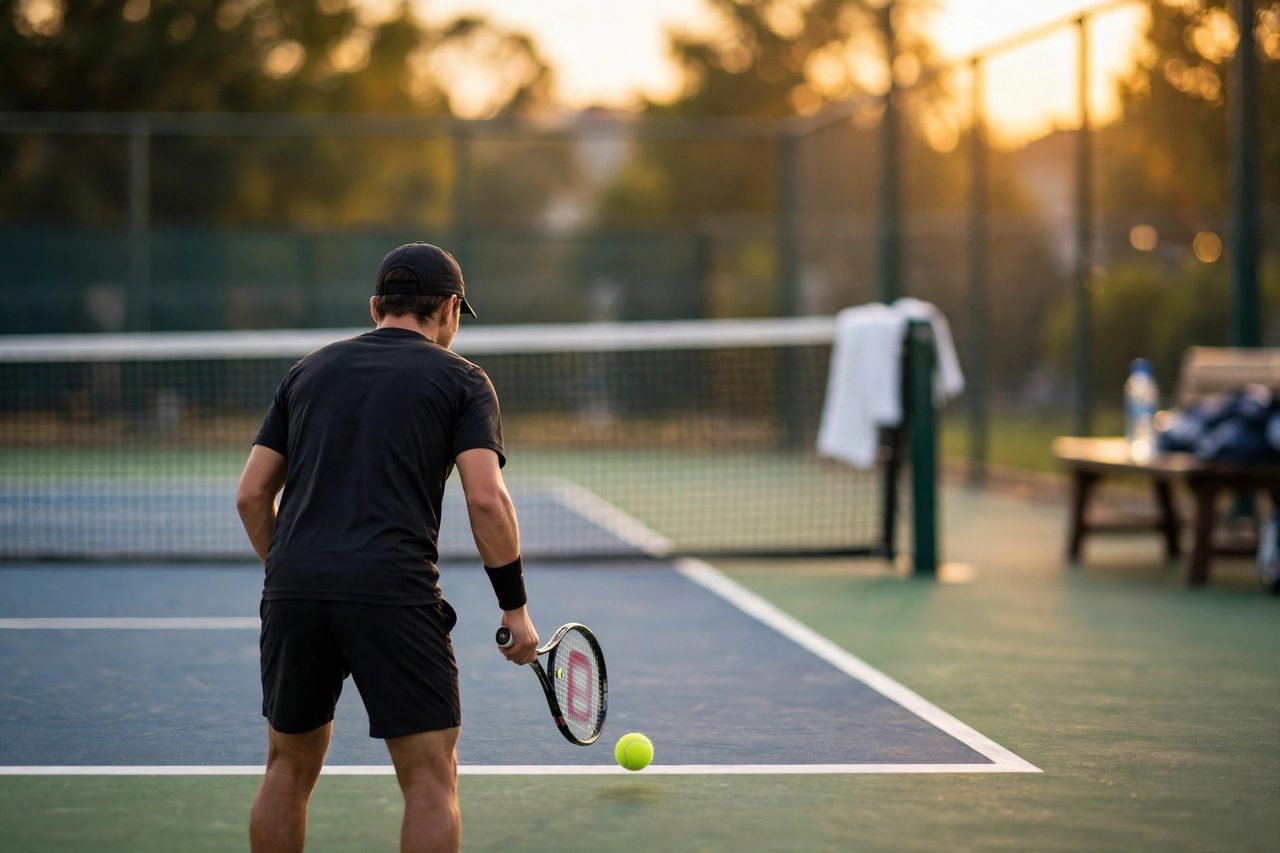
Watch a tennis match for five minutes and you will spot something strange. A player bounces the ball ten times before serving. Another touches their strings, adjusts their shirt, then touches their strings again. A third walks to the towel after every single point, even when they are not sweating.
None of this is random. For the players, these rituals are a way to stay calm and focused.
The pause between points
Tennis is a stop-start sport. A point lasts a few seconds. Then everything stops. The players walk back, catch their breath, and get ready to do it all again.
That pause is where rituals live. On most professional tours, players get 25 seconds between points — enough time for a small routine. And because a match can last two or three hours, a player might repeat the same routine hundreds of times in one match.
A routine gives the brain something simple to do. Instead of thinking about the last point they just lost, or the crowd, or the score, the player thinks: bounce, bounce, bounce, serve. It is a reset button.
The ball bounce
The most famous ritual in tennis is the ball bounce before a serve. A serve is the shot that starts each point, when one player throws the ball up and hits it into the other side of the court. Almost every player bounces the ball a set number of times first.
Serena Williams, one of the greatest players of all time, bounced the ball five times before a first serve, and twice before a second serve.
Novak Djokovic takes it further. He often bounces the ball more than 20 times in big moments, and crowds have been known to count out loud along with him. Djokovic himself once said his record was 38 or 39 bounces, during a Davis Cup match against Australia in 2007. A Davis Cup match is a team event where players represent their country.
Why bounce at all? It settles the body, sets a rhythm, and buys a few seconds to decide where to aim the serve. The bounce is not superstition for its own sake. It is a warm-up for the shot that follows.
Nadal and the bottles
No player is more famous for rituals than Rafael Nadal.
When Nadal sat down at a changeover — the short break every two games when players swap ends of the court — he placed two water bottles on the ground in exactly the same spot, labels facing the court. Before serving, he pulled up his socks, adjusted his shorts, fixed his shirt, tucked his hair behind his ears, and touched his nose, always in the same order. He stepped onto the court with his right foot first and tried never to step on the white lines.
Nadal never said his rituals brought him luck. They were about order. Tennis is full of things a player cannot control: the wind, the bounce, the opponent, the crowd. A routine is something they can control completely.
Towels, strings and self-talk
Some rituals are about comfort. Players reach for a towel after almost every point, even early in a match. Part of it is sweat. Part of it is a pause — a few seconds to breathe before the next point.
Other players touch their racquet strings between points. The strings are the woven cords stretched across the racquet head that actually hit the ball. A quick touch is mostly just a habit, a small familiar feeling before the next point starts.
Then there is self-talk. Watch a match closely and you will see players muttering to themselves or pumping a fist after a point. This is not madness. It is coaching from inside their own head. A player who just missed an easy shot might tell themselves to move their feet faster next time. A player who won a long rally — a long back-and-forth exchange of shots — might say “come on” to keep their energy up. The words are simple on purpose: watch the ball, move your feet, stay calm.
The lucky ball
Some rituals are pure superstition, and players know it. Richard Gasquet, a French player, famously asked for the same ball back after winning a point on his serve. If he lost the point, he sorted through the balls until he found the one he had won with before. One ball is the same as another, but if a player believes a ball is lucky, asking for it costs nothing. Confidence matters in tennis, and small beliefs can build it.
Maria Sharapova had a different kind of routine. Before every serve she turned her back to her opponent, walked to the baseline — the line at the back of the court — did a few small jumps, brushed her hair behind her ears, and bounced the ball. In reality it was the same reset as everyone else’s: a fixed set of moves that told her body it was time to serve.
When rituals go too far
Rituals help, but they can also become a trap. A player who needs everything to be exactly right can fall apart when something goes wrong. A bottle gets knocked over. A crowd counts the bounces out loud and breaks the rhythm.
That is why coaches today teach young players to keep routines short and simple. Three bounces, not thirty. One breath, one thought, then play. A routine should be a tool, not a cage.
Why we love watching them
Part of the fun of tennis is spotting these habits. Fans notice the bounce count, the bottle line-up, the fist pump. These small repeated gestures make players feel familiar, almost like characters in a long-running show.
They also make the sport feel human. Tennis players are elite athletes, but between points they are just people trying to calm their nerves. That is the real secret of the rituals. They are not magic. They are a way to handle pressure, one small habit at a time.
Related articles
The Tiebreak: How Tennis's Greatest Invention Saved the Sport
Before the tiebreak, a tennis set could go on forever. One match lasted three days. This is the story of the man who fixed it — and why the rule is still changing today.
The Ball Kids: Tennis's Smallest, Fastest Stars
They sprint, roll, crouch and vanish — all without a word. Ball kids are the quiet engine of every big tennis match, and getting the job is harder than most people think.
The Sound of Tennis: Grunts, Crowds and the Quiet Rule
Tennis asks its crowds to stay quiet, its players to grunt or not, and every tournament to find its own sound. Here is why the quiet rule exists — and why it keeps being broken.