
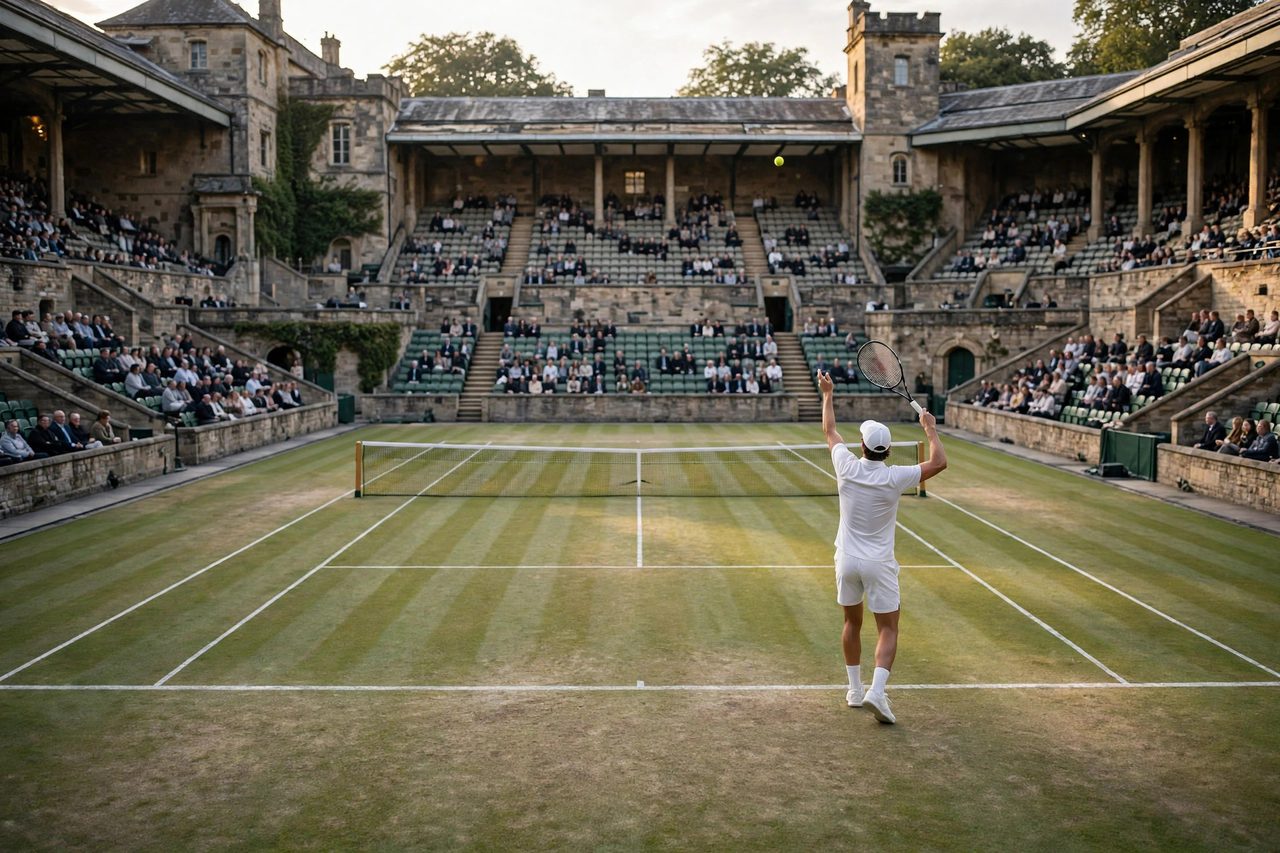
Picture a full football stadium. Now picture it silent. Twenty thousand people holding their breath while one person tosses a ball in the air. That is tennis. No other big sport asks its crowd to be quiet — and no other sport argues so much about the noise its own players make.
The quiet rule that isn’t a rule
If you have ever watched Wimbledon on television, you know the voice. “Ladies and gentlemen, quiet please. Players are ready. Thank you.” The chair umpire — the lead official who sits high above the net — says it before almost every serve, and the crowd obeys.
Here is the surprise: silence during play is not actually in the rulebook. Wimbledon’s own code of conduct bans “excess noise” as anti-social behaviour, but it never writes down a rule that says the crowd must be quiet. The quiet is a tradition, not a law. It is old, though. A 1923 guide to the game, Spalding’s Lawn Tennis Annual, listed the unwritten rules of good behaviour: do not talk loudly while a match is on, and do not applaud or shout while a rally is going. A rally is the back-and-forth exchange of shots inside a single point.
Tennis grew up in private clubs and garden parties, where good manners mattered as much as good shots. The first Wimbledon was held in 1877, and the hush came with it. At Wimbledon, the silence is so deep you can hear a shoe squeak and the soft thump of the ball — and when the crowd finally erupts after a long point, the roar lands harder because of everything that came before it.
Why silence helps the players
There is a practical reason, too. A serve can travel at more than 200 kilometres per hour, and the player returning it has a fraction of a second to read it. Players listen to the sound of the ball leaving the other racquet. That sound tells them how hard the ball was hit and how much spin is on it. A shout at the wrong second can steal that clue — and the point with it.
Fans are also asked to stay seated during play and only move at the changeover — the short break when players swap ends. A moving shape in the corner of a player’s eye, mid-point, is a distraction, not just bad manners.
The grunt debate
If the crowd must be quiet, what about the players themselves? Some players grunt — a loud breath out — every time they hit the ball. Others play in near silence. Tennis has argued about the difference for fifty years.
Grunting entered the men’s game in the 1970s, when Jimmy Connors grunted his way through Wimbledon in 1974. It became a flashpoint in the women’s game in the early 1990s, when Monica Seles arrived with a loud grunt on nearly every shot, and Martina Navratilova complained about it at Wimbledon in 1992. The argument peaked in 2009, when Maria Sharapova was measured grunting at 101 decibels and Michelle Larcher de Brito at 109. A decibel is the unit used to measure how loud a sound is — 100 decibels is roughly as loud as a chainsaw. Navratilova called loud grunting “cheating, pure and simple”, saying it drowned out the sound of the ball and hid information from the opponent.
The other side says grunting is natural. Many coaches teach players to breathe out hard as they hit, because holding your breath makes your body tense. For some players the grunt is part of their rhythm. And there is no rule that bans it. What the rules do have is a hindrance rule: if an umpire believes a player’s noise unfairly distracts the opponent, they can step in — usually a quiet word first, then a warning, and in rare cases a lost point. At Wimbledon in 2023, Novak Djokovic lost a point in his semi-final against Jannik Sinner after a long grunt that came after he had hit the ball.
So the line is fuzzy on purpose. A short grunt at the moment of impact is fine. A long, late or wildly changing noise is not.
Every tournament has its own sound
Not every crowd sounds like Wimbledon. Tennis has four Grand Slams — the four biggest tournaments of the year — and each one has its own noise.
The US Open in New York is the loudest of the four. Its main court, Arthur Ashe Stadium, holds more than 23,000 people, making it the biggest tennis stadium in the world. The noise hangs in the air there, helped by the roof and the sheer size of the place. Planes from nearby LaGuardia Airport rumble overhead — they have been part of the tournament’s sound since it moved to Flushing Meadows in 1978. Music plays at changeovers, fans chat and cheer, and nobody pretends it is Wimbledon. Some players love the noise; others find it draining.
Roland-Garros in Paris is elegant but partisan — the French crowd sings, whistles and picks a favourite, loudly. The Australian Open in Melbourne is the most relaxed of the four. And then there is the Davis Cup, the men’s team event, where crowds chant and sing like football fans and nobody asks them to stop. The same sport, five different soundtracks.
What the noise is really about
Strip away the arguments and the sound of tennis is really about respect — respect for the players’ focus, and respect for the people around you. The quiet rule asks 20,000 strangers to agree, without being told in law, to hold their breath together.
The grunt debate is the same argument from the other side of the net: how much noise is yours to make, and how much belongs to the person across from you? Tennis has never quite settled it.
Next time you watch a match, turn the sound up, not down. Listen for the squeak of the shoes, the thump of the ball, the crowd holding its breath — and then the roar when it finally lets go. That is the sound of tennis. It is quieter than any other sport, and somehow louder, too.
Sources: Atlas Obscura on why tennis crowds are quiet · Wikipedia on grunting in tennis · Associated Press on the US Open’s noise
Related articles
The Tiebreak: How Tennis's Greatest Invention Saved the Sport
Before the tiebreak, a tennis set could go on forever. One match lasted three days. This is the story of the man who fixed it — and why the rule is still changing today.

The Ball Kids: Tennis's Smallest, Fastest Stars
They sprint, roll, crouch and vanish — all without a word. Ball kids are the quiet engine of every big tennis match, and getting the job is harder than most people think.
Tennis's On-Court Rituals: Why Players Bounce the Ball, Fix Their Strings and Talk to Themselves
From Nadal's water bottles to Djokovic's endless ball bounces, tennis players repeat the same small habits before almost every point — and there is a good reason for it.