
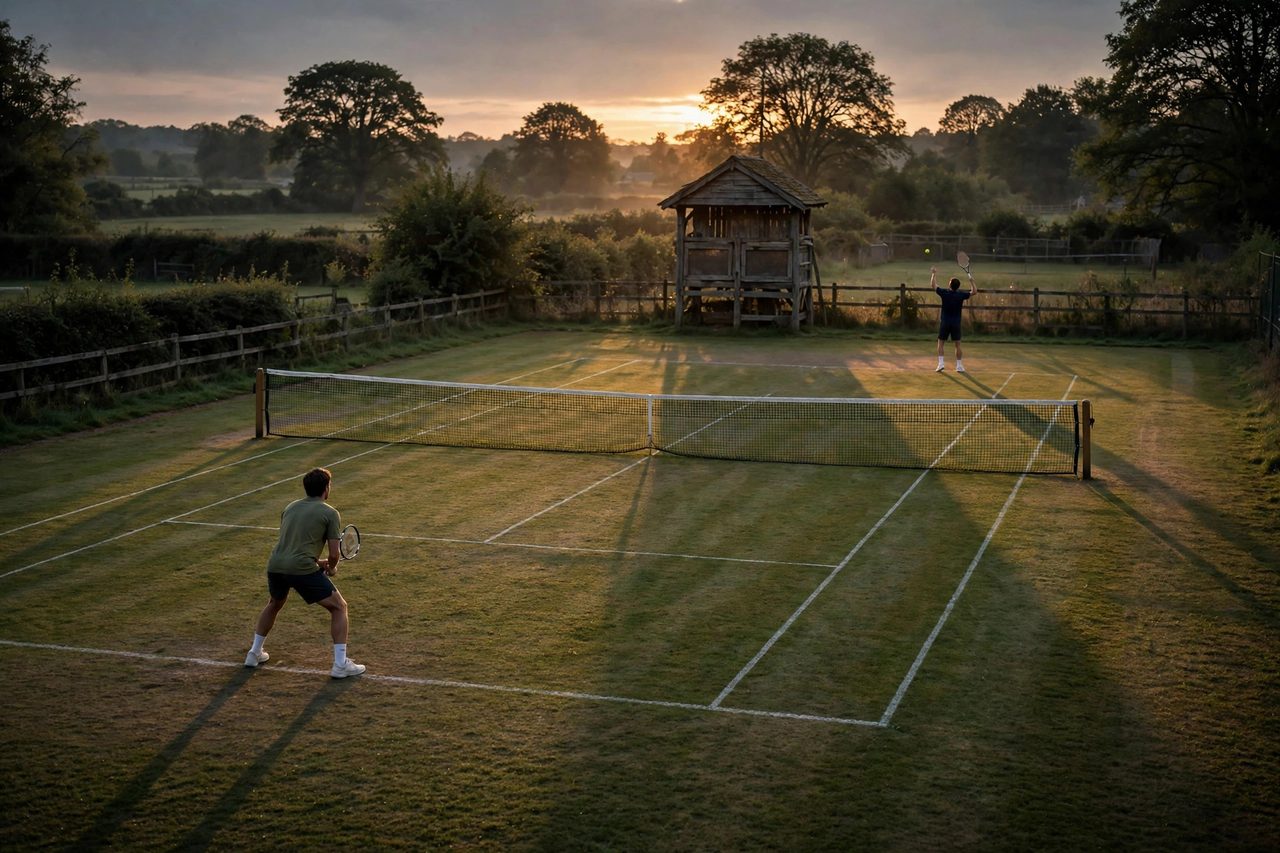
Imagine a match that never ends. Not in a fun way. In a “the players have been on court for two days and nobody knows how to stop it” way. That was tennis before the tiebreak.
The day tennis broke
A tiebreak is a short game played when a set reaches 6-6. Instead of playing game after game until someone leads by two, the players race to seven points, and the winner takes the set.
Before it existed, sets had no finish line. You had to win by two games, and if neither player could break the other’s serve, the set just kept going.
The worst case came at Wimbledon in 2010. John Isner of the United States played Nicolas Mahut of France in the first round, on Court 18. It was not a big match. Then the fifth set started, and it would not stop.
The two men held serve, hour after hour. Play was stopped twice because it got dark. The match stretched over three days, from June 22 to June 24. When it finally ended, Isner had won the fifth set 70-68. The whole match lasted 11 hours and 5 minutes. The fifth set alone took 8 hours and 11 minutes.
The numbers still sound fake. The match had 183 games. The two players hit 215 aces between them. An ace is a serve the other player cannot touch at all. Isner hit 112 of them, Mahut 103. Both men broke the old record on their own.
Here is the strange part: by 2010, the tiebreak had already existed for 40 years. It was used in the first four sets. But Wimbledon, like the other Grand Slams, refused to use one in the final set. A Grand Slam is one of the four biggest tournaments in tennis. At those events, the deciding set was still played the old way. Isner and Mahut showed the world exactly why that had to change.
The man with the red flag
The tiebreak was the idea of one man: Jimmy Van Alen. He was an American player and tennis official who ran the grass courts at Newport, Rhode Island, and founded the International Tennis Hall of Fame there.
Van Alen thought tennis scoring was broken. Matches ran long, schedules fell apart, and television could not plan around a match with no end. So he spent years pushing his own fix.
The heart of it was the tiebreak. He came up with the idea in the 1950s. In 1965 he tested it for real, paying ten professional players to try his system at Newport. On July 10, 1965, Mike Davis and Luis Ayala reached six games all, and the first tiebreak in tennis history was played. Van Alen waved a red flag to mark the start of it. Davis won.
It still took five more years to reach a big tournament. In 1970, the US Open became the first Grand Slam to use a tiebreak. The first version was brutal: a race to five points, and if the score reached 4-4, a single point decided the whole set.
Players hated it. Imagine playing for two hours and losing the set on one serve. So the format was changed. In 1975, Peter Jones of the British tennis association designed the version we know today: first to seven points, win by two.
Wimbledon brought in the tiebreak in 1971, then moved it to 6-6 in 1979. One by one, the rest of the sport followed. But the final set stayed different. At the Grand Slams, the deciding set still had no tiebreak, because tradition is strong in tennis.
The final push
In 2018, Kevin Anderson beat John Isner 26-24 in the fifth set of a Wimbledon semi-final. The match lasted more than six and a half hours, and Anderson was so tired he had almost nothing left for the final. Wimbledon finally acted. From 2019, a tiebreak would be played when the final set reached 12-12. The first men’s final decided that way came the same year, when Novak Djokovic beat Roger Federer 13-12 in the fifth set.
Meanwhile the Australian Open had already gone further, using a 10-point tiebreak in the final set since 2019. The French Open still had no final-set tiebreak at all.
Then, in March 2022, the four Grand Slams finally agreed on one rule. When the final set reaches 6-6, the players now play a tiebreak to 10 points, win by two. It was first used at the French Open in 2022.
How it works today
The modern tiebreak is short and tense. At 6-6, the players stop counting games and start counting points: 1, 2, 3, and so on. One player serves the first point, then the serve switches every two points. The players change ends every six points, so neither one spends the whole tiebreak staring into the sun or the wind. First to seven points wins a normal set. First to ten wins a final set at a Grand Slam. Either way, you have to win by two.
It is the most exciting minute in tennis. A set that has lasted an hour comes down to a handful of points. Every serve matters. That is why the tiebreak works on television and in the stadium. It turns a long, slow ending into a sprint.
The next time you watch a set reach 6-6 and the crowd goes quiet, remember what came before. Two men once played 138 games in a single set because there was no other way to end it. The tiebreak gave tennis an ending, and in a sport with no clock, that ending is everything.
Van Alen saw that 70 years ago, and he was laughed at for it. They called him the Newport Bolshevik, a rebel in a sport that hates change. He kept pushing anyway, and the rule every tennis fan now takes for granted is his.
Related articles

The Ball Kids: Tennis's Smallest, Fastest Stars
They sprint, roll, crouch and vanish — all without a word. Ball kids are the quiet engine of every big tennis match, and getting the job is harder than most people think.
The Sound of Tennis: Grunts, Crowds and the Quiet Rule
Tennis asks its crowds to stay quiet, its players to grunt or not, and every tournament to find its own sound. Here is why the quiet rule exists — and why it keeps being broken.

Tennis's On-Court Rituals: Why Players Bounce the Ball, Fix Their Strings and Talk to Themselves
From Nadal's water bottles to Djokovic's endless ball bounces, tennis players repeat the same small habits before almost every point — and there is a good reason for it.